Artículo
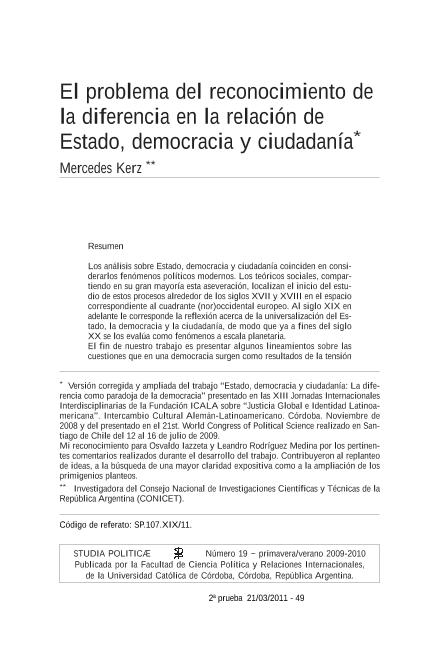
Los análisis sobre Estado, democracia y ciudadanía coinciden en considerarlos fenómenos políticos modernos. Los teóricos sociales, compartiendo en su gran mayoría esta aseveración, localizan el inicio del estudio de estos procesos alrededor de los siglos XVII y XVIII en el espacio correspondiente al cuadrante (nor)occidental europeo. Al siglo XIX en adelante le corresponde la reflexión acerca de la universalización del Estado, la democracia y la ciudadanía, de modo que ya a fines del siglo XX se los evalúa como fenómenos a escala planetaria. El fin de nuestro trabajo es presentar algunos lineamientos sobre las cuestiones que en una democracia surgen como resultados de la tensión entre la demanda de aceptación de la/s pluralidad/es y la de reconocimiento/s de la/s diferencia/s. La proposición que defendemos en este escrito es que las exigencias de aceptación de las pluralidades ocasionan menos problemas a una democracia que los resultantes de las exigencias de reconocimiento de las diferencias. The studies about State, Democracy and Citizenship coincide in that they all consider them modern political phenomena. The social theorists, most of them sharing this idea, set the beginning of the study of these processes around the XVII and XVIII centuries in an area corresponding to north-west Europe. From the XIX century onward, the idea of the universality of the State, democracy and citizenship starts to appear so, by the end of the XX century, they are considered whole-world phenomena. The representative democracy organizes the institutional system which is key to develop the problem of harmonizing the coercive power of the State with the civil equality of all citizens. This equality allows a civil space in which the problems corresponding to its own constitution start to filter; at the same time being this constitution produced upon the conflict originated between the demands of civil equality and those of recognizing the difference. The aim of this research is to show some features of the matters that appear in a democracy as results of this tension between the pluralities’ demand for acceptance and the recognition of the differences. The proposition that we defend is that the requirements of the acceptance of pluralities unlikeness cause less problems to a democracy than those resulting from the requirements of recognizing the differences.
El problema del reconocimiento de la diferencia en la relación Estado, democracia y ciudadanía

Fecha de publicación:
09/2010
Editorial:
Universidad Católica de Córdoba. Facultad de Ciencia Política y Relaciones Internacionales
Revista:
Studia Politicae
ISSN:
1669-7405
Idioma:
Español
Tipo de recurso:
Artículo publicado
Clasificación temática:
Resumen
Palabras clave:
DEMOCRACIA
,
CIUDADANÍA
,
RECONOCIMIENTO
Archivos asociados

Tamaño:
114.1Kb
Formato:
PDF
Licencia
 Excepto donde se diga explícitamente, este item se publica bajo la siguiente descripción:
Atribución-NoComercial-SinDerivadas 2.5 Argentina (CC BY-NC-ND 2.5 AR)
Excepto donde se diga explícitamente, este item se publica bajo la siguiente descripción:
Atribución-NoComercial-SinDerivadas 2.5 Argentina (CC BY-NC-ND 2.5 AR)
Identificadores
Colecciones
Articulos(SEDE CENTRAL)
Articulos de SEDE CENTRAL
Articulos de SEDE CENTRAL
Citación
Kerz, Mercedes María de Guadalupe; El problema del reconocimiento de la diferencia en la relación Estado, democracia y ciudadanía; Universidad Católica de Córdoba. Facultad de Ciencia Política y Relaciones Internacionales; Studia Politicae; 19; 9-2010; 49-78
Compartir

