Artículo
Arabidopsis thaliana lipid phosphate phosphatase 2 is involved in abscisic acid signalling in leaves
Paradis, Sophie; Villasuso, Ana Laura ; Saez Aguayo, Susana; Maldiney, Régis; Habricot, Yvette; Zalejski, Christine; Machado, Estela; Sotta, Bruno; Miginiac, Emile; Jeannette, Emmanuelle
; Saez Aguayo, Susana; Maldiney, Régis; Habricot, Yvette; Zalejski, Christine; Machado, Estela; Sotta, Bruno; Miginiac, Emile; Jeannette, Emmanuelle
Fecha de publicación:
03/2011
Editorial:
Elsevier France-Editions Scientifiques Medicales Elsevier
Revista:
Plant Physiology and Biochemistry
ISSN:
0981-9428
Idioma:
Inglés
Tipo de recurso:
Artículo publicado
Clasificación temática:
Resumen
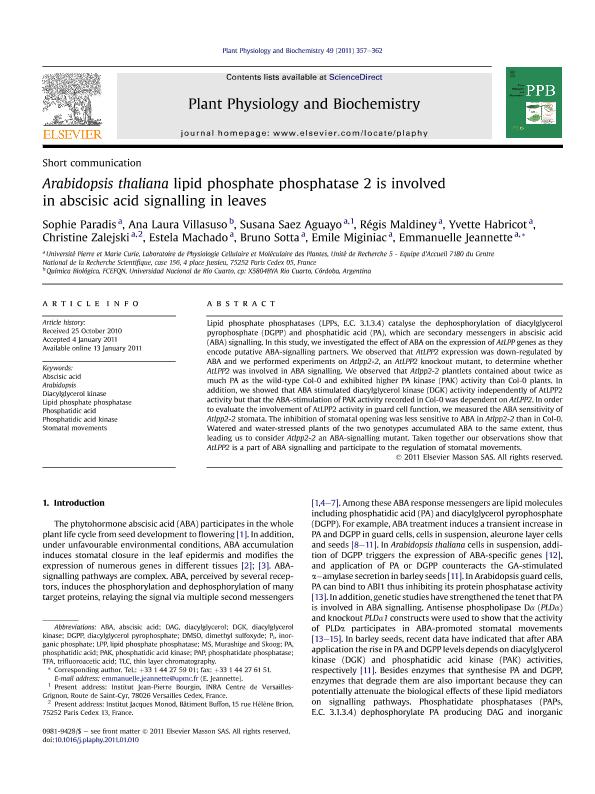
Lipid phosphate phosphatases (LPPs, E.C. 3.1.3.4) catalyse the dephosphorylation of diacylglycerol pyrophosphate (DGPP) and phosphatidic acid (PA), which are secondary messengers in abscisic acid (ABA) signalling. In this study, we investigated the effect of ABA on the expression of AtLPP genes as they encode putative ABA-signalling partners. We observed that AtLPP2 expression was down-regulated by ABA and we performed experiments on Atlpp2-2, an AtLPP2 knockout mutant, to determine whether AtLPP2 was involved in ABA signalling. We observed that Atlpp2-2 plantlets contained about twice as much PA as the wild-type Col-0 and exhibited higher PA kinase (PAK) activity than Col-0 plants. In addition, we showed that ABA stimulated diacylglycerol kinase (DGK) activity independently of AtLPP2 activity but that the ABA-stimulation of PAK activity recorded in Col-0 was dependent on AtLPP2. In order to evaluate the involvement of AtLPP2 activity in guard cell function, we measured the ABA sensitivity of Atlpp2-2 stomata. The inhibition of stomatal opening was less sensitive to ABA in Atlpp2-2 than in Col-0. Watered and water-stressed plants of the two genotypes accumulated ABA to the same extent, thus leading us to consider Atlpp2-2 an ABA-signalling mutant. Taken together our observations show that AtLPP2 is a part of ABA signalling and participate to the regulation of stomatal movements.
Archivos asociados

Tamaño:
213.1Kb
Formato:
PDF
Licencia
 Excepto donde se diga explícitamente, este item se publica bajo la siguiente descripción:
Creative Commons Attribution-NonCommercial-ShareAlike 2.5 Unported (CC BY-NC-SA 2.5)
Excepto donde se diga explícitamente, este item se publica bajo la siguiente descripción:
Creative Commons Attribution-NonCommercial-ShareAlike 2.5 Unported (CC BY-NC-SA 2.5)
Identificadores
Colecciones
Articulos(CCT - CORDOBA)
Articulos de CTRO.CIENTIFICO TECNOL.CONICET - CORDOBA
Articulos de CTRO.CIENTIFICO TECNOL.CONICET - CORDOBA
Citación
Paradis, Sophie; Villasuso, Ana Laura; Saez Aguayo, Susana; Maldiney, Régis; Habricot, Yvette; et al.; Arabidopsis thaliana lipid phosphate phosphatase 2 is involved in abscisic acid signalling in leaves; Elsevier France-Editions Scientifiques Medicales Elsevier; Plant Physiology and Biochemistry; 49; 3; 3-2011; 357-362
Compartir


Altmétricas