Artículo
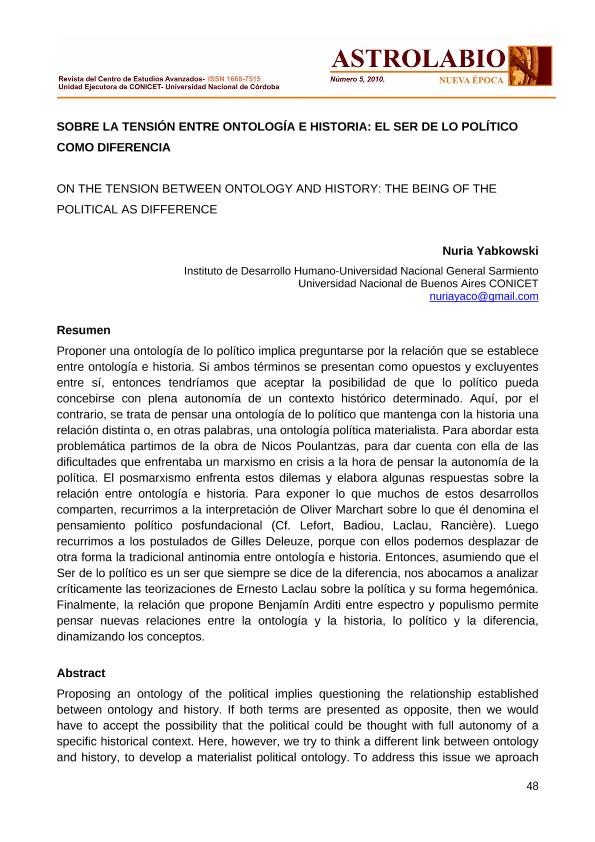
Proponer una ontología de lo político implica preguntarse por la relación que se establece entre ontología e historia. Si ambos términos se presentan como opuestos y excluyentes entre sí, entonces tendríamos que aceptar la posibilidad de que lo político pueda concebirse con plena autonomía de un contexto histórico determinado. Aquí, por el contrario, se trata de pensar una ontología de lo político que mantenga con la historia una relación distinta o, en otras palabras, una ontología política materialista. Para abordar esta problemática partimos de la obra de Nicos Poulantzas, para dar cuenta con ella de las dificultades que enfrentaba un marxismo en crisis a la hora de pensar la autonomía de la política. El posmarxismo enfrenta estos dilemas y elabora algunas respuestas sobre la relación entre ontología e historia. Para exponer lo que muchos de estos desarrollos comparten, recurrimos a la interpretación de Oliver Marchart sobre lo que él denomina el pensamiento político posfundacional (Cf. Lefort, Badiou, Laclau, Rancière). Luego recurrimos a los postulados de Gilles Deleuze, porque con ellos podemos desplazar de otra forma la tradicional antinomia entre ontología e historia. Entonces, asumiendo que el Ser de lo político es un ser que siempre se dice de la diferencia, nos abocamos a analizar críticamente las teorizaciones de Ernesto Laclau sobre la política y su forma hegemónica. Finalmente, la relación que propone Benjamín Arditi entre espectro y populismo permite pensar nuevas relaciones entre la ontología y la historia, lo político y la diferencia, dinamizando los conceptos. Proposing an ontology of the political implies questioning the relationship established between ontology and history. If both terms are presented as opposite, then we would have to accept the possibility that the political could be thought with full autonomy of a specific historical context. Here, however, we try to think a different link between ontology and history, to develop a materialist political ontology. To address this issue we aproach the work of Nicos Poulantzas, to express through it the difficulties faced by marxism in crisis when thinking about the autonomy of politics. Post-marxism faces these dilemmas and presents some answers to the paradox between ontology and history. To expose what many of these developments share, we turn to the interpretation of Oliver Marchart on what he calls post-fundational political thought (see Lefort, Badiou, Laclau, Rancière). Then we turn to the postulates of Gilles Deleuze, understanding that with them we can displace the traditional opposition between ontology and history in another way. Then, assuming that the Being of the political is one who always is said of the difference, we analyze the theories of Ernesto Laclau on politics and hegemony. Finally, the relation proposed by Benjamin Arditi between populism and the notion of spectre suggests new relationships between ontology and history, the political and the difference, giving dynamism to these concepts.
Sobre la tensión entre ontología e historia: El ser de lo político como diferencia
Título:
On the tension between ontology and history: The being of the political as difference

Fecha de publicación:
12/2010
Editorial:
Consejo Nacional de Investigaciones Científicas y Técnicas. Centro de Investigaciones y Estudios sobre Cultura y Sociedad
Revista:
Astrolabio
ISSN:
1668-7515
Idioma:
Español
Tipo de recurso:
Artículo publicado
Clasificación temática:
Resumen
Palabras clave:
ONTOLOGÍA
,
HISTORIA
,
LO POLÍTICO
,
POPULISMO
Archivos asociados

Tamaño:
101.6Kb
Formato:
PDF
Licencia
 Excepto donde se diga explícitamente, este item se publica bajo la siguiente descripción:
Creative Commons Attribution-NonCommercial-ShareAlike 2.5 Unported (CC BY-NC-SA 2.5)
Excepto donde se diga explícitamente, este item se publica bajo la siguiente descripción:
Creative Commons Attribution-NonCommercial-ShareAlike 2.5 Unported (CC BY-NC-SA 2.5)
Identificadores
Colecciones
Articulos(SEDE CENTRAL)
Articulos de SEDE CENTRAL
Articulos de SEDE CENTRAL
Citación
Yabkowski, Nuria Paola; Sobre la tensión entre ontología e historia: El ser de lo político como diferencia; Consejo Nacional de Investigaciones Científicas y Técnicas. Centro de Investigaciones y Estudios sobre Cultura y Sociedad; Astrolabio; 5; 12-2010; 48-64
Compartir

