Artículo
Diversification patterns in the CES clade (Brassicaceae tribes Cremolobeae, Eudemeae, Schizopetaleae) in Andean South America
Salariato, Diego Leonel ; Zuloaga, Fernando Omar
; Franzke, Andreas; Mummenhoff, Klaus; Al-Shehbaz, Ihsan
; Zuloaga, Fernando Omar
; Franzke, Andreas; Mummenhoff, Klaus; Al-Shehbaz, Ihsan
; Zuloaga, Fernando Omar
; Franzke, Andreas; Mummenhoff, Klaus; Al-Shehbaz, Ihsan
Fecha de publicación:
08/2016
Editorial:
Wiley
Revista:
Botanical Journal of The Linnean Society
ISSN:
0024-4074
Idioma:
Inglés
Tipo de recurso:
Artículo publicado
Clasificación temática:
Resumen
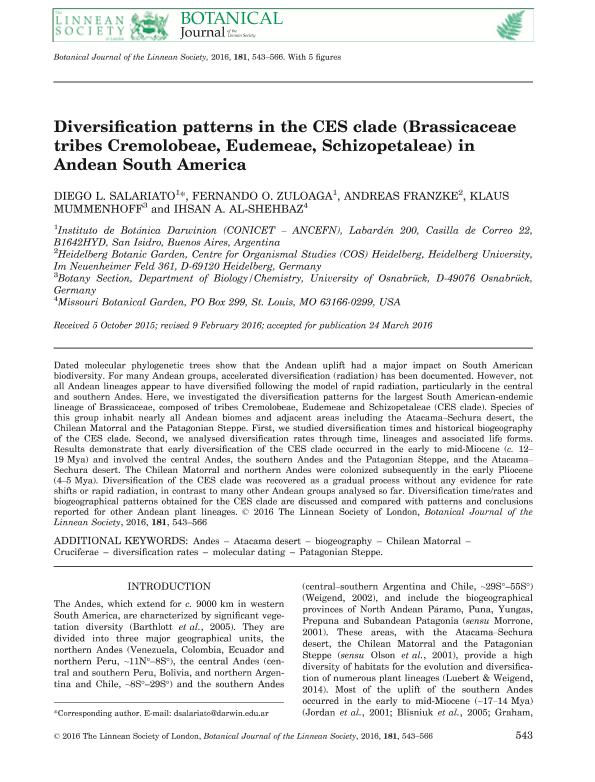
Dated molecular phylogenetic trees show that the Andean uplift had a major impact on South American biodiversity. For many Andean groups, accelerated diversification (radiation) has been documented. However, not all Andean lineages appear to have diversified following the model of rapid radiation, particularly in the central and southern Andes. Here, we investigated the diversification patterns for the largest South American-endemic lineage of Brassicaceae, composed of tribes Cremolobeae, Eudemeae and Schizopetaleae (CES clade). Species of this group inhabit nearly all Andean biomes and adjacent areas including the Atacama–Sechura desert, the Chilean Matorral and the Patagonian Steppe. First, we studied diversification times and historical biogeography of the CES clade. Second, we analysed diversification rates through time, lineages and associated life forms. Results demonstrate that early diversification of the CES clade occurred in the early to mid-Miocene (c. 12–19 Mya) and involved the central Andes, the southern Andes and the Patagonian Steppe, and the Atacama–Sechura desert. The Chilean Matorral and northern Andes were colonized subsequently in the early Pliocene (4–5 Mya). Diversification of the CES clade was recovered as a gradual process without any evidence for rate shifts or rapid radiation, in contrast to many other Andean groups analysed so far. Diversification time/rates and biogeographical patterns obtained for the CES clade are discussed and compared with patterns and conclusions reported for other Andean plant lineages.
Archivos asociados

Tamaño:
864.9Kb
Formato:
PDF
Licencia
 Excepto donde se diga explícitamente, este item se publica bajo la siguiente descripción:
Creative Commons Attribution-NonCommercial-ShareAlike 2.5 Unported (CC BY-NC-SA 2.5)
Excepto donde se diga explícitamente, este item se publica bajo la siguiente descripción:
Creative Commons Attribution-NonCommercial-ShareAlike 2.5 Unported (CC BY-NC-SA 2.5)
Identificadores
Colecciones
Articulos(IBODA)
Articulos de INST.DE BOTANICA DARWINION (I)
Articulos de INST.DE BOTANICA DARWINION (I)
Citación
Salariato, Diego Leonel; Zuloaga, Fernando Omar; Franzke, Andreas; Mummenhoff, Klaus; Al-Shehbaz, Ihsan; Diversification patterns in the CES clade (Brassicaceae tribes Cremolobeae, Eudemeae, Schizopetaleae) in Andean South America; Wiley; Botanical Journal of The Linnean Society; 181; 4; 8-2016; 543-566
Compartir


Altmétricas