Mostrar el registro sencillo del ítem
dc.contributor.author
Astolfi, P.
dc.contributor.author
Reynoso, Maria Marta
dc.contributor.author
Ramirez, Maria Laura
dc.contributor.author
Chulze, Sofia Noemi
dc.contributor.author
Alves, T. C. A.
dc.contributor.author
Tessmann, D. J.
dc.contributor.author
Del Ponte, E. M.
dc.date.available
2023-02-28T17:12:25Z
dc.date.issued
2012-07
dc.identifier.citation
Astolfi, P.; Reynoso, Maria Marta; Ramirez, Maria Laura; Chulze, Sofia Noemi; Alves, T. C. A.; et al.; Genetic population structure and trichothecene genotypes of Fusarium graminearum isolated from wheat in southern Brazil; Wiley Blackwell Publishing, Inc; Plant Pathology; 61; 2; 7-2012; 289-295
dc.identifier.issn
0032-0862
dc.identifier.uri
http://hdl.handle.net/11336/189135
dc.description.abstract
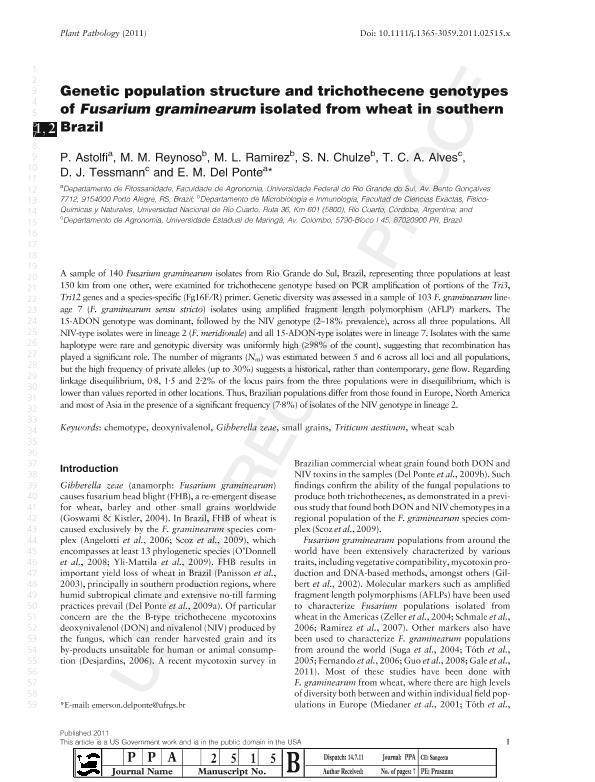
A sample of 140 Fusarium graminearum isolates from Rio Grande do Sul, Brazil, representing three populations at least 150km from one another, were examined for trichothecene genotype based on PCR amplification of portions of the Tri3 and Tri12 genes and a species-specific (Fg16F/R) primer pair. Genetic diversity was assessed in a sample of 103 F. graminearum lineage 7 (F. graminearum sensu stricto) isolates using amplified fragment length polymorphism (AFLP) markers. The 15-ADON genotype was dominant, followed by the NIV genotype (2-18% prevalence), across all three populations. All NIV-type isolates were in lineage 2 (F. meridionale) and all 15-ADON-type isolates were in lineage 7. Isolates with the same haplotype were rare and genotypic diversity was uniformly high (≥98% of the count), suggesting that recombination has played a significant role. The number of migrants (N m) was estimated between 5 and 6 across all loci and all populations, but the high frequency of private alleles (up to 30%) suggests a historical, rather than contemporary, gene flow. Regarding linkage disequilibrium, 0·8, 1·5 and 2·2% of the locus pairs from the three populations were in disequilibrium, which is lower than values reported in other locations. Thus, Brazilian populations differ from those found in Europe, North America and most of Asia in the presence of a significant frequency (7·8%) of isolates of the NIV genotype in lineage 2. © 2011 The Authors. Plant Pathology © 2011 BSPP.
dc.format
application/pdf
dc.language.iso
eng
dc.publisher
Wiley Blackwell Publishing, Inc
dc.rights
info:eu-repo/semantics/openAccess
dc.rights.uri
https://creativecommons.org/licenses/by-nc-sa/2.5/ar/
dc.subject
CHEMOTYPE,
dc.subject
DEOXYNIVALENOL,
dc.subject
GIBBERELLA ZEAE,
dc.subject
SMALL GRAINS,
dc.subject
TRITICUM AESTIVUM,
dc.subject
WHEAT SCAB
dc.subject.classification
Micología
dc.subject.classification
Ciencias Biológicas
dc.subject.classification
CIENCIAS NATURALES Y EXACTAS
dc.title
Genetic population structure and trichothecene genotypes of Fusarium graminearum isolated from wheat in southern Brazil
dc.type
info:eu-repo/semantics/article
dc.type
info:ar-repo/semantics/artículo
dc.type
info:eu-repo/semantics/publishedVersion
dc.date.updated
2023-02-27T17:44:11Z
dc.journal.volume
61
dc.journal.number
2
dc.journal.pagination
289-295
dc.journal.pais
Reino Unido
dc.journal.ciudad
Londres
dc.description.fil
Fil: Astolfi, P.. Universidade Federal do Rio Grande do Sul; Brasil
dc.description.fil
Fil: Reynoso, Maria Marta. Universidad Nacional de Río Cuarto. Facultad de Ciencias Exactas, Fisicoquímicas y Naturales. Departamento de Microbiología e Inmunología; Argentina. Universidad Nacional de Río Cuarto. Facultad de Ciencias Exactas Fisicoquímicas y Naturales. Instituto de Investigación en Micología y Micotoxicología. - Consejo Nacional de Investigaciones Científicas y Técnicas. Centro Científico Tecnológico Conicet - Córdoba. Instituto de Investigación en Micología y Micotoxicología; Argentina
dc.description.fil
Fil: Ramirez, Maria Laura. Universidad Nacional de Río Cuarto. Facultad de Ciencias Exactas Fisicoquímicas y Naturales. Instituto de Investigación en Micología y Micotoxicología. - Consejo Nacional de Investigaciones Científicas y Técnicas. Centro Científico Tecnológico Conicet - Córdoba. Instituto de Investigación en Micología y Micotoxicología; Argentina. Universidad Nacional de Río Cuarto. Facultad de Ciencias Exactas, Fisicoquímicas y Naturales. Departamento de Microbiología e Inmunología; Argentina
dc.description.fil
Fil: Chulze, Sofia Noemi. Universidad Nacional de Río Cuarto. Facultad de Ciencias Exactas Fisicoquímicas y Naturales. Instituto de Investigación en Micología y Micotoxicología. - Consejo Nacional de Investigaciones Científicas y Técnicas. Centro Científico Tecnológico Conicet - Córdoba. Instituto de Investigación en Micología y Micotoxicología; Argentina. Universidad Nacional de Río Cuarto. Facultad de Ciencias Exactas, Fisicoquímicas y Naturales. Departamento de Microbiología e Inmunología; Argentina
dc.description.fil
Fil: Alves, T. C. A.. Universidade Estadual de Maringá; Brasil
dc.description.fil
Fil: Tessmann, D. J.. Universidade Estadual de Maringá; Brasil
dc.description.fil
Fil: Del Ponte, E. M.. Universidade Federal do Rio Grande do Sul; Brasil
dc.journal.title
Plant Pathology
dc.relation.alternativeid
info:eu-repo/semantics/altIdentifier/doi/http://dx.doi.org/10.1111/j.1365-3059.2011.02515.x
dc.relation.alternativeid
info:eu-repo/semantics/altIdentifier/url/https://bsppjournals.onlinelibrary.wiley.com/doi/10.1111/j.1365-3059.2011.02515.x
Archivos asociados

Tamaño:
742.0Kb
Formato:
PDF