Artículo
Preferential formation of the different hydrogen bonds and their effects in tetrahydrofuran and tetrahydropyran microhydrated complexes

Fecha de publicación:
02/2012
Editorial:
American Chemical Society
Revista:
Journal of Physical Chemistry A
ISSN:
1089-5639
Idioma:
Inglés
Tipo de recurso:
Artículo publicado
Clasificación temática:
Resumen
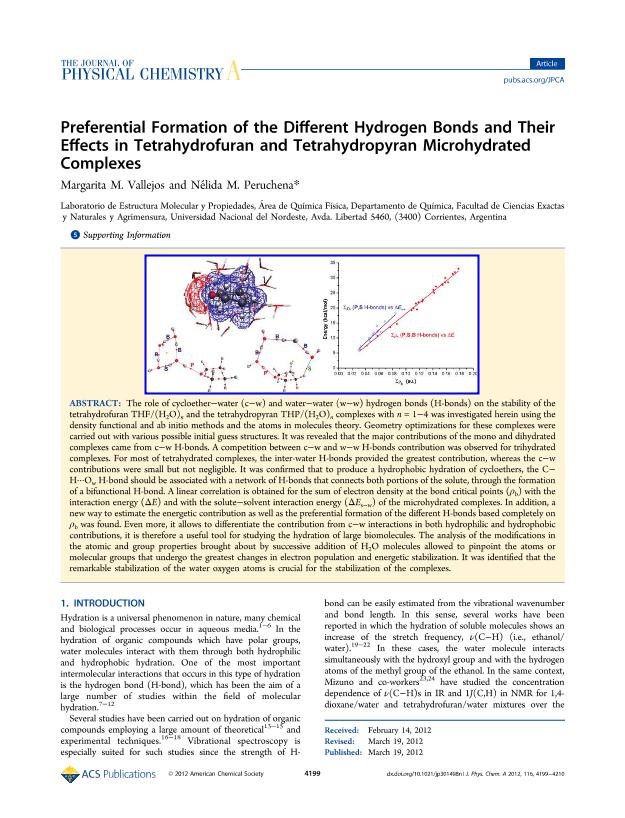
The role of cycloether-water (c-w) and water-water (w-w) hydrogen bonds (H-bonds) on the stability of the tetrahydrofuran THF/(H 2O) n and the tetrahydropyran THP/(H 2O) n complexes with n = 1-4 was investigated herein using the density functional and ab initio methods and the atoms in molecules theory. Geometry optimizations for these complexes were carried out with various possible initial guess structures. It was revealed that the major contributions of the mono and dihydrated complexes came from c-w H-bonds. A competition between c-w and w-w H-bonds contribution was observed for trihydrated complexes. For most of tetrahydrated complexes, the inter-water H-bonds provided the greatest contribution, whereas the c-w contributions were small but not negligible. It was confirmed that to produce a hydrophobic hydration of cycloethers, the C-H•••O w H-bond should be associated with a network of H-bonds that connects both portions of the solute, through the formation of a bifunctional H-bond. A linear correlation is obtained for the sum of electron density at the bond critical points (ρ b) with the interaction energy (ΔE) and with the solute-solvent interaction energy (ΔE s-w) of the microhydrated complexes. In addition, a new way to estimate the energetic contribution as well as the preferential formation of the different H-bonds based completely on ρ b was found. Even more, it allows to differentiate the contribution from c-w interactions in both hydrophilic and hydrophobic contributions, it is therefore a useful tool for studying the hydration of large biomolecules. The analysis of the modifications in the atomic and group properties brought about by successive addition of H 2O molecules allowed to pinpoint the atoms or molecular groups that undergo the greatest changes in electron population and energetic stabilization. It was identified that the remarkable stabilization of the water oxygen atoms is crucial for the stabilization of the complexes.
Palabras clave:
AIM
,
hydrogen bonds
,
charge density
,
hydrations
Archivos asociados

Tamaño:
714.3Kb
Formato:
PDF
Licencia
 Excepto donde se diga explícitamente, este item se publica bajo la siguiente descripción:
Creative Commons Attribution-NonCommercial-ShareAlike 2.5 Unported (CC BY-NC-SA 2.5)
Excepto donde se diga explícitamente, este item se publica bajo la siguiente descripción:
Creative Commons Attribution-NonCommercial-ShareAlike 2.5 Unported (CC BY-NC-SA 2.5)
Identificadores
Colecciones
Articulos(CCT - NORDESTE)
Articulos de CTRO.CIENTIFICO TECNOL.CONICET - NORDESTE
Articulos de CTRO.CIENTIFICO TECNOL.CONICET - NORDESTE
Citación
Vallejos, Margarita; Peruchena, Nelida Maria; Preferential formation of the different hydrogen bonds and their effects in tetrahydrofuran and tetrahydropyran microhydrated complexes; American Chemical Society; Journal of Physical Chemistry A; 116; 16; 2-2012; 4199-4210
Compartir


Altmétricas