Artículo
The use of microbead-based spoligotyping for Mycobacterium tuberculosis complex to evaluate the quality of the conventional method: Providing guidelines for Quality Assurance when working on membranes
Abadia, Edgar; Zhang, Jian; Ritacco, Gloria Viviana ; Kremer, Kristin; Ruimy, Raymond; Rigouts, Leen; Gomes, Harrison M.; Elias, Atiná R.; Fauville-Dufaux, Maryse; Stoffels, Karolien; Rasolofo Razanamparany, Voahangy; de Viedma, Darío G.; Herranz, Marta; Al-Hajoj, Sahal; Rastogi, Nalin; Garzelli, Carlo; Tortoli, Enrico; Suffys, Philip Noel; van Soolingen, Dick; Refrégier, Guislaine; Sola, Christophe
; Kremer, Kristin; Ruimy, Raymond; Rigouts, Leen; Gomes, Harrison M.; Elias, Atiná R.; Fauville-Dufaux, Maryse; Stoffels, Karolien; Rasolofo Razanamparany, Voahangy; de Viedma, Darío G.; Herranz, Marta; Al-Hajoj, Sahal; Rastogi, Nalin; Garzelli, Carlo; Tortoli, Enrico; Suffys, Philip Noel; van Soolingen, Dick; Refrégier, Guislaine; Sola, Christophe
Fecha de publicación:
04/2011
Editorial:
BioMed Central
Revista:
BMC Infectious Diseases
ISSN:
1471-2334
Idioma:
Inglés
Tipo de recurso:
Artículo publicado
Clasificación temática:
Resumen
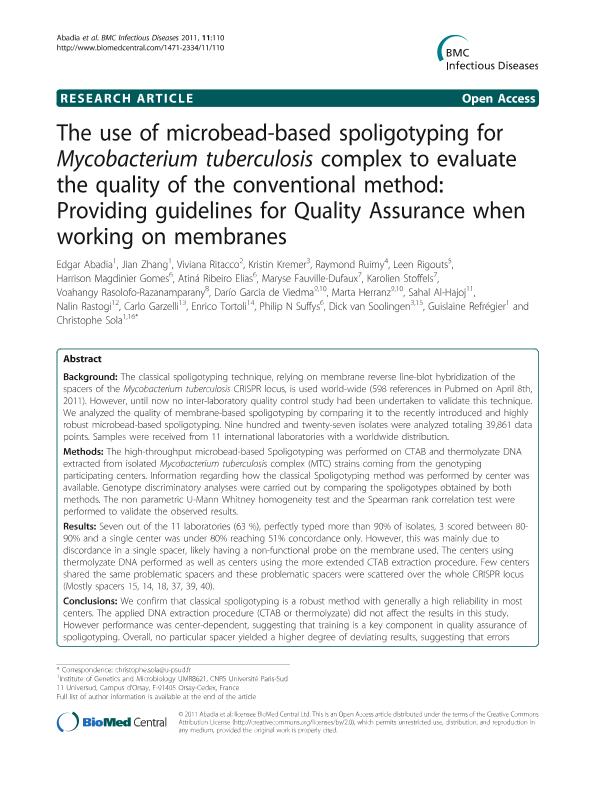
Background: The classical spoligotyping technique, relying on membrane reverse line-blot hybridization of the spacers of the Mycobacterium tuberculosis CRISPR locus, is used world-wide (598 references in Pubmed on April 8th, 2011). However, until now no inter-laboratory quality control study had been undertaken to validate this technique. We analyzed the quality of membrane-based spoligotyping by comparing it to the recently introduced and highly robust microbead-based spoligotyping. Nine hundred and twenty-seven isolates were analyzed totaling 39,861 data points. Samples were received from 11 international laboratories with a worldwide distribution.Methods: The high-throughput microbead-based Spoligotyping was performed on CTAB and thermolyzate DNA extracted from isolated Mycobacterium tuberculosis complex (MTC) strains coming from the genotyping participating centers. Information regarding how the classical Spoligotyping method was performed by center was available. Genotype discriminatory analyses were carried out by comparing the spoligotypes obtained by both methods. The non parametric U-Mann Whitney homogeneity test and the Spearman rank correlation test were performed to validate the observed results.Results: Seven out of the 11 laboratories (63 %), perfectly typed more than 90% of isolates, 3 scored between 80-90% and a single center was under 80% reaching 51% concordance only. However, this was mainly due to discordance in a single spacer, likely having a non-functional probe on the membrane used. The centers using thermolyzate DNA performed as well as centers using the more extended CTAB extraction procedure. Few centers shared the same problematic spacers and these problematic spacers were scattered over the whole CRISPR locus (Mostly spacers 15, 14, 18, 37, 39, 40).Conclusions: We confirm that classical spoligotyping is a robust method with generally a high reliability in most centers. The applied DNA extraction procedure (CTAB or thermolyzate) did not affect the results in this study. However performance was center-dependent, suggesting that training is a key component in quality assurance of spoligotyping. Overall, no particular spacer yielded a higher degree of deviating results, suggesting that errors occur randomly either in the process of re-using membranes, or during the reading of the results and transferring of data from the film to a digital file. Last, the performance of the microbead-based method was excellent as previously shown by Cowan et al. (J. Clin. Microbiol. 2004) and Zhang et al. (J. Med. Microbiol. 2009) and demonstrated the proper detection of spacer 15 that is known to occasionally give weak signals in the classical spoligotyping.
Palabras clave:
SPOLIGTYPING
,
MYCOBACTERIUM TUBERCULOSIS
,
CRISP LOCUS
,
MICROBEADS
Archivos asociados

Tamaño:
366.4Kb
Formato:
PDF
Licencia
 Excepto donde se diga explícitamente, este item se publica bajo la siguiente descripción:
Creative Commons Attribution 2.5 Unported (CC BY 2.5)
Excepto donde se diga explícitamente, este item se publica bajo la siguiente descripción:
Creative Commons Attribution 2.5 Unported (CC BY 2.5)
Identificadores
Colecciones
Articulos(SEDE CENTRAL)
Articulos de SEDE CENTRAL
Articulos de SEDE CENTRAL
Citación
Abadia, Edgar; Zhang, Jian; Ritacco, Gloria Viviana; Kremer, Kristin; Ruimy, Raymond; et al.; The use of microbead-based spoligotyping for Mycobacterium tuberculosis complex to evaluate the quality of the conventional method: Providing guidelines for Quality Assurance when working on membranes; BioMed Central; BMC Infectious Diseases; 11; 4-2011; 1-8
Compartir


Altmétricas