Artículo
Flow disturbances generated by feeding and swimming zooplankton

Fecha de publicación:
12/08/2014
Editorial:
National Academy Of Sciences
Revista:
Proceedings of the National Academy of Sciences of The United States of America
ISSN:
0027-8424
Idioma:
Inglés
Tipo de recurso:
Artículo publicado
Clasificación temática:
Resumen
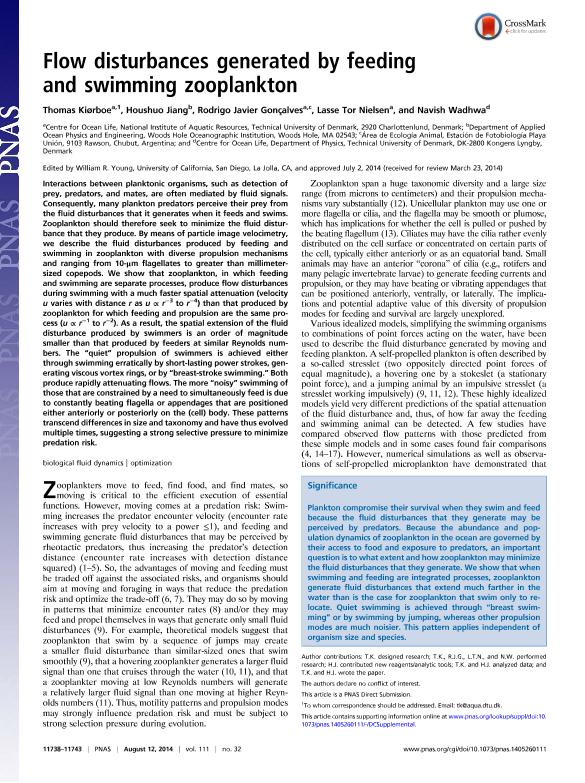
Interactions between planktonic organisms, such as detection of prey, predators, and mates, are often mediated by fluid signals. Consequently, many plankton predators perceive their prey from the fluid disturbances that it generates when it feeds and swims. Zooplankton should therefore seek to minimize the fluid disturbance that they produce. By means of particle image velocimetry, we describe the fluid disturbances produced by feeding and swimming in zooplankton with diverse propulsion mechanisms and ranging from 10-µm flagellates to greater than millimeter-sized copepods. We show that zooplankton, in which feeding and swimming are separate processes, produce flow disturbances during swimming with a much faster spatial attenuation (velocity u varies with distance r as u ∝ r−3 to r−4) than that produced by zooplankton for which feeding and propulsion are the same process (u ∝ r−1 to r−2). As a result, the spatial extension of the fluid disturbance produced by swimmers is an order of magnitude smaller than that produced by feeders at similar Reynolds numbers. The “quiet” propulsion of swimmers is achieved either through swimming erratically by short-lasting power strokes, generating viscous vortex rings, or by “breast-stroke swimming.” Both produce rapidly attenuating flows. The more “noisy” swimming of those that are constrained by a need to simultaneously feed is due to constantly beating flagella or appendages that are positioned either anteriorly or posteriorly on the (cell) body. These patterns transcend differences in size and taxonomy and have thus evolved multiple times, suggesting a strong selective pressure to minimize predation risk.
Palabras clave:
Zooplankton
,
Flow Disturbances
,
Swimming Behavior
,
Predator Avoidance
Archivos asociados

Tamaño:
3.927Mb
Formato:
PDF
Licencia
 Excepto donde se diga explícitamente, este item se publica bajo la siguiente descripción:
Creative Commons Attribution-NonCommercial-ShareAlike 2.5 Unported (CC BY-NC-SA 2.5)
Excepto donde se diga explícitamente, este item se publica bajo la siguiente descripción:
Creative Commons Attribution-NonCommercial-ShareAlike 2.5 Unported (CC BY-NC-SA 2.5)
Identificadores
Colecciones
Articulos(CCT-CENPAT)
Articulos de CTRO.CIENTIFICO TECNOL.CONICET - CENPAT
Articulos de CTRO.CIENTIFICO TECNOL.CONICET - CENPAT
Citación
Kiørboe, Thomas; Jiang, Houshuo; Gonçalves, Rodrigo Javier; Nielsen, Lasse Tor; Wadhwa, Navish; Flow disturbances generated by feeding and swimming zooplankton; National Academy Of Sciences; Proceedings of the National Academy of Sciences of The United States of America; 111; 32; 12-8-2014; 11738-11743
Compartir


Altmétricas