Artículo
Phylogenetic analysis of the Panochthini (Xenarthra, Glyptodontidae), with remarks on their temporal distribution

Fecha de publicación:
02/2013
Editorial:
Taylor & Francis
Revista:
Alcheringa
ISSN:
0311-5518
Idioma:
Inglés
Tipo de recurso:
Artículo publicado
Clasificación temática:
Resumen
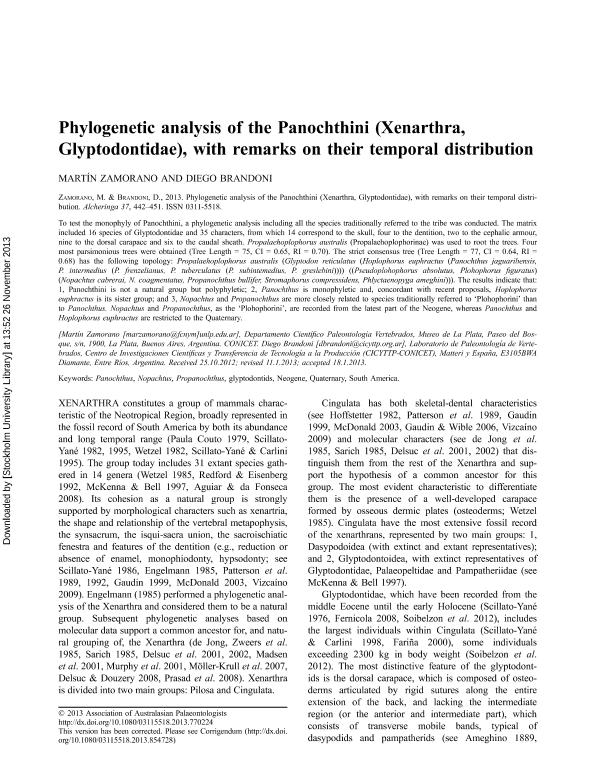
To test the monophyly of Panochthini, a phylogenetic analysis including all the species traditionally referred to the tribe was conducted. The matrix included 16 species of Glyptodontidae and 35 characters, from which 14 correspond to the skull, four to the dentition, two to the cephalic armour, nine to the dorsal carapace and six to the caudal sheath. Propalaehoplophorus australis (Propalaehoplophorinae) was used to root the trees. Four most parsimonious trees were obtained (Tree Length = 75, CI = 0.65, RI = 0.70). The strict consensus tree (Tree Length = 77, CI = 0.64, RI = 0.68) has the following topology: Propalaehoplophorus australis (Glyptodon reticulatus (Hoplophorus euphractus (Panochthus jaguaribensis, P. intermedius (P. frenzelianus, P. tuberculatus (P. subintemedius, P. greslebini)))) ((Pseudoplohophorus absolutus, Plohophorus figuratus) (Nopachtus cabrerai, N. coagmentatus, Propanochthus bullifer, Stromaphorus compressidens, Phlyctaenopyga ameghini))). The results indicate that: 1, Panochthini is not a natural group but polyphyletic; 2, Panochthus is monophyletic and, concordant with recent proposals, Hoplophorus euphractus is its sister group; and 3, Nopachtus and Propanochthus are more closely related to species traditionally referred to ‘Plohophorini’ than to Panochthus. Nopachtus and Propanochthus, as the ‘Plohophorini’, are recorded from the latest part of the Neogene, whereas Panochthus and Hoplophorus euphractus are restricted to the Quaternary.
Palabras clave:
Panochthus
,
Nopachtus
,
Propanochthus
,
Glyptodontids
,
Neogene
,
Quaternary
,
South America
Archivos asociados

Tamaño:
531.6Kb
Formato:
PDF
Licencia
 Excepto donde se diga explícitamente, este item se publica bajo la siguiente descripción:
Creative Commons Attribution-NonCommercial-ShareAlike 2.5 Unported (CC BY-NC-SA 2.5)
Excepto donde se diga explícitamente, este item se publica bajo la siguiente descripción:
Creative Commons Attribution-NonCommercial-ShareAlike 2.5 Unported (CC BY-NC-SA 2.5)
Identificadores
Colecciones
Articulos(CICYTTP)
Articulos de CENTRO DE INV.CIENT.Y TRANSFERENCIA TEC A LA PROD
Articulos de CENTRO DE INV.CIENT.Y TRANSFERENCIA TEC A LA PROD
Citación
Zamorano, Martín; Brandoni, Diego; Phylogenetic analysis of the Panochthini (Xenarthra, Glyptodontidae), with remarks on their temporal distribution; Taylor & Francis; Alcheringa; 37; 4; 2-2013; 442-451
Compartir


Altmétricas