Mostrar el registro sencillo del ítem
dc.contributor.author
Manta, Gaston
dc.contributor.author
Speich, Sabrina
dc.contributor.author
Barreiro, Marcelo
dc.contributor.author
Trinchin, Romina
dc.contributor.author
de Mello, Camila
dc.contributor.author
Laxenaire, Rémi
dc.contributor.author
Piola, Alberto Ricardo
dc.date.available
2023-02-07T13:21:55Z
dc.date.issued
2022-03
dc.identifier.citation
Manta, Gaston; Speich, Sabrina; Barreiro, Marcelo; Trinchin, Romina; de Mello, Camila; et al.; Shelf Water Export at the Brazil-Malvinas Confluence Evidenced From Combined in situ and Satellite Observations; Frontiers Media; Frontiers In Marine Science; 9; 3-2022; 1-19
dc.identifier.issn
2296-7745
dc.identifier.uri
http://hdl.handle.net/11336/187150
dc.description.abstract
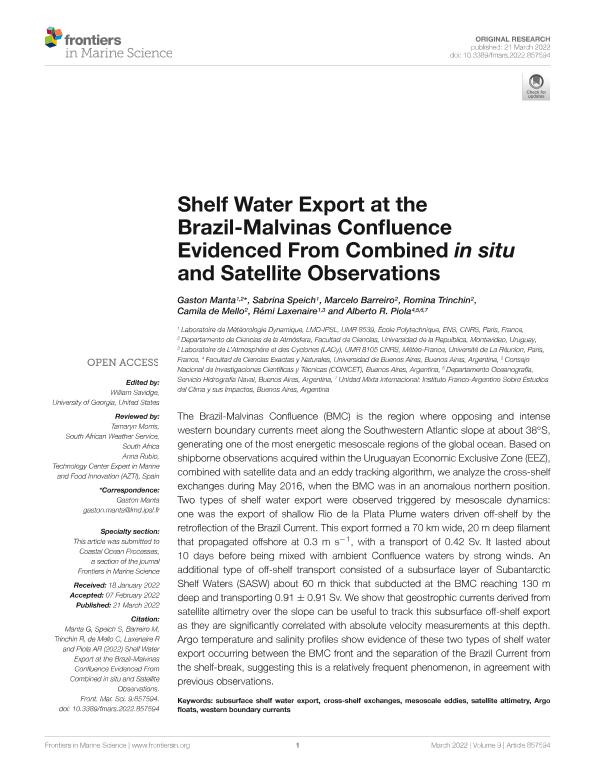
The Brazil-Malvinas Confluence (BMC) is the region where opposing and intense western boundary currents meet along the Southwestern Atlantic slope at about 38°S, generating one of the most energetic mesoscale regions of the global ocean. Based on shipborne observations acquired within the Uruguayan Economic Exclusive Zone (EEZ), combined with satellite data and an eddy tracking algorithm, we analyze the cross-shelf exchanges during May 2016, when the BMC was in an anomalous northern position. Two types of shelf water export were observed triggered by mesoscale dynamics: one was the export of shallow Rio de la Plata Plume waters driven off-shelf by the retroflection of the Brazil Current. This export formed a 70 km wide, 20 m deep filament that propagated offshore at 0.3 m s–1, with a transport of 0.42 Sv. It lasted about 10 days before being mixed with ambient Confluence waters by strong winds. An additional type of off-shelf transport consisted of a subsurface layer of Subantarctic Shelf Waters (SASW) about 60 m thick that subducted at the BMC reaching 130 m deep and transporting 0.91 ± 0.91 Sv. We show that geostrophic currents derived from satellite altimetry over the slope can be useful to track this subsurface off-shelf export as they are significantly correlated with absolute velocity measurements at this depth. Argo temperature and salinity profiles show evidence of these two types of shelf water export occurring between the BMC front and the separation of the Brazil Current from the shelf-break, suggesting this is a relatively frequent phenomenon, in agreement with previous observations.
dc.format
application/pdf
dc.language.iso
eng
dc.publisher
Frontiers Media
dc.rights
info:eu-repo/semantics/openAccess
dc.rights.uri
https://creativecommons.org/licenses/by-nc-sa/2.5/ar/
dc.subject
ARGO FLOATS
dc.subject
CROSS-SHELF EXCHANGES
dc.subject
MESOSCALE EDDIES
dc.subject
SATELLITE ALTIMETRY
dc.subject
SUBSURFACE SHELF WATER EXPORT
dc.subject
WESTERN BOUNDARY CURRENTS
dc.subject.classification
Oceanografía, Hidrología, Recursos Hídricos
dc.subject.classification
Ciencias de la Tierra y relacionadas con el Medio Ambiente
dc.subject.classification
CIENCIAS NATURALES Y EXACTAS
dc.title
Shelf Water Export at the Brazil-Malvinas Confluence Evidenced From Combined in situ and Satellite Observations
dc.type
info:eu-repo/semantics/article
dc.type
info:ar-repo/semantics/artículo
dc.type
info:eu-repo/semantics/publishedVersion
dc.date.updated
2023-02-07T10:16:19Z
dc.journal.volume
9
dc.journal.pagination
1-19
dc.journal.pais
Suiza
dc.journal.ciudad
Lusana
dc.description.fil
Fil: Manta, Gaston. Universidad de la República. Facultad de Ciencias; Uruguay
dc.description.fil
Fil: Speich, Sabrina. Ecole Normale Supérieure; Francia
dc.description.fil
Fil: Barreiro, Marcelo. Universidad de la República. Facultad de Ciencias; Uruguay
dc.description.fil
Fil: Trinchin, Romina. Universidad de la República. Facultad de Ciencias; Uruguay
dc.description.fil
Fil: de Mello, Camila. Universidad de la República. Facultad de Ciencias; Uruguay
dc.description.fil
Fil: Laxenaire, Rémi. Ecole Normale Superieure. Laboratoire de Meteorologie Dynamique; Francia
dc.description.fil
Fil: Piola, Alberto Ricardo. Ministerio de Defensa. Armada Argentina. Servicio de Hidrografía Naval; Argentina. Consejo Nacional de Investigaciones Científicas y Técnicas; Argentina. Universidad de Buenos Aires; Argentina
dc.journal.title
Frontiers In Marine Science
dc.relation.alternativeid
info:eu-repo/semantics/altIdentifier/url/https://www.frontiersin.org/articles/10.3389/fmars.2022.857594/full
dc.relation.alternativeid
info:eu-repo/semantics/altIdentifier/doi/http://dx.doi.org/10.3389/fmars.2022.857594
Archivos asociados

Tamaño:
7.946Mb
Formato:
PDF