Artículo
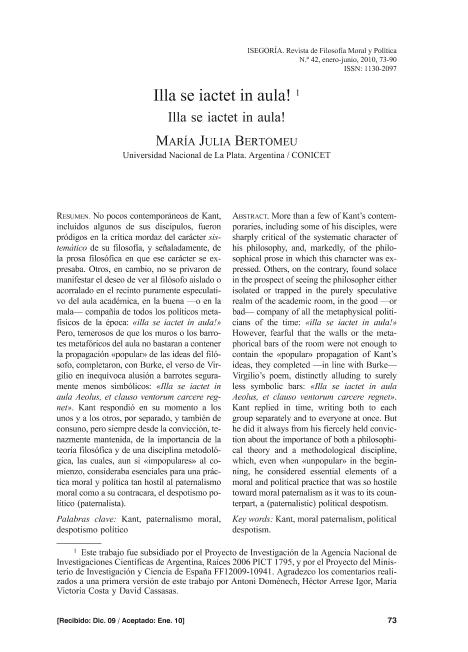
No pocos contemporáneos de Kant, incluidos algunos de sus discípulos, fueron pródigos en la crítica mordaz del carácter sistemático de su filosofía, y señaladamente, de la prosa filosófica en que ese carácter se expresaba. Otros, en cambio, no se privaron de manifestar el deseo de ver al filósofo aislado o acorralado en el recinto puramente especulativo del aula académica, en la buena —o en la mala— compañía de todos los políticos metafísicos de la época: «illa se iactet in aula!» Pero, temerosos de que los muros o los barrotes metafóricos del aula no bastaran a contener la propagación «popular» de las ideas del filósofo, completaron, con Burke, el verso de Virgilio en inequívoca alusión a barrotes seguramente menos simbólicos: «Illa se iactet in aula Aeolus, et clauso ventorum carcere regnet». Kant respondió en su momento a los unos y a los otros, por separado, y también de consuno, pero siempre desde la convicción, tenazmente mantenida, de la importancia de la teoría filosófica y de una disciplina metodológica, las cuales, aun si «impopulares» al comienzo, consideraba esenciales para una práctica moral y política tan hostil al paternalismo moral como a su contracara, el despotismo político (paternalista). More than a few of Kant's contemporaries, including some of his disciples, were sharply critical of the systematic character of his philosophy, and, markedly, of the philosophical prose in which this character was expressed. Others, on the contrary, found solace in the prospect of seeing the philosopher either isolated or trapped in the purely speculative realm of the academic room, in the good - or bad - company of all the metaphysical politicians of the time: «illa se iactet in aula!» However, fearful that the walls or the metaphorical bars of the room were not enough to contain the «popular» propagation of Kant's ideas, they completed - in line with Burke - Virgilio's poem, distinctly alluding to surely less symbolic bars: «Illa se iactet in aula Aeolus, et clauso ventorum carcere regnet». Kant replied in time, writing both to each group separately and to everyone at once. But he did it always from his fiercely held conviction about the importance of both a philosophical theory and a methodological discipline, which, even when «unpopular» in the beginning, he considered essential elements of a moral and political practice that was so hostile toward moral paternalism as it was to its counterpart, a (paternalistic) political despotism.
Illa se iactet in aula! Illa se iactet in aula!

Fecha de publicación:
03/2010
Editorial:
Consejo Superior de Investigaciones Científicas. Instituto de Filosofía
Revista:
Isegoría
ISSN:
1130-2097
e-ISSN:
1988-8376
Idioma:
Español
Tipo de recurso:
Artículo publicado
Clasificación temática:
Resumen
Palabras clave:
Kant
,
Paternalismo moral
,
Despotismo Político
Archivos asociados

Tamaño:
109.3Kb
Formato:
PDF
Licencia
 Excepto donde se diga explícitamente, este item se publica bajo la siguiente descripción:
Creative Commons Attribution 2.5 Unported (CC BY 2.5)
Excepto donde se diga explícitamente, este item se publica bajo la siguiente descripción:
Creative Commons Attribution 2.5 Unported (CC BY 2.5)
Identificadores
Colecciones
Articulos(SEDE CENTRAL)
Articulos de SEDE CENTRAL
Articulos de SEDE CENTRAL
Citación
Bertomeu, Maria Julia; Illa se iactet in aula! Illa se iactet in aula!; Consejo Superior de Investigaciones Científicas. Instituto de Filosofía; Isegoría; 42; 3-2010; 73-90
Compartir


Altmétricas