Artículo
Maize reproductive development and kernel set under limited plant growth environments

Fecha de publicación:
06/2018
Editorial:
Oxford University Press
Revista:
Journal of Experimental Botany
ISSN:
0022-0957
Idioma:
Inglés
Tipo de recurso:
Artículo publicado
Clasificación temática:
Resumen
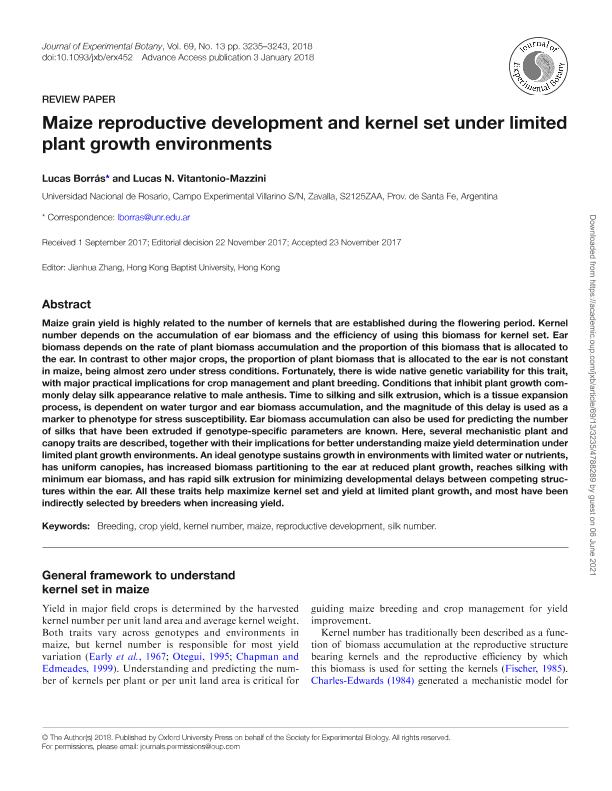
Maize grain yield is highly related to the number of kernels that are established during the flowering period. Kernel number depends on the accumulation of ear biomass and the efficiency of using this biomass for kernel set. Ear biomass depends on the rate of plant biomass accumulation and the proportion of this biomass that is allocated to the ear. In contrast to other major crops, the proportion of plant biomass that is allocated to the ear is not constant in maize, being almost zero under stress conditions. Fortunately, there is wide native genetic variability for this trait, with major practical implications for crop management and plant breeding. Conditions that inhibit plant growth commonly delay silk appearance relative to male anthesis. Time to silking and silk extrusion, which is a tissue expansion process, is dependent on water turgor and ear biomass accumulation, and the magnitude of this delay is used as a marker to phenotype for stress susceptibility. Ear biomass accumulation can also be used for predicting the number of silks that have been extruded if genotype-specific parameters are known. Here, several mechanistic plant and canopy traits are described, together with their implications for better understanding maize yield determination under limited plant growth environments. An ideal genotype sustains growth in environments with limited water or nutrients, has uniform canopies, has increased biomass partitioning to the ear at reduced plant growth, reaches silking with minimum ear biomass, and has rapid silk extrusion for minimizing developmental delays between competing structures within the ear. All these traits help maximize kernel set and yield at limited plant growth, and most have been indirectly selected by breeders when increasing yield.
Palabras clave:
BREEDING
,
CROP YIELD
,
KERNEL NUMBER
,
MAIZE
,
REPRODUCTIVE DEVELOPMENT
,
SILK NUMBER
Archivos asociados

Tamaño:
326.5Kb
Formato:
PDF
Licencia
 Excepto donde se diga explícitamente, este item se publica bajo la siguiente descripción:
Creative Commons Attribution-NonCommercial-ShareAlike 2.5 Unported (CC BY-NC-SA 2.5)
Excepto donde se diga explícitamente, este item se publica bajo la siguiente descripción:
Creative Commons Attribution-NonCommercial-ShareAlike 2.5 Unported (CC BY-NC-SA 2.5)
Identificadores
Colecciones
Articulos(IICAR)
Articulos de INST. DE INVESTIGACIONES EN CIENCIAS AGRARIAS DE ROSARIO
Articulos de INST. DE INVESTIGACIONES EN CIENCIAS AGRARIAS DE ROSARIO
Citación
Borras, Lucas; Vitantonio Mazzini, Lucas Nicolás; Maize reproductive development and kernel set under limited plant growth environments; Oxford University Press; Journal of Experimental Botany; 69; 13; 6-2018; 3235-3243
Compartir


Altmétricas