Artículo
Secondary traits explaining sorghum genotype by environment interactions for grain yield

Fecha de publicación:
08/2017
Editorial:
Csiro Publishing
Revista:
Crop and Pasture Science
ISSN:
1836-0947
e-ISSN:
1836-5795
Idioma:
Inglés
Tipo de recurso:
Artículo publicado
Clasificación temática:
Resumen
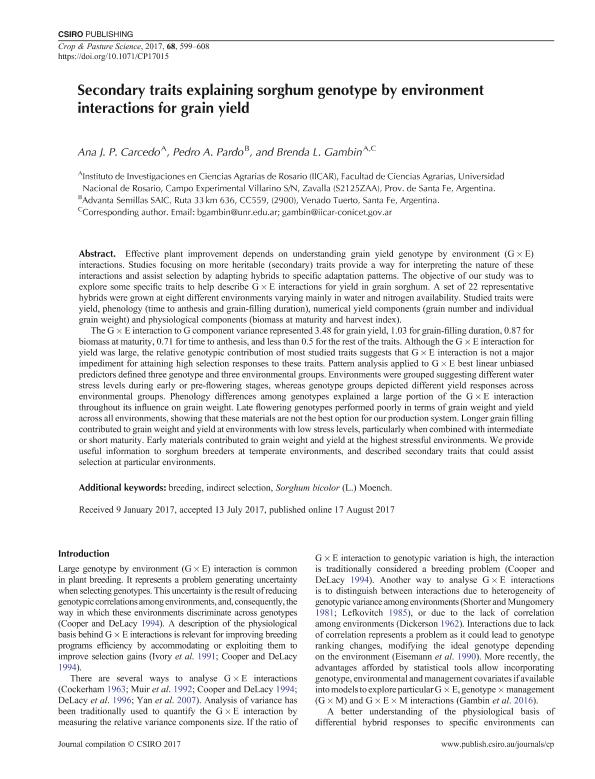
Effective plant improvement depends on understanding grain yield genotype by environment (G×E) interactions. Studies focusing on more heritable (secondary) traits provide a way for interpreting the nature of these interactions and assist selection by adapting hybrids to specific adaptation patterns. The objective of our study was to explore some specific traits to help describe G×E interactions for yield in grain sorghum. A set of 22 representative hybrids were grown at eight different environments varying mainly in water and nitrogen availability. Studied traits were yield, phenology (time to anthesis and grain-filling duration), numerical yield components (grain number and individual grain weight) and physiological components (biomass at maturity and harvest index). The G×E interaction to G component variance represented 3.48 for grain yield, 1.03 for grain-filling duration, 0.87 for biomass at maturity, 0.71 for time to anthesis, and less than 0.5 for the rest of the traits. Although the G×E interaction for yield was large, the relative genotypic contribution of most studied traits suggests that G×E interaction is not a major impediment for attaining high selection responses to these traits. Pattern analysis applied to G×E best linear unbiased predictors defined three genotype and three environmental groups. Environments were grouped suggesting different water stress levels during early or pre-flowering stages, whereas genotype groups depicted different yield responses across environmental groups. Phenology differences among genotypes explained a large portion of the G×E interaction throughout its influence on grain weight. Late flowering genotypes performed poorly in terms of grain weight and yield across all environments, showing that these materials are not the best option for our production system. Longer grain filling contributed to grain weight and yield at environments with low stress levels, particularly when combined with intermediate or short maturity. Early materials contributed to grain weight and yield at the highest stressful environments. We provide useful information to sorghum breeders at temperate environments, and described secondary traits that could assist selection at particular environments.
Palabras clave:
BREEDING
,
INDIRECT SELECTION
,
SORGHUM BICOLOR (L.) MOENCH.
Archivos asociados

Tamaño:
396.3Kb
Formato:
PDF
Licencia
 Excepto donde se diga explícitamente, este item se publica bajo la siguiente descripción:
Creative Commons Attribution-NonCommercial-ShareAlike 2.5 Unported (CC BY-NC-SA 2.5)
Excepto donde se diga explícitamente, este item se publica bajo la siguiente descripción:
Creative Commons Attribution-NonCommercial-ShareAlike 2.5 Unported (CC BY-NC-SA 2.5)
Identificadores
Colecciones
Articulos(IICAR)
Articulos de INST. DE INVESTIGACIONES EN CIENCIAS AGRARIAS DE ROSARIO
Articulos de INST. DE INVESTIGACIONES EN CIENCIAS AGRARIAS DE ROSARIO
Citación
Carcedo, Ana Julia Paula; Pardo, Pedro A.; Gambin, Brenda Laura; Secondary traits explaining sorghum genotype by environment interactions for grain yield; Csiro Publishing; Crop and Pasture Science; 68; 7; 8-2017; 599-608
Compartir


Altmétricas