Artículo
White paper: from bound states to the continuum
Johnson, Calvin W.; Launey, Kristina D.; Auerbach, Naftali; Bacca, Sonia; Barrett, Bruce R.; Brune, Carl R.; Caprio, Mark A.; Dickhoff, W. H.; Elster, Charlotte; Fasano, Patrick J.; Fossez, Kevin; Hergert, Heiko; Hjorth Jensen, Morten; Hlophe, Linda; Hu, Baishan; Id Betan, Rodolfo Mohamed ; Idini, Andrea; König, Sebastian; Lee, Dean; Lei, Jin; Mercenne, Alexis; Perez, Rodrigo Navarro; Navarro Perez, Rodrigo; Nazarewicz, Witold; Nunes, Filomena M.; Nunes, Filomena M.; Płoszajczak, Marek; Rotureau, Jimmy; Rupak, Gautam; Shirokov, Andrey M.; Thompson, Ian; Vary, James P.; Volya, Alexander; Xu, Furong; Zegers, Remco G.T.; Zelevinsky, Vladimir; Zhang, Xilin
; Idini, Andrea; König, Sebastian; Lee, Dean; Lei, Jin; Mercenne, Alexis; Perez, Rodrigo Navarro; Navarro Perez, Rodrigo; Nazarewicz, Witold; Nunes, Filomena M.; Nunes, Filomena M.; Płoszajczak, Marek; Rotureau, Jimmy; Rupak, Gautam; Shirokov, Andrey M.; Thompson, Ian; Vary, James P.; Volya, Alexander; Xu, Furong; Zegers, Remco G.T.; Zelevinsky, Vladimir; Zhang, Xilin
Fecha de publicación:
12/2020
Editorial:
IOP Publishing
Revista:
Journal Of Physics G-nuclear And Particle Physics
ISSN:
0954-3899
Idioma:
Inglés
Tipo de recurso:
Artículo publicado
Clasificación temática:
Resumen
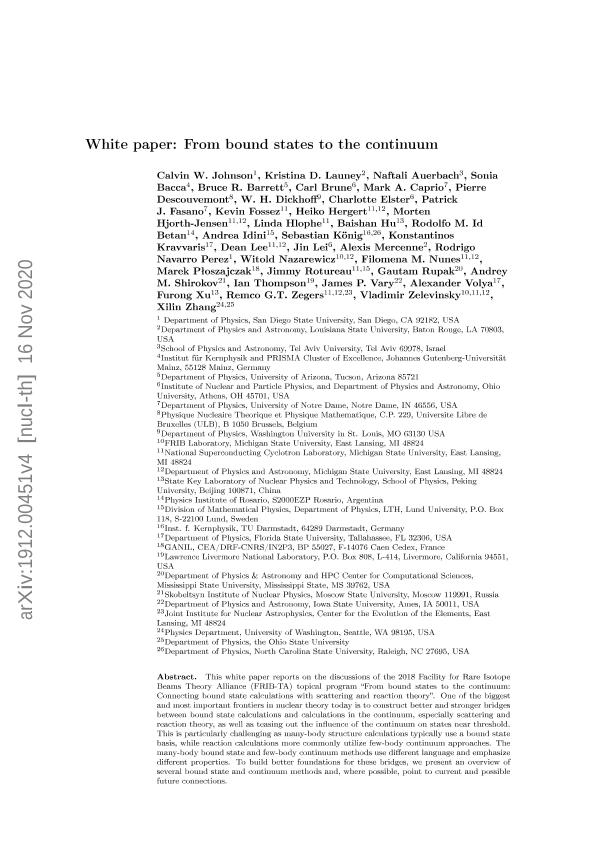
This white paper reports on the discussions of the 2018 Facility for Rare Isotope Beams Theory Alliance (FRIB-TA) topical program ‘From bound states to the continuum: Connecting bound state calculations with scattering and reaction theory’. One of the biggest and most important frontiers in nuclear theory today is to construct better and stronger bridges between bound state calculations and calculations in the continuum, especially scattering and reaction theory, as well as teasing out the influence of the continuum on states near threshold. This is particularly challenging as many-body structure calculations typically use a bound state basis, while reaction calculations more commonly utilize few-body continuum approaches. The many-body bound state and few-body continuum methods use different language and emphasize different properties. To build better foundations for these bridges, we present an overview of several bound state and continuum methods and, where possible, point to current and possible future connections.
Palabras clave:
FEW-BODY SYSTEMS
,
NUCLEAR STRUCTURE
,
REACTIONS
Archivos asociados

Tamaño:
3.358Mb
Formato:
PDF
Licencia
 Excepto donde se diga explícitamente, este item se publica bajo la siguiente descripción:
Atribución-NoComercial-SinDerivadas 2.5 Argentina (CC BY-NC-ND 2.5 AR)
Excepto donde se diga explícitamente, este item se publica bajo la siguiente descripción:
Atribución-NoComercial-SinDerivadas 2.5 Argentina (CC BY-NC-ND 2.5 AR)
Identificadores
Colecciones
Articulos(IFIR)
Articulos de INST.DE FISICA DE ROSARIO (I)
Articulos de INST.DE FISICA DE ROSARIO (I)
Citación
Johnson, Calvin W.; Launey, Kristina D.; Auerbach, Naftali; Bacca, Sonia; Barrett, Bruce R.; et al.; White paper: from bound states to the continuum; IOP Publishing; Journal Of Physics G-nuclear And Particle Physics; 47; 12; 12-2020; 1-48
Compartir


Altmétricas