Artículo
Changes in planktonic and sediment bacterial communities under the highly regulated dam in the mid-part of the Three Gorges Reservoir

Fecha de publicación:
01/2021
Editorial:
Springer
Revista:
Applied Microbiology and Biotechnology
ISSN:
0175-7598
Idioma:
Inglés
Tipo de recurso:
Artículo publicado
Clasificación temática:
Resumen
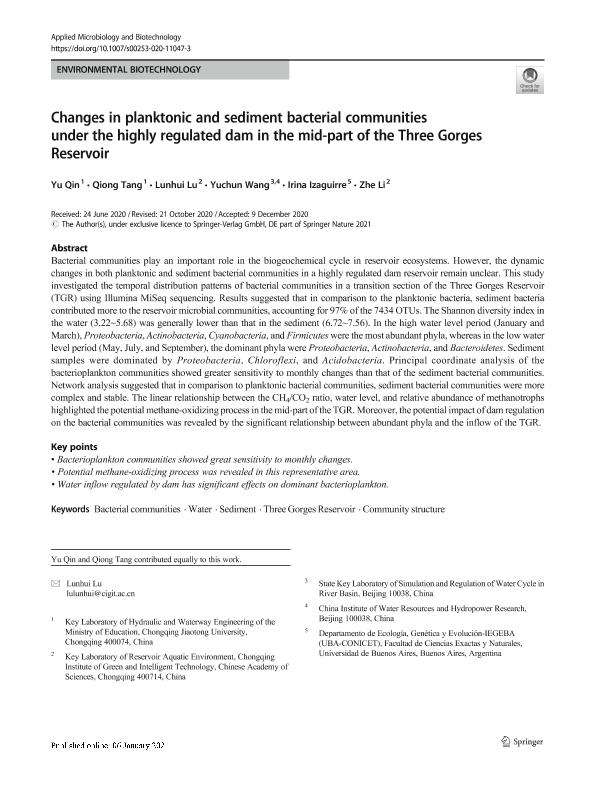
Bacterial communities play an important role in the biogeochemical cycle in reservoir ecosystems. However, the dynamic changes in both planktonic and sediment bacterial communities in a highly regulated dam reservoir remain unclear. This study investigated the temporal distribution patterns of bacterial communities in a transition section of the Three Gorges Reservoir (TGR) using Illumina MiSeq sequencing. Results suggested that in comparison to the planktonic bacteria, sediment bacteria contributed more to the reservoir microbial communities, accounting for 97% of the 7434 OTUs. The Shannon diversity index in the water (3.22~5.68) was generally lower than that in the sediment (6.72~7.56). In the high water level period (January and March), Proteobacteria, Actinobacteria, Cyanobacteria, and Firmicutes were the most abundant phyla, whereas in the low water level period (May, July, and September), the dominant phyla were Proteobacteria, Actinobacteria, and Bacteroidetes. Sediment samples were dominated by Proteobacteria, Chloroflexi, and Acidobacteria. Principal coordinate analysis of the bacterioplankton communities showed greater sensitivity to monthly changes than that of the sediment bacterial communities. Network analysis suggested that in comparison to planktonic bacterial communities, sediment bacterial communities were more complex and stable. The linear relationship between the CH4/CO2 ratio, water level, and relative abundance of methanotrophs highlighted the potential methane-oxidizing process in the mid-part of the TGR. Moreover, the potential impact of dam regulation on the bacterial communities was revealed by the significant relationship between abundant phyla and the inflow of the TGR.
Archivos asociados

Tamaño:
1.838Mb
Formato:
PDF
Licencia
 Excepto donde se diga explícitamente, este item se publica bajo la siguiente descripción:
Creative Commons Attribution-NonCommercial-ShareAlike 2.5 Unported (CC BY-NC-SA 2.5)
Excepto donde se diga explícitamente, este item se publica bajo la siguiente descripción:
Creative Commons Attribution-NonCommercial-ShareAlike 2.5 Unported (CC BY-NC-SA 2.5)
Identificadores
Colecciones
Articulos(IEGEBA)
Articulos de INSTITUTO DE ECOLOGIA, GENETICA Y EVOLUCION DE BS. AS
Articulos de INSTITUTO DE ECOLOGIA, GENETICA Y EVOLUCION DE BS. AS
Citación
Qin, Yu; Tang, Qiong; Lu, Lunhui; Wang, Yuchun; Izaguirre, Irina; et al.; Changes in planktonic and sediment bacterial communities under the highly regulated dam in the mid-part of the Three Gorges Reservoir; Springer; Applied Microbiology and Biotechnology; 105; 2; 1-2021; 839-852
Compartir


Altmétricas