Mostrar el registro sencillo del ítem
dc.contributor.author
del Mármol, Mariana
dc.date.available
2022-12-15T16:14:28Z
dc.date.issued
2020-02
dc.identifier.citation
del Mármol, Mariana; Afecto, emoción e intensidad en la formación de cuerpos para la actuación; Universitat Autònoma de Barcelona; Athenea Digital; 20; 1; 2-2020; 1-28
dc.identifier.issn
2014-4539
dc.identifier.uri
http://hdl.handle.net/11336/181348
dc.description.abstract
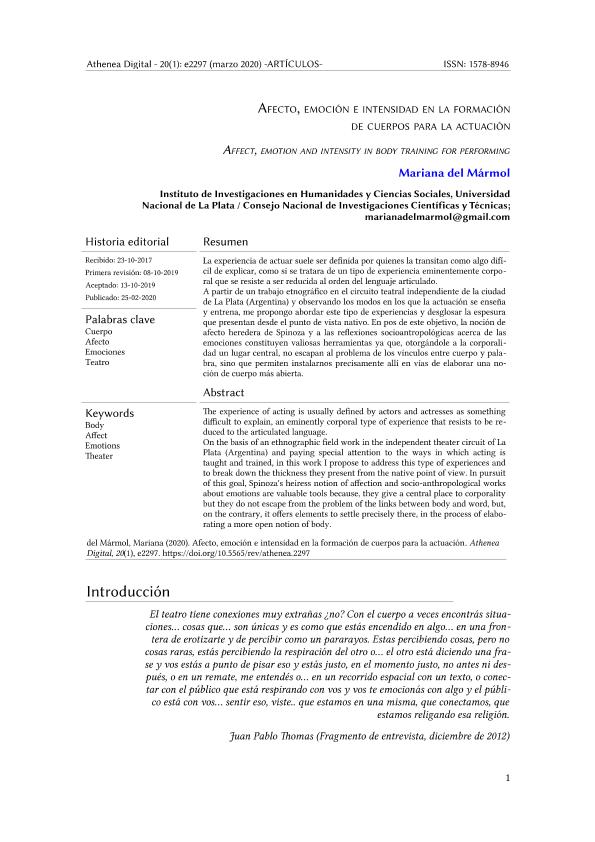
La experiencia de actuar suele ser definida por quienes la transitan como algo difícil de explicar, como si se tratara de un tipo de experiencia eminentemente corporal que se resiste a ser reducida al orden del lenguaje articulado. A partir de un trabajo etnográfico en el circuito teatral independiente de la ciudad de La Plata (Argentina) y observando los modos en los que la actuación se enseña y entrena, me propongo abordar este tipo de experiencias y desglosar la espesura que presentan desde el punto de vista nativo. En pos de este objetivo, la noción de afecto heredera de Spinoza y a las reflexiones socioantropológicas acerca de las emociones constituyen valiosas herramientas ya que, otorgándole a la corporalidad un lugar central, no escapan al problema de los vínculos entre cuerpo y palabra, sino que permiten instalarnos precisamente allí en vías de elaborar una noción de cuerpo más abierta.
dc.description.abstract
The experience of acting is usually defined by actors and actresses as something difficult to explain, an eminently corporal type of experience that resists to be reduced to the articulated language. On the basis of an ethnographic field work in the independent theater circuit of La Plata (Argentina) and paying special attention to the ways in which acting is taught and trained, in this work I propose to address this type of experiences and to break down the thickness they present from the native point of view. In pursuit of this goal, Spinoza's heiress notion of affection and socio-anthropological works about emotions are valuable tools because, they give a central place to corporality but they do not escape from the problem of the links between body and word, but, on the contrary, it offers elements to settle precisely there, in the process of elaborating a more open notion of body.
dc.format
application/pdf
dc.language.iso
spa
dc.publisher
Universitat Autònoma de Barcelona
dc.rights
info:eu-repo/semantics/openAccess
dc.rights.uri
https://creativecommons.org/licenses/by/2.5/ar/
dc.subject
CUERPO
dc.subject
AFECTO
dc.subject
EMOCIONES
dc.subject
TEATRO
dc.subject.classification
Otras Humanidades
dc.subject.classification
Otras Humanidades
dc.subject.classification
HUMANIDADES
dc.title
Afecto, emoción e intensidad en la formación de cuerpos para la actuación
dc.title
Affect, emotion and intensity in body training for performing
dc.type
info:eu-repo/semantics/article
dc.type
info:ar-repo/semantics/artículo
dc.type
info:eu-repo/semantics/publishedVersion
dc.date.updated
2022-12-14T13:14:31Z
dc.identifier.eissn
1578-8946
dc.journal.volume
20
dc.journal.number
1
dc.journal.pagination
1-28
dc.journal.pais
España
dc.journal.ciudad
Barcelona
dc.description.fil
Fil: del Mármol, Mariana. Consejo Nacional de Investigaciones Científicas y Técnicas. Centro Científico Tecnológico Conicet - La Plata. Instituto de Investigaciones en Humanidades y Ciencias Sociales. Universidad Nacional de La Plata. Facultad de Humanidades y Ciencias de la Educación. Instituto de Investigaciones en Humanidades y Ciencias Sociales; Argentina
dc.journal.title
Athenea Digital
dc.relation.alternativeid
info:eu-repo/semantics/altIdentifier/url/https://atheneadigital.net/article/view/v20-1-del-marmol
dc.relation.alternativeid
info:eu-repo/semantics/altIdentifier/doi/http://dx.doi.org/10.5565/rev/athenea.2297
Archivos asociados

Tamaño:
202.6Kb
Formato:
PDF