Artículo
Relational mechanics as a gauge theory

Fecha de publicación:
02/2016
Editorial:
Springer/plenum Publishers
Revista:
General Relativity And Gravitation
ISSN:
0001-7701
Idioma:
Inglés
Tipo de recurso:
Artículo publicado
Clasificación temática:
Resumen
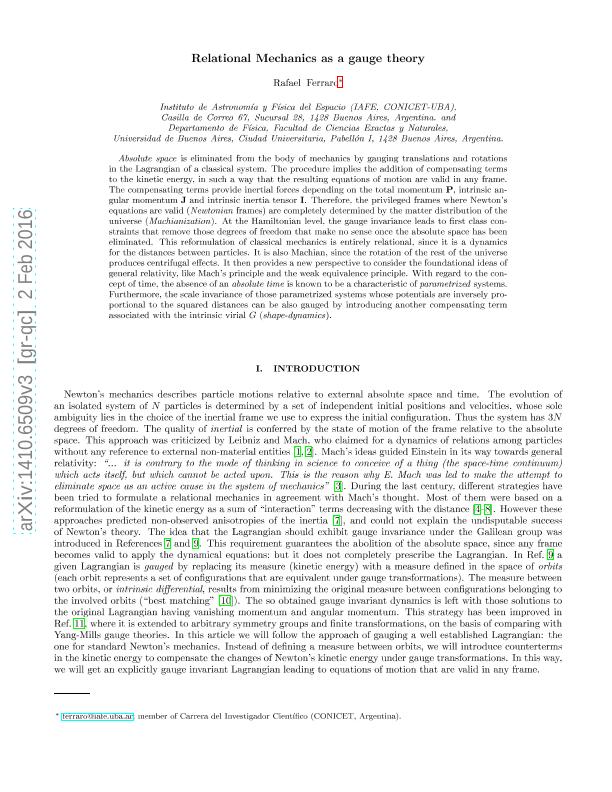
Absolute space is eliminated from the body of mechanics by gauging translations and rotations in the Lagrangian of a classical system. The procedure implies the addition of compensating terms to the kinetic energy, in such a way that the resulting equations of motion are valid in any frame. The compensating terms provide inertial forces depending on the total momentum P, intrinsic angular momentum J and intrinsic inertia tensor I. Therefore, the privileged frames where Newton?s equations are valid (Newtonian frames) are completely determined by the matter distribution of the universe (Machianization). At the Hamiltonian level, the gauge invariance leads to first class constraints that remove those degrees of freedom that make no sense once the absolute space has been eliminated. This reformulation of classical mechanics is entirely relational, since it is a dynamics for the distances between particles. It is also Machian, since the rotation of the rest of the universe produces centrifugal effects. It then provides a new perspective to consider the foundational ideas of general relativity, like Mach?s principle and the weak equivalence principle. With regard to the concept of time, the absence of an absolute time is known to be a characteristic of parametrized systems. Furthermore, the scale invariance of those parametrized systems whose potentials are inversely proportional to the squared distances can be also gauged by introducing another compensating term associated with the intrinsic virial G (shape-dynamics).
Palabras clave:
Classical Mechanics
,
Gauge Theories
Archivos asociados

Tamaño:
282.8Kb
Formato:
PDF
Licencia
 Excepto donde se diga explícitamente, este item se publica bajo la siguiente descripción:
Creative Commons Attribution-NonCommercial-ShareAlike 2.5 Unported (CC BY-NC-SA 2.5)
Excepto donde se diga explícitamente, este item se publica bajo la siguiente descripción:
Creative Commons Attribution-NonCommercial-ShareAlike 2.5 Unported (CC BY-NC-SA 2.5)
Identificadores
Colecciones
Articulos(IAFE)
Articulos de INST.DE ASTRONOMIA Y FISICA DEL ESPACIO(I)
Articulos de INST.DE ASTRONOMIA Y FISICA DEL ESPACIO(I)
Citación
Ferraro, Rafael; Relational mechanics as a gauge theory; Springer/plenum Publishers; General Relativity And Gravitation; 48; 23; 2-2016; 1-22
Compartir


Altmétricas