Artículo
Sustainable pome fruit production in Patagonia, Argentina

Fecha de publicación:
12/2016
Editorial:
University of Tuzla
Revista:
Technologica Acta
ISSN:
1840-0426
e-ISSN:
2232-7568
Idioma:
Inglés
Tipo de recurso:
Artículo publicado
Clasificación temática:
Resumen
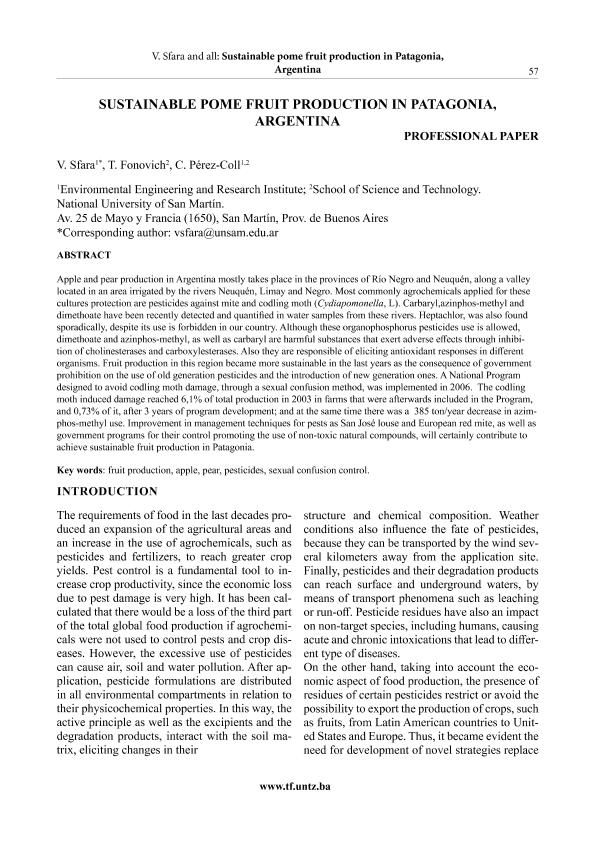
Apple and pear production in Argentina mostly takes place in the provinces of Río Negro and Neuquén, along a valley located in an area irrigated by the rivers Neuquén, Limay and Negro. Most commonly agrochemicals applied for these cultures protection are pesticides against mite and codling moth (Cydiapomonella, L). Carbaryl,azinphos-methyl and dimethoate have been recently detected and quantified in water samples from these rivers. Heptachlor, was also found sporadically, despite its use is forbidden in our country. Although these organophosphorus pesticides use is allowed, dimethoate and azinphos-methyl, as well as carbaryl are harmful substances that exert adverse effects through inhibition of cholinesterases and carboxylesterases. Also they are responsible of eliciting antioxidant responses in different organisms. Fruit production in this region became more sustainable in the last years as the consequence of government prohibition on the use of old generation pesticides and the introduction of new generation ones. A National Program designed to avoid codling moth damage, through a sexual confusion method, was implemented in 2006. The codling moth induced damage reached 6,1% of total production in 2003 in farms that were afterwards included in the Program, and 0,73% of it, after 3 years of program development; and at the same time there was a 385 ton/year decrease in azimphos-methyl use. Improvement in management techniques for pests as San José louse and European red mite, as well as government programs for their control promoting the use of non-toxic natural compounds, will certainly contribute to achieve sustainable fruit production in Patagonia.
Palabras clave:
SUSTAINABLE MANAGEMENT
,
FRUIT PRODUCTION
,
PATAGONIA
Archivos asociados

Tamaño:
394.2Kb
Formato:
PDF
Licencia
 Excepto donde se diga explícitamente, este item se publica bajo la siguiente descripción:
Creative Commons Attribution 2.5 Unported (CC BY 2.5)
Excepto donde se diga explícitamente, este item se publica bajo la siguiente descripción:
Creative Commons Attribution 2.5 Unported (CC BY 2.5)
Identificadores
Colecciones
Articulos(SEDE CENTRAL)
Articulos de SEDE CENTRAL
Articulos de SEDE CENTRAL
Citación
Sfara, Valeria; Fonovich, Teresa Mabel; Perez Coll, Cristina Silvia; Sustainable pome fruit production in Patagonia, Argentina; University of Tuzla; Technologica Acta; 9; 2; 12-2016; 57-61
Compartir

