Artículo
Kinship and Phenotypic Divergence in the Ancient Population of the Puna Plateau of Northwestern Argentina

Fecha de publicación:
02/2016
Editorial:
Scientific Research Publishing
Revista:
Advances in Anthropology
ISSN:
2163-9361
Idioma:
Inglés
Tipo de recurso:
Artículo publicado
Clasificación temática:
Resumen
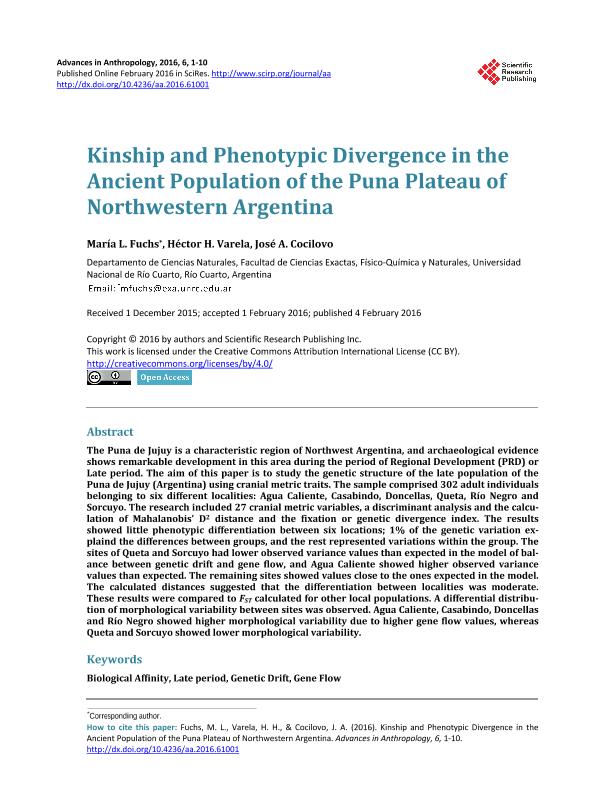
The Puna de Jujuy is a characteristic region of Northwest Argentina, and archaeological evidence shows remarkable development in this area during the period of Regional Development (PRD) or Late period. The aim of this paper is to study the genetic structure of the late population of the Puna de Jujuy (Argentina) using cranial metric traits. The sample comprised 302 adult individuals belonging to six different localities: Agua Caliente, Casabindo, Doncellas, Queta, Río Negro and Sorcuyo. The research included 27 cranial metric variables, a discriminant analysis and the calculation of Mahalanobis? D2 distance and the fixation or genetic divergence index. The results showed little phenotypic differentiation between six locations; 1% of the genetic variation explains the differences between groups, and the rest represents variations within the group. The sites of Queta and Sorcuyo have lower observed variance values than expected in the model of balance between genetic drift and gene flow, and Agua Caliente showed higher observed variance values than expected. The remaining sites showed values close to the ones expected in the model. The calculated distances suggest that the differentiation between localities is moderate. These results are compared to FST calculated for other local populations. A differential distribution of morphological variability between sites was observed. Agua Caliente, Casabindo, Doncellas and Río Negro showed higher morphological variability due to higher gene flow values, whereas Queta and Sorcuyo showed lower morphological variability.
Palabras clave:
BIOLOGICAL AFFINITY
,
LATE PERIOD
,
GENETIC DRIFT
,
GENE FLOW
Archivos asociados

Tamaño:
745.5Kb
Formato:
PDF
Licencia
 Excepto donde se diga explícitamente, este item se publica bajo la siguiente descripción:
Creative Commons Attribution 2.5 Unported (CC BY 2.5)
Excepto donde se diga explícitamente, este item se publica bajo la siguiente descripción:
Creative Commons Attribution 2.5 Unported (CC BY 2.5)
Identificadores
Colecciones
Articulos(CCT - CORDOBA)
Articulos de CTRO.CIENTIFICO TECNOL.CONICET - CORDOBA
Articulos de CTRO.CIENTIFICO TECNOL.CONICET - CORDOBA
Citación
Fuchs, Maria Laura; Varela, Hector Hugo; Cocilovo, Jose Alberto; Kinship and Phenotypic Divergence in the Ancient Population of the Puna Plateau of Northwestern Argentina; Scientific Research Publishing; Advances in Anthropology; 6; 2-2016; 1-10
Compartir


Altmétricas