Artículo
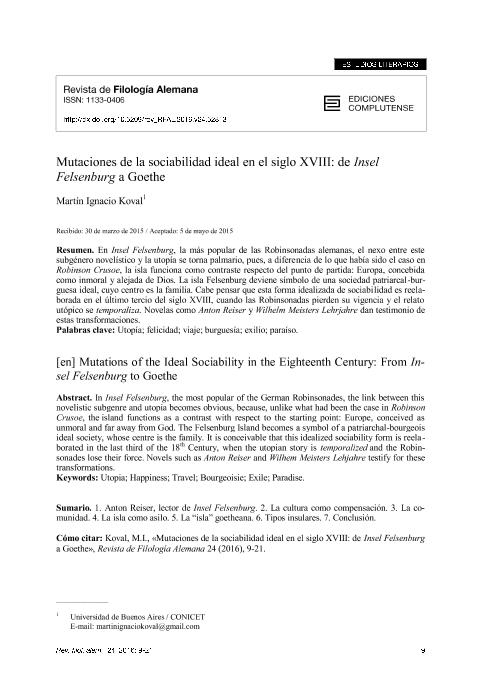
En Insel Felsenburg, la más popular de las robinsoniadas alemanas, el nexo entre este subgénero novelístico y la utopía se torna palmario, pues, a diferencia de lo que había sido el caso en Robinson Crusoe, la isla funciona como contraste respecto del punto de partida: Europa, concebida como inmoral y alejada de Dios. La isla Felsenburg deviene símbolo de una sociedad patriarcal-burguesa ideal, cuyo centro es la familia. Cabe pensar que esta forma idealizada de sociabilidad es reelaborada en el último tercio del siglo XVIII, cuando las robinsoniadas pierden su vigencia y el relato utópico se temporaliza. Novelas como Anton Reiser y Wilhelm Meisters Lehrjahre dan testimonio de estas transformaciones. In Insel Felsenburg, the most popular of the German Robinsonades, the link between this novelistic subgenre and utopia becomes obvious, because, unlike what had been the case in Robinson Crusoe, the island functions as a contrast with respect to the starting point: Europe, conceived as unmoral and far away from God. The Felsenburg Island becomes a symbol of a patriarchal-bourgeois ideal society, whose centre is the family. It is conceivable that this idealized sociability form is reelaborated in the last third of the 18th Century, when the utopian story is temporalized and the Robinsonades lose their force. Novels such as Anton Reiser and Wilhem Meisters Lehjahre testify for these transformations.
Mutaciones de la sociabilidad ideal en el siglo XVIII: de Insel Felsenburg a Goethe
Título:
Mutations of the Ideal Sociability in the Eighteenth Century: From Insel Felsenburg to Goethe

Fecha de publicación:
11/2016
Editorial:
Universidad Complutense de Madrid
Revista:
Revista de Filología Alemana
ISSN:
1133-0406
Idioma:
Español
Tipo de recurso:
Artículo publicado
Clasificación temática:
Resumen
Palabras clave:
UTOPÍA
,
VIAJE
,
SIGLO XVIII
,
BILDUNG
Archivos asociados

Tamaño:
212.6Kb
Formato:
PDF
Licencia
 Excepto donde se diga explícitamente, este item se publica bajo la siguiente descripción:
Creative Commons Attribution 2.5 Unported (CC BY 2.5)
Excepto donde se diga explícitamente, este item se publica bajo la siguiente descripción:
Creative Commons Attribution 2.5 Unported (CC BY 2.5)
Identificadores
Colecciones
Articulos(SEDE CENTRAL)
Articulos de SEDE CENTRAL
Articulos de SEDE CENTRAL
Citación
Koval, Martín Ignacio; Mutaciones de la sociabilidad ideal en el siglo XVIII: de Insel Felsenburg a Goethe; Universidad Complutense de Madrid; Revista de Filología Alemana; 24; 11-2016; 9-21
Compartir

