Mostrar el registro sencillo del ítem
dc.contributor.author
Angeloni, Patricia Norma
dc.contributor.author
Echarte, Maria Mercedes
dc.contributor.author
Pereyra Irujo, Gustavo Adrian
dc.contributor.author
Izquierdo, Natalia Gabriela
dc.contributor.author
Aguirrezábal, Luis Adolfo Nazareno
dc.date.available
2022-11-24T11:19:55Z
dc.date.issued
2017-02
dc.identifier.citation
Angeloni, Patricia Norma; Echarte, Maria Mercedes; Pereyra Irujo, Gustavo Adrian; Izquierdo, Natalia Gabriela; Aguirrezábal, Luis Adolfo Nazareno; Fatty acid composition of high oleic sunflower hybrids in a changing environment; Elsevier Science; Field Crops Research; 202; 2-2017; 146-157
dc.identifier.issn
0378-4290
dc.identifier.uri
http://hdl.handle.net/11336/178761
dc.description.abstract
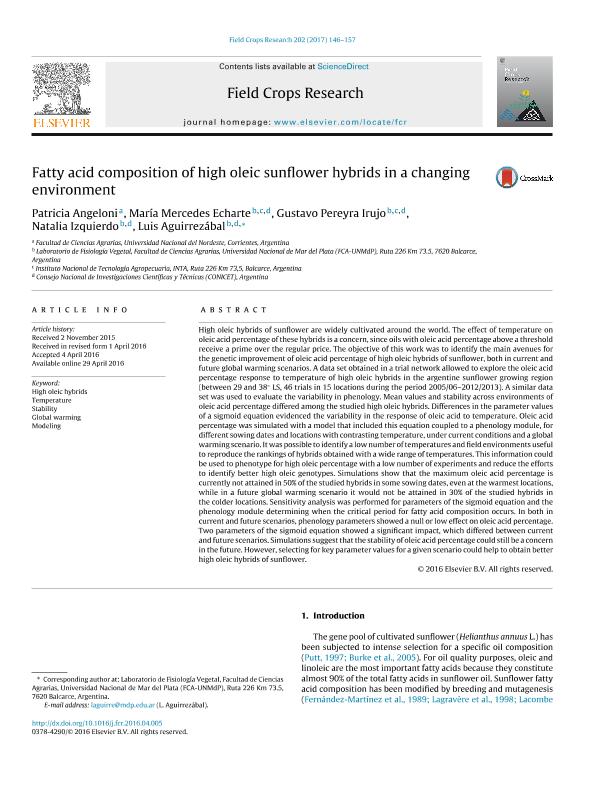
High oleic hybrids of sunflower are widely cultivated around the world. The effect of temperature on oleic acid percentage of these hybrids is a concern, since oils with oleic acid percentage above a threshold receive a prime over the regular price. The objective of this work was to identify the main avenues for the genetic improvement of oleic acid percentage of high oleic hybrids of sunflower, both in current and future global warming scenarios. A data set obtained in a trial network allowed to explore the oleic acid percentage response to temperature of high oleic hybrids in the argentine sunflower growing region (between 29 and 38° LS, 46 trials in 15 locations during the period 2005/06–2012/2013). A similar data set was used to evaluate the variability in phenology. Mean values and stability across environments of oleic acid percentage differed among the studied high oleic hybrids. Differences in the parameter values of a sigmoid equation evidenced the variability in the response of oleic acid to temperature. Oleic acid percentage was simulated with a model that included this equation coupled to a phenology module, for different sowing dates and locations with contrasting temperature, under current conditions and a global warming scenario. It was possible to identify a low number of temperatures and field environments useful to reproduce the rankings of hybrids obtained with a wide range of temperatures. This information could be used to phenotype for high oleic percentage with a low number of experiments and reduce the efforts to identify better high oleic genotypes. Simulations show that the maximum oleic acid percentage is currently not attained in 50% of the studied hybrids in some sowing dates, even at the warmest locations, while in a future global warming scenario it would not be attained in 30% of the studied hybrids in the colder locations. Sensitivity analysis was performed for parameters of the sigmoid equation and the phenology module determining when the critical period for fatty acid composition occurs. In both in current and future scenarios, phenology parameters showed a null or low effect on oleic acid percentage. Two parameters of the sigmoid equation showed a significant impact, which differed between current and future scenarios. Simulations suggest that the stability of oleic acid percentage could still be a concern in the future. However, selecting for key parameter values for a given scenario could help to obtain better high oleic hybrids of sunflower.
dc.format
application/pdf
dc.language.iso
eng
dc.publisher
Elsevier Science
dc.rights
info:eu-repo/semantics/openAccess
dc.rights.uri
https://creativecommons.org/licenses/by-nc-sa/2.5/ar/
dc.subject
GLOBAL WARMING
dc.subject
HIGH OLEIC HYBRIDS
dc.subject
MODELING
dc.subject
STABILITY
dc.subject
TEMPERATURE
dc.subject.classification
Agronomía, reproducción y protección de plantas
dc.subject.classification
Agricultura, Silvicultura y Pesca
dc.subject.classification
CIENCIAS AGRÍCOLAS
dc.title
Fatty acid composition of high oleic sunflower hybrids in a changing environment
dc.type
info:eu-repo/semantics/article
dc.type
info:ar-repo/semantics/artículo
dc.type
info:eu-repo/semantics/publishedVersion
dc.date.updated
2022-11-23T18:01:25Z
dc.journal.volume
202
dc.journal.pagination
146-157
dc.journal.pais
Países Bajos
dc.journal.ciudad
Amsterdam
dc.description.fil
Fil: Angeloni, Patricia Norma. Universidad Nacional del Nordeste; Argentina
dc.description.fil
Fil: Echarte, Maria Mercedes. Universidad Nacional de Mar del Plata; Argentina. Instituto Nacional de Tecnología Agropecuaria. Centro Regional Buenos Aires; Argentina. Consejo Nacional de Investigaciones Científicas y Técnicas. Centro Científico Tecnológico Conicet - Mar del Plata; Argentina
dc.description.fil
Fil: Pereyra Irujo, Gustavo Adrian. Universidad Nacional de Mar del Plata; Argentina. Consejo Nacional de Investigaciones Científicas y Técnicas. Centro Científico Tecnológico Conicet - Mar del Plata; Argentina. Instituto Nacional de Tecnología Agropecuaria. Centro Regional Buenos Aires; Argentina
dc.description.fil
Fil: Izquierdo, Natalia Gabriela. Consejo Nacional de Investigaciones Científicas y Técnicas. Centro Científico Tecnológico Conicet - Mar del Plata; Argentina. Universidad Nacional de Mar del Plata; Argentina
dc.description.fil
Fil: Aguirrezábal, Luis Adolfo Nazareno. Universidad Nacional de Mar del Plata; Argentina. Consejo Nacional de Investigaciones Científicas y Técnicas. Centro Científico Tecnológico Conicet - Mar del Plata; Argentina
dc.journal.title
Field Crops Research
dc.relation.alternativeid
info:eu-repo/semantics/altIdentifier/url/http://www.sciencedirect.com/science/article/pii/S0378429016300892
dc.relation.alternativeid
info:eu-repo/semantics/altIdentifier/doi/http://dx.doi.org/10.1016/j.fcr.2016.04.005
Archivos asociados

Tamaño:
743.1Kb
Formato:
PDF