Artículo
Radio emission from Supernova Remnants

Fecha de publicación:
16/09/2015
Editorial:
Springer
Revista:
Astronomy And Astrophysics Review
ISSN:
0935-4956
Idioma:
Inglés
Tipo de recurso:
Artículo publicado
Clasificación temática:
Resumen
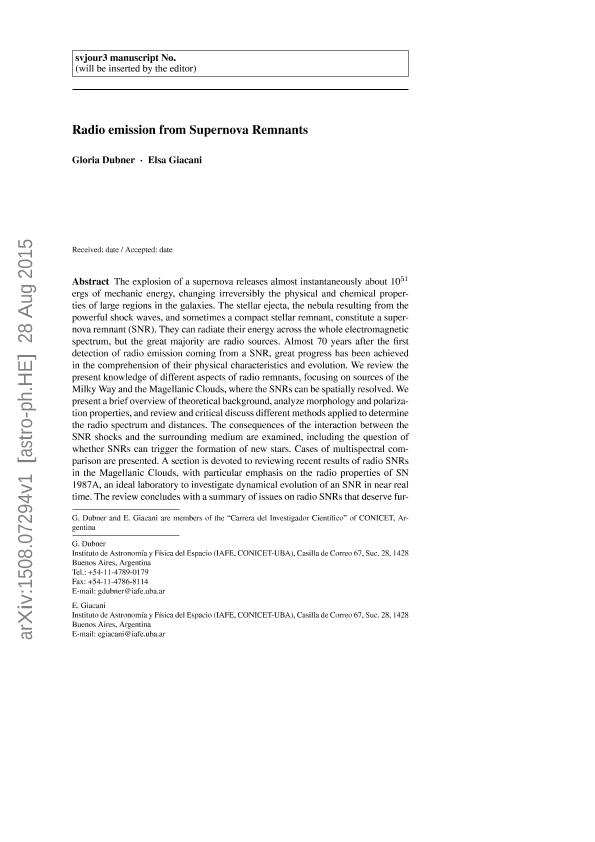
The explosion of a supernova releases almost instantaneously about 10^51ergs of mechanic energy, changing irreversibly the physical and chemical proper- ties of large regions in the galaxies. The stellar ejecta, the nebula resulting from the powerful shock waves, and sometimes a compact stellar remnant, constitute a super- nova remnant (SNR). They can radiate their energy across the whole electromagnetic spectrum, but the great majority are radio sources. Almost 70 years after the first detection of radio emission coming from a SNR, great progress has been achieved in the comprehension of their physical characteristics and evolution. We review the present knowledge of different aspects of radio remnants, focusing on sources of the Milky Way and the Magellanic Clouds, where the SNRs can be spatially resolved. We present a brief overview of theoretical background, analyze morphology and polariza- tion properties, and review and critical discuss different methods applied to determine the radio spectrum and distances. The consequences of the interaction between the SNR shocks and the surrounding medium are examined, including the question of whether SNRs can trigger the formation of new stars. Cases of multispectral com- parison are presented. A section is devoted to reviewing recent results of radio SNRs in the Magellanic Clouds, with particular emphasis on the radio properties of SN 1987A, an ideal laboratory to investigate dynamical evolution of an SNR in near real time. The review concludes with a summary of issues on radio SNRs that deserve further study, and analyzing the prospects for future research with the latest generation radio telescopes.
Palabras clave:
Supernova Remnants
,
Radio
Archivos asociados

Tamaño:
1.492Mb
Formato:
PDF
Licencia
 Excepto donde se diga explícitamente, este item se publica bajo la siguiente descripción:
Creative Commons Attribution-NonCommercial-ShareAlike 2.5 Unported (CC BY-NC-SA 2.5)
Excepto donde se diga explícitamente, este item se publica bajo la siguiente descripción:
Creative Commons Attribution-NonCommercial-ShareAlike 2.5 Unported (CC BY-NC-SA 2.5)
Identificadores
Colecciones
Articulos(IAFE)
Articulos de INST.DE ASTRONOMIA Y FISICA DEL ESPACIO(I)
Articulos de INST.DE ASTRONOMIA Y FISICA DEL ESPACIO(I)
Citación
Dubner, Gloria Mabel; Giacani, Elsa Beatriz; Radio emission from Supernova Remnants; Springer; Astronomy And Astrophysics Review; 23; 1; 16-9-2015; 3-52
Compartir

