Artículo
Inhibition of mTOR signaling impairs rat embryo organogenesis by affecting folate availability
Higa, Romina Daniela ; Rosario, Fredrick; Powell, Theresa; Jansson, Thomas; Jawerbaum, Alicia Sandra
; Rosario, Fredrick; Powell, Theresa; Jansson, Thomas; Jawerbaum, Alicia Sandra
Fecha de publicación:
04/2021
Editorial:
BioScientifica
Revista:
Reproduction
ISSN:
1470-1626
Idioma:
Inglés
Tipo de recurso:
Artículo publicado
Clasificación temática:
Resumen
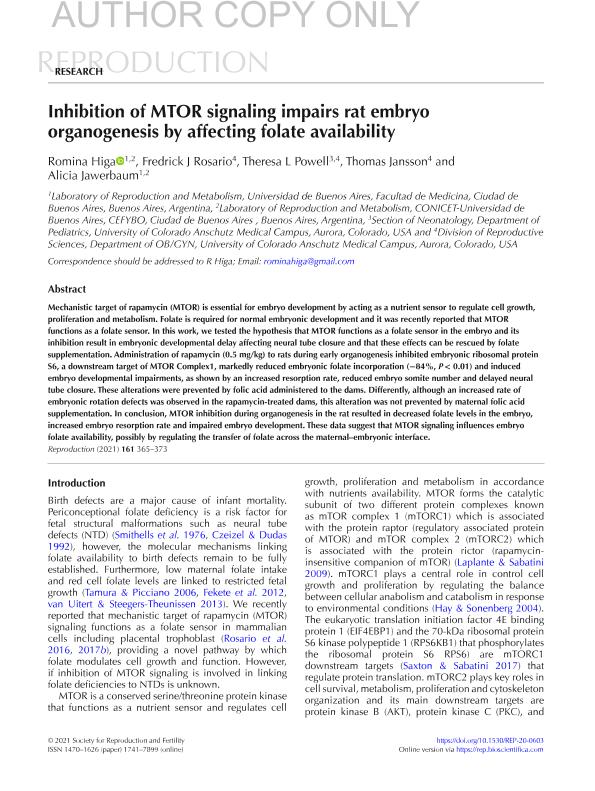
Mechanistic target of rapamycin (MTOR) is essential for embryo development by acting as a nutrient sensor to regulate cell growth, proliferation and metabolism. Folate is required for normal embryonic development and it was recently reported that MTOR functions as a folate sensor. In this work, we tested the hypothesis that MTOR functions as a folate sensor in the embryo and its inhibition result in embryonic developmental delay affecting neural tube closure and that these effects can be rescued by folate supplementation. Administration of rapamycin (0.5 mg/kg) to rats during early organogenesis inhibited embryonic ribosomal protein S6, a downstream target of MTOR Complex1, markedly reduced embryonic folate incorporation (−84%, P< 0.01) and induced embryo developmental impairments, as shown by an increased resorption rate, reduced embryo somite number and delayed neural tube closure. These alterations were prevented by folic acid administered to the dams. Differently, although an increased rate of embryonic rotation defects was observed in the rapamycin-treated dams, this alteration was not prevented by maternal folic acid supplementation. In conclusion, MTOR inhibition during organogenesis in the rat resulted in decreased folate levels in the embryo, increased embryo resorption rate and impaired embryo development. These data suggest that MTOR signaling influences embryo folate availability, possibly by regulating the transfer of folate across the maternal–embryonic interface.
Archivos asociados

Tamaño:
1.114Mb
Formato:
PDF
Licencia
 Excepto donde se diga explícitamente, este item se publica bajo la siguiente descripción:
Creative Commons Attribution-NonCommercial-ShareAlike 2.5 Unported (CC BY-NC-SA 2.5)
Excepto donde se diga explícitamente, este item se publica bajo la siguiente descripción:
Creative Commons Attribution-NonCommercial-ShareAlike 2.5 Unported (CC BY-NC-SA 2.5)
Identificadores
Colecciones
Articulos(CEFYBO)
Articulos de CENTRO DE ESTUDIOS FARMACOLOGICOS Y BOTANICOS
Articulos de CENTRO DE ESTUDIOS FARMACOLOGICOS Y BOTANICOS
Citación
Higa, Romina Daniela; Rosario, Fredrick; Powell, Theresa; Jansson, Thomas; Jawerbaum, Alicia Sandra; Inhibition of mTOR signaling impairs rat embryo organogenesis by affecting folate availability; BioScientifica; Reproduction; 161; 4; 4-2021; 365-373
Compartir


Altmétricas