Mostrar el registro sencillo del ítem
dc.contributor.author
Vlachos, Evangelos
dc.date.available
2022-10-27T19:53:05Z
dc.date.issued
2019-11
dc.identifier.citation
Vlachos, Evangelos; Introducing a new tool to navigate, understand and use International Codes of Nomenclature; PeerJ Inc.; PeerJ; 2019; 11; 11-2019; 1-17
dc.identifier.uri
http://hdl.handle.net/11336/175257
dc.description.abstract
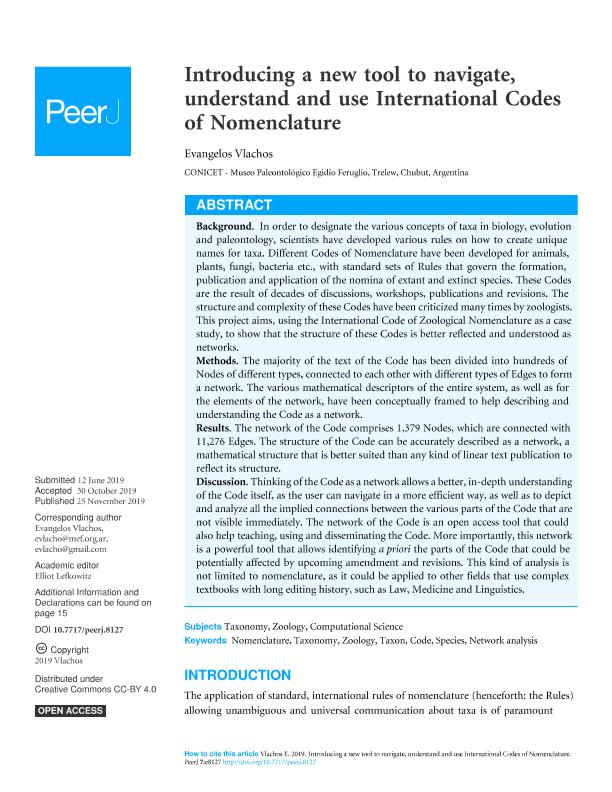
Background. In order to designate the various concepts of taxa in biology, evolution and paleontology, scientists have developed various rules on how to create unique names for taxa. Different Codes of Nomenclature have been developed for animals, plants, fungi, bacteria etc., with standard sets of Rules that govern the formation, publication and application of the nomina of extant and extinct species. These Codes are the result of decades of discussions, workshops, publications and revisions. The structure and complexity of these Codes have been criticized many times by zoologists. This project aims, using the International Code of Zoological Nomenclature as a case study, to show that the structure of these Codes is better reflected and understood as networks. Methods. The majority of the text of the Code has been divided into hundreds of Nodes of different types, connected to each other with different types of Edges to form a network. The various mathematical descriptors of the entire system, as well as for the elements of the network, have been conceptually framed to help describing and understanding the Code as a network. Results. The network of the Code comprises 1,379 Nodes, which are connected with 11,276 Edges. The structure of the Code can be accurately described as a network, a mathematical structure that is better suited than any kind of linear text publication to reflect its structure. Discussion. Thinking of the Code as a network allows a better, in-depth understanding of the Code itself, as the user can navigate in a more efficient way, as well as to depict and analyze all the implied connections between the various parts of the Code that are not visible immediately. The network of the Code is an open access tool that could also help teaching, using and disseminating the Code. More importantly, this network is a powerful tool that allows identifying a priori the parts of the Code that could be potentially affected by upcoming amendment and revisions. This kind of analysis is not limited to nomenclature, as it could be applied to other fields that use complex textbooks with long editing history, such as Law, Medicine and Linguistics.
dc.format
application/pdf
dc.language.iso
eng
dc.publisher
PeerJ Inc.
dc.rights
info:eu-repo/semantics/openAccess
dc.rights.uri
https://creativecommons.org/licenses/by/2.5/ar/
dc.subject
CODE
dc.subject
NETWORK ANALYSIS
dc.subject
NOMENCLATURE
dc.subject
SPECIES
dc.subject
TAXON
dc.subject
TAXONOMY
dc.subject
ZOOLOGY
dc.subject.classification
Zoología, Ornitología, Entomología, Etología
dc.subject.classification
Ciencias Biológicas
dc.subject.classification
CIENCIAS NATURALES Y EXACTAS
dc.title
Introducing a new tool to navigate, understand and use International Codes of Nomenclature
dc.type
info:eu-repo/semantics/article
dc.type
info:ar-repo/semantics/artículo
dc.type
info:eu-repo/semantics/publishedVersion
dc.date.updated
2022-10-27T10:19:45Z
dc.identifier.eissn
2167-8359
dc.journal.volume
2019
dc.journal.number
11
dc.journal.pagination
1-17
dc.journal.pais
Estados Unidos
dc.description.fil
Fil: Vlachos, Evangelos. Consejo Nacional de Investigaciones Científicas y Técnicas; Argentina. Museo Paleontológico Egidio Feruglio; Argentina
dc.journal.title
PeerJ
dc.relation.alternativeid
info:eu-repo/semantics/altIdentifier/url/https://peerj.com/articles/8127/
dc.relation.alternativeid
info:eu-repo/semantics/altIdentifier/doi/http://dx.doi.org/10.7717/peerj.8127
Archivos asociados

Tamaño:
27.02Mb
Formato:
PDF