Mostrar el registro sencillo del ítem
dc.contributor.author
Bidaseca, Karina Andrea
dc.date.available
2022-10-25T13:11:03Z
dc.date.issued
2019-06
dc.identifier.citation
Bidaseca, Karina Andrea; Ilse Fusková: el cuerpo como archivo; Universidad del Estado de Rio de Janeiro; Ékstasis; 8; 2; 6-2019; 112-133
dc.identifier.uri
http://hdl.handle.net/11336/174751
dc.description.abstract
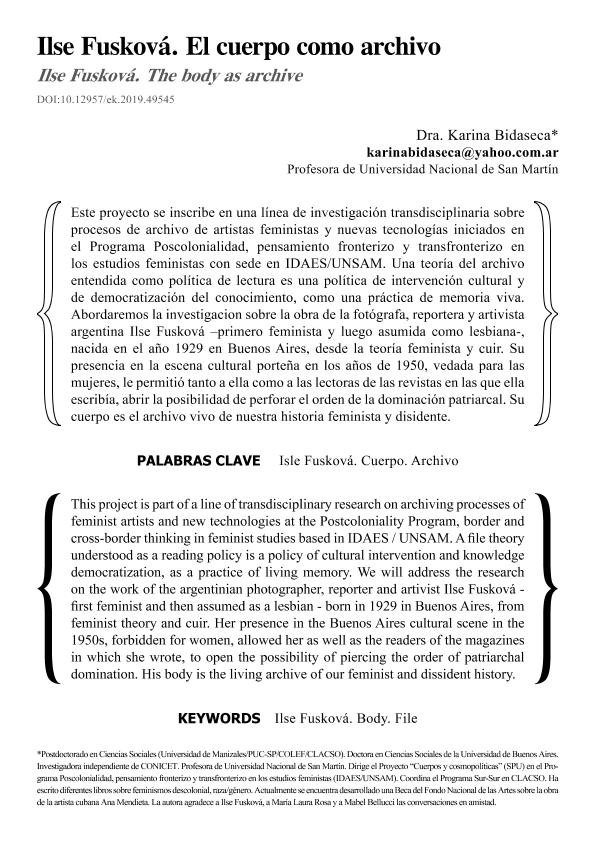
Este proyecto se inscribe en una línea de investigación transdisciplinaria sobre procesos de archivo de artistas feministas y nuevas tecnologías iniciados en el Programa Poscolonialidad, pensamiento fronterizo y transfronterizo en los estudios feministas con sede en IDAES/UNSAM. Una teoría del archivo entendida como política de lectura es una política de intervención cultural y de democratización del conocimiento, como una práctica de memoria viva. Abordaremos la investigacion sobre la obra de la fotógrafa, reportera y artivista argentina Ilse Fusková –primero feminista y luego asumida como lesbiana-, nacida en el año 1929 en Buenos Aires, desde la teoría feminista y cuir. Su presencia en la escena cultural porteña en los años de 1950, vedada para las mujeres, le permitió tanto a ella como a las lectoras de las revistas en las que ella escribía, abrir la posibilidad de perforar el orden de la dominación patriarcal. Su cuerpo es el archivo vivo de nuestra historia feminista y disidente.
dc.description.abstract
This project is part of a line of transdisciplinary research on archiving processes of feminist artists and new technologies at the Postcoloniality Program, border and cross-border thinking in feminist studies based in IDAES / UNSAM. A file theory understood as a reading policy is a policy of cultural intervention and knowledge democratization, as a practice of living memory. We will address the research on the work of the argentinian photographer, reporter and artivist Ilse Fusková - first feminist and then assumed as a lesbian - born in 1929 in Buenos Aires, from feminist theory and cuir. Her presence in the Buenos Aires cultural scene in the 1950s, forbidden for women, allowed her as well as the readers of the magazines in which she wrote, to open the possibility of piercing the order of patriarchal domination. His body is the living archive of our feminist and dissident history.
dc.format
application/pdf
dc.language.iso
spa
dc.publisher
Universidad del Estado de Rio de Janeiro
dc.rights
info:eu-repo/semantics/openAccess
dc.rights.uri
https://creativecommons.org/licenses/by-nc-sa/2.5/ar/
dc.subject
CUERPOS Y CORPORALIDADES
dc.subject
TEORÍA FEMINISTA
dc.subject
CUIR
dc.subject
DISIDENCIAS
dc.subject.classification
Ciencias Sociales Interdisciplinarias
dc.subject.classification
Otras Ciencias Sociales
dc.subject.classification
CIENCIAS SOCIALES
dc.title
Ilse Fusková: el cuerpo como archivo
dc.title
Ilse Fusková: the body as archive
dc.type
info:eu-repo/semantics/article
dc.type
info:ar-repo/semantics/artículo
dc.type
info:eu-repo/semantics/publishedVersion
dc.date.updated
2022-10-24T17:33:45Z
dc.identifier.eissn
2316-4786
dc.journal.volume
8
dc.journal.number
2
dc.journal.pagination
112-133
dc.journal.pais
Brasil
dc.journal.ciudad
Rio de Janeiro
dc.description.fil
Fil: Bidaseca, Karina Andrea. Consejo Nacional de Investigaciones Científicas y Técnicas; Argentina. Universidad Nacional de San Martín. Instituto de Altos Estudios Sociales; Argentina
dc.journal.title
Ékstasis
dc.relation.alternativeid
info:eu-repo/semantics/altIdentifier/url/https://www.e-publicacoes.uerj.br/index.php/Ekstasis/article/view/49545
dc.relation.alternativeid
info:eu-repo/semantics/altIdentifier/doi/http://dx.doi.org/10.12957/ek.2019.49545
Archivos asociados

Tamaño:
671.2Kb
Formato:
PDF