Artículo
Quantum coherence enfeebled by classical uncertainties

Fecha de publicación:
12/2020
Editorial:
American Physical Society
Revista:
Physical Review Research
ISSN:
2643-1564
Idioma:
Inglés
Tipo de recurso:
Artículo publicado
Clasificación temática:
Resumen
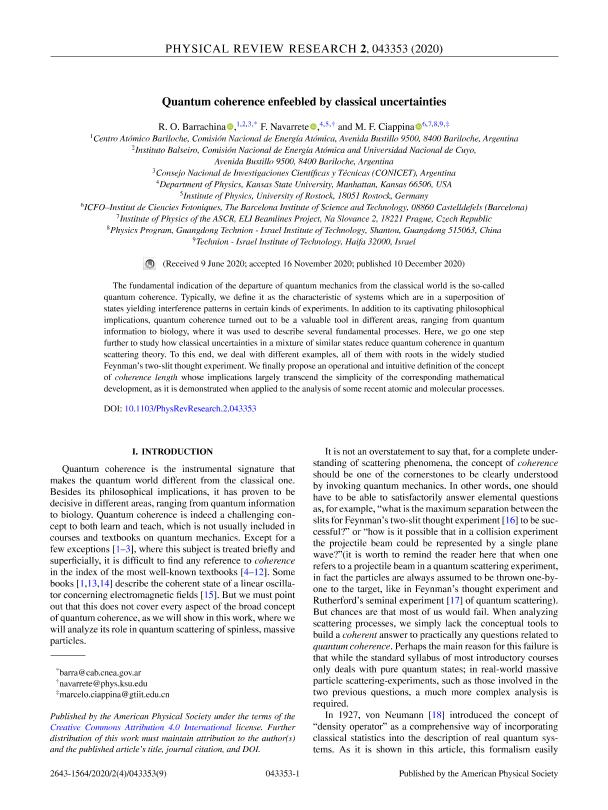
The fundamental indication of the departure of quantum mechanics from the classical world is the so-called quantum coherence. Typically, we define it as the characteristic of systems which are in a superposition of states yielding interference patterns in certain kinds of experiments. In addition to its captivating philosophical implications, quantum coherence turned out to be a valuable tool in different areas, ranging from quantum information to biology, where it was used to describe several fundamental processes. Here, we go one step further to study how classical uncertainties in a mixture of similar states reduce quantum coherence in quantum scattering theory. To this end, we deal with different examples, all of them with roots in the widely studied Feynman's two-slit thought experiment. We finally propose an operational and intuitive definition of the concept of coherence length whose implications largely transcend the simplicity of the corresponding mathematical development, as it is demonstrated when applied to the analysis of some recent atomic and molecular processes.
Archivos asociados

Tamaño:
799.8Kb
Formato:
PDF
Licencia
 Excepto donde se diga explícitamente, este item se publica bajo la siguiente descripción:
Creative Commons Attribution-NonCommercial-ShareAlike 2.5 Unported (CC BY-NC-SA 2.5)
Excepto donde se diga explícitamente, este item se publica bajo la siguiente descripción:
Creative Commons Attribution-NonCommercial-ShareAlike 2.5 Unported (CC BY-NC-SA 2.5)
Identificadores
Colecciones
Articulos(CCT - PATAGONIA NORTE)
Articulos de CTRO.CIENTIFICO TECNOL.CONICET - PATAGONIA NORTE
Articulos de CTRO.CIENTIFICO TECNOL.CONICET - PATAGONIA NORTE
Citación
Barrachina Tejada, Raul Oscar; Navarrete, F.; Ciappina, M. F.; Quantum coherence enfeebled by classical uncertainties; American Physical Society; Physical Review Research; 2; 4; 12-2020; 1-9
Compartir


Altmétricas