Artículo
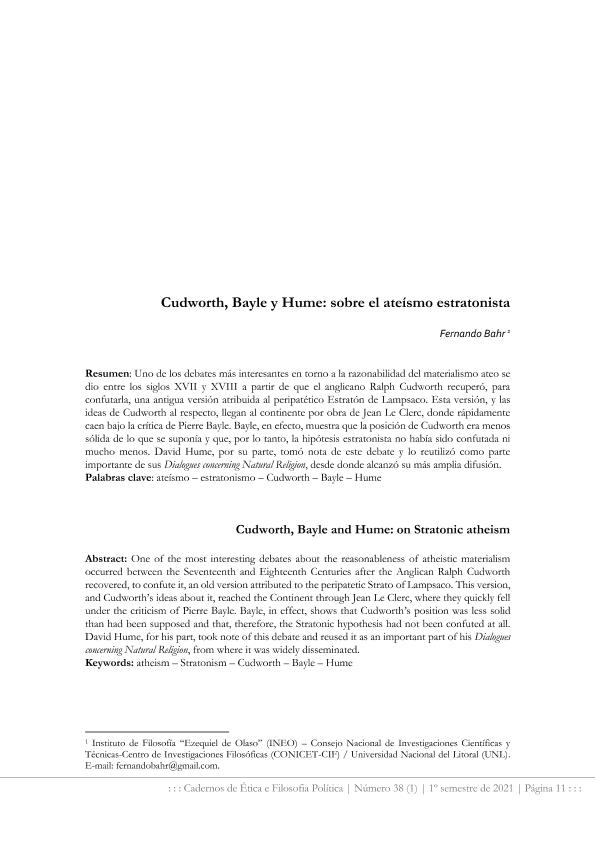
Uno de los debates más interesantes en torno a la razonabilidad del materialismo ateo sedio entre los siglos XVII y XVIII a partir de que el anglicano Ralph Cudworth recuperó, paraconfutarla, una antigua versión atribuida al peripatético Estratón de Lampsaco. Esta versión, y lasideas de Cudworth al respecto, llegan al continente por obra de Jean Le Clerc, donde rápidamentecaen bajo la crítica de Pierre Bayle. Bayle, en efecto, muestra que la posición de Cudworth era menossólida de lo que se suponía y que, por lo tanto, la hipótesis estratonista no había sido confutada nimucho menos. David Hume, por su parte, tomó nota de este debate y lo reutilizó como parteimportante de sus Dialogues concerning Natural Religion, desde donde alcanzó su más amplia difusión One of the most interesting debates about the reasonableness of atheistic materialism occurred between the Seventeenth and Eighteenth Centuries after the Anglican Ralph Cudworth recovered, to confute it, an old version attributed to the peripatetic Strato of Lampsaco. This version, and Cudworth’s ideas about it, reached the Continent through Jean Le Clerc, where they quickly fell under the criticism of Pierre Bayle. Bayle, in effect, shows that Cudworth’s position was less solid than had been supposed and that, therefore, the Stratonic hypothesis had not been confuted at all. David Hume, for his part, took note of this debate and reused it as an important part of his Dialogues concerning Natural Religion, from where it was widely disseminated.
Cudworth, Bayle y Hume: sobre el ateísmo estratonista
Título:
Cudworth, Bayle and Hume: on Stratonic atheism

Fecha de publicación:
07/2021
Editorial:
Universidade de São Paulo
Revista:
Cadernos de Etica E Filosofia Politica
ISSN:
1517-0128
e-ISSN:
2317-806X
Idioma:
Español
Tipo de recurso:
Artículo publicado
Clasificación temática:
Resumen
Palabras clave:
Ateísmo
,
Estratonismo
,
Cudworth
,
Bayle
,
Hume
Archivos asociados

Tamaño:
239.5Kb
Formato:
PDF
Licencia
 Excepto donde se diga explícitamente, este item se publica bajo la siguiente descripción:
Creative Commons Attribution-ShareAlike 2.5 Unported (CC BY-SA 2.5)
Excepto donde se diga explícitamente, este item se publica bajo la siguiente descripción:
Creative Commons Attribution-ShareAlike 2.5 Unported (CC BY-SA 2.5)
Identificadores
Colecciones
Articulos (INEO)
Articulos de INSTITUTO DE FILOSOFIA "EZEQUIEL DE OLASO"
Articulos de INSTITUTO DE FILOSOFIA "EZEQUIEL DE OLASO"
Citación
Bahr, Fernando Anibal; Cudworth, Bayle y Hume: sobre el ateísmo estratonista; Universidade de São Paulo; Cadernos de Etica E Filosofia Politica; 1; 38; 7-2021; 11-24
Compartir


Altmétricas