Artículo
Improvement of bipv efficiency by application of highly reflective surfaces at the building envelope

Fecha de publicación:
08/11/2021
Editorial:
Multidisciplinary Digital Publishing Institute
Revista:
Energies
e-ISSN:
1996-1073
Idioma:
Inglés
Tipo de recurso:
Artículo publicado
Clasificación temática:
Resumen
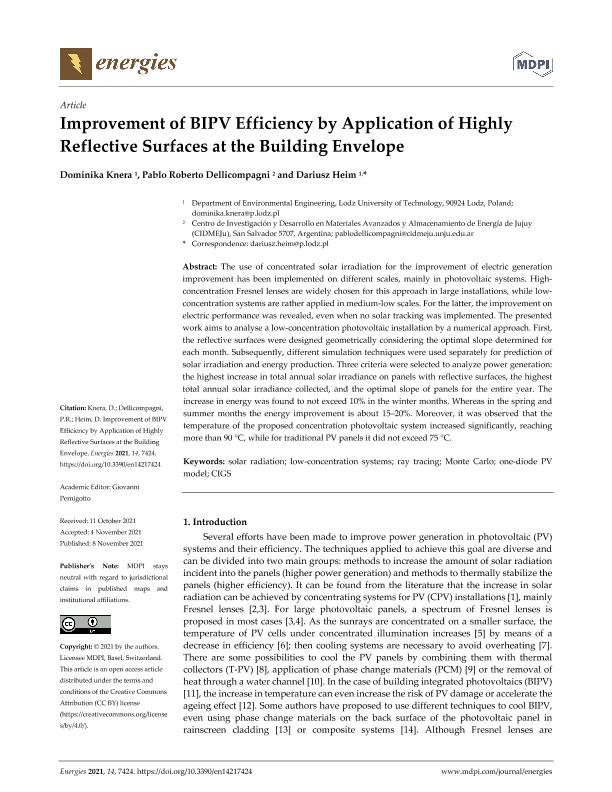
The use of concentrated solar irradiation for the improvement of electric generation improvement has been implemented on different scales, mainly in photovoltaic systems. High-concentration Fresnel lenses are widely chosen for this approach in large installations, while low-concentration systems are rather applied in medium-low scales. For the latter, the improvement on electric performance was revealed, even when no solar tracking was implemented. The presented work aims to analyse a low-concentration photovoltaic installation by a numerical approach. First, the reflective surfaces were designed geometrically considering the optimal slope determined for each month. Subsequently, different simulation techniques were used separately for prediction of solar irradiation and energy production. Three criteria were selected to analyze power generation: the highest increase in total annual solar irradiance on panels with reflective surfaces, the highest total annual solar irradiance collected, and the optimal slope of panels for the entire year. The increase in energy was found to not exceed 10% in the winter months. Whereas in the spring and summer months the energy improvement is about 15–20%. Moreover, it was observed that the temperature of the proposed concentration photovoltaic system increased significantly, reaching more than 90◦ C, while for traditional PV panels it did not exceed 75◦ C.
Archivos asociados

Tamaño:
2.285Mb
Formato:
PDF
Licencia
 Excepto donde se diga explícitamente, este item se publica bajo la siguiente descripción:
Creative Commons Attribution 2.5 Unported (CC BY 2.5)
Excepto donde se diga explícitamente, este item se publica bajo la siguiente descripción:
Creative Commons Attribution 2.5 Unported (CC BY 2.5)
Identificadores
Colecciones
Articulos(INENCO)
Articulos de INST.DE INVEST.EN ENERGIA NO CONVENCIONAL
Articulos de INST.DE INVEST.EN ENERGIA NO CONVENCIONAL
Citación
Knera, Dominika; Dellicompagni, Pablo Roberto; Heim, Dariusz; Improvement of bipv efficiency by application of highly reflective surfaces at the building envelope; Multidisciplinary Digital Publishing Institute; Energies; 14; 21; 8-11-2021; 1-17
Compartir


Altmétricas