Artículo
Impact of the Use of Non-Pharmacological Care Tools in Building the Perception of Dignity in Ailing People at the End-of-Life

Fecha de publicación:
12/08/2020
Editorial:
Openventio publishers
Revista:
Palliative medicine and hospice care
ISSN:
2377-8393
e-ISSN:
2377-8393
Idioma:
Inglés
Tipo de recurso:
Artículo publicado
Clasificación temática:
Resumen
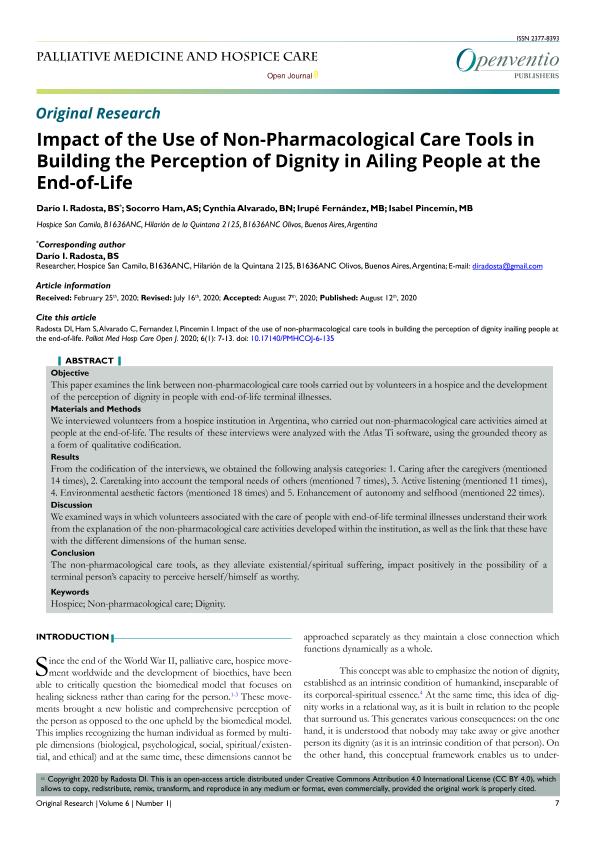
Objective This paper examines the link between non-pharmacological care tools carried out by volunteers in a hospice and the development of the perception of dignity in people with end-of-life terminal illnesses. Materials and Methods We interviewed volunteers from a hospice institution in Argentina, who carried out non-pharmacological care activities aimed at people at the end-of-life. The results of these interviews were analyzed with the Atlas Ti software, using the grounded theory as a form of qualitative codification. Results From the codification of the interviews, we obtained the following analysis categories: 1. Caring after the caregivers (mentioned 14 times), 2. Caretaking into account the temporal needs of others (mentioned 7 times), 3. Active listening (mentioned 11 times), 4. Environmental aesthetic factors (mentioned 18 times) and 5. Enhancement of autonomy and selfhood (mentioned 22 times). Discussion We examined ways in which volunteers associated with the care of people with end-of-life terminal illnesses understand their work from the explanation of the non-pharmacological care activities developed within the institution, as well as the link that these have with the different dimensions of the human sense. Conclusion The non-pharmacological care tools, as they alleviate existential/spiritual suffering, impact positively in the possibility of a terminal person’s capacity to perceive herself/himself as worthy.
Palabras clave:
Hospice
,
Non-pharmacological care
,
Dignity
Archivos asociados

Tamaño:
380.2Kb
Formato:
PDF
Licencia
 Excepto donde se diga explícitamente, este item se publica bajo la siguiente descripción:
Creative Commons Attribution 2.5 Unported (CC BY 2.5)
Excepto donde se diga explícitamente, este item se publica bajo la siguiente descripción:
Creative Commons Attribution 2.5 Unported (CC BY 2.5)
Identificadores
Colecciones
Articulos(SEDE CENTRAL)
Articulos de SEDE CENTRAL
Articulos de SEDE CENTRAL
Citación
Radosta Rosas, Darío Iván; Ham, Socorro; Alvarado, Cynthia; Fernández, Irupé; Pincemín, Isabel; Impact of the Use of Non-Pharmacological Care Tools in Building the Perception of Dignity in Ailing People at the End-of-Life; Openventio publishers; Palliative medicine and hospice care; 6; 1; 12-8-2020; 7-13
Compartir


Altmétricas