Artículo
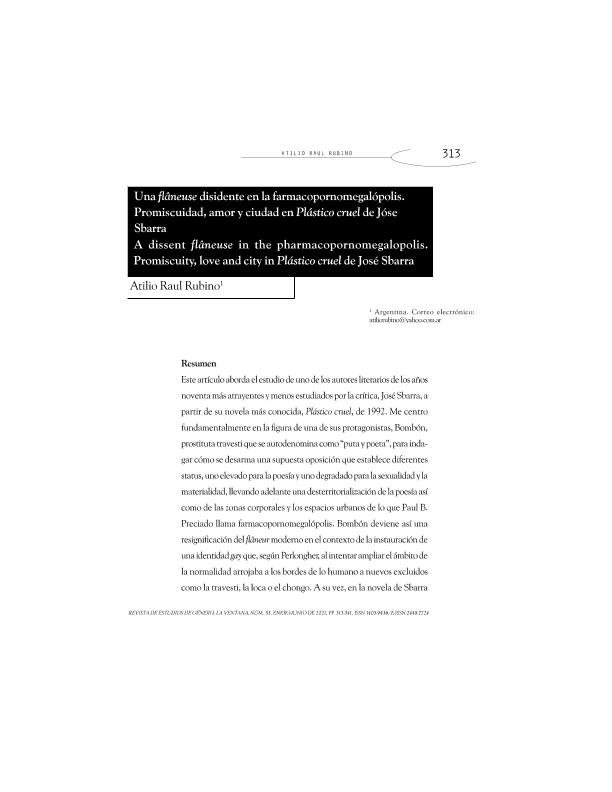
Este artículo aborda el estudio de uno de los autores literarios de los años noventa más atrayentes y menos estudiados por la crítica, José Sbarra, a partir de su novela más conocida, Plástico cruel, de 1992. Me centro fundamentalmente en la figura de una de sus protagonistas, Bombón, prostituta travesti que se autodenomina como “puta y poeta”, para indagar cómo se desarma una supuesta oposición que establece diferentes status, uno elevado para la poesía y uno degradado para la sexualidad y la materialidad, llevando adelante una desterritorialización de la poesía así como de las zonas corporales y los espacios urbanos de lo que Paul B. Preciado llama farmacopornomegalópolis. Bombón deviene así una resignificación del flâneur moderno en el contexto de la instauración de una identidad gay que, según Perlongher, al intentar ampliar el ámbito de la normalidad arrojaba a los bordes de lo humano a nuevos excluidos como la travesti, la loca o el chongo. A su vez, en la novela de Sbarra podemos pensar también en un cuestionamiento a la naturalización del cuerpo a partir del binomio natural/artificial. Así, los cuerpos hegemónicos respecto a la cisheteronorma aparecen des-naturalizados. En ese sentido, es el personaje de Bombón el que desde una posición abyecta se erige como sujeto deseante (más que como objeto del deseo o de intercambio mercantil). La promiscuidad, así, deviene en un agenciamiento del propio cuerpo y un desvelamiento de que el amor y la familia son fuertes dispositivos de disciplinamiento corporal. Con un estilo fragmentario y polifónico que pasa de lo lírico a lo narrativo, siempre en un tono irónico llevado por momentos al absurdo, la novela de Sbarra constituye para la época un fuerte cuestionamiento a los estándares de la familia tradicional así como a la incipiente normalización de lo gay. This article deals with the study of one of the most attractive and least analyzed literary authors from the 1990s, José Sbarra, in his most widely known novel, Plástico cruel, from 1992. I essentially focus on the figure of one of its main characters, Bombón, a transvestite prostitute who calls herself “a whore and a poet”, in order to look into how an apparent opposition that sets different statuses —one that is elevated towards poetry and the other that is degraded to sexuality and materiality— is taken apart by carrying out a deterritorialization of poetry as well as of the body areas and the city spaces of which Paul B. Preciado calls a pharmaco-porno-megalopolis. Bombón thus becomes a redefinition of the modern flâneur in the context of the establishment of a gay identity, which — according to Perlongher— when trying to broaden the scopes of normality, pushed away new outcasts —such as the transvestite, the fairy or the pickup— to the borders of what is human. At the same time, in Sbarra’s novel, we can also think about a questioning of the naturalization of the body from the pairing natural/artificial. Therefore, the hegemonic bodies (regarding the cisheteronormativity) seem to be un-naturalized. In this sense, it is the character of Bombón the one which, from an abject position, sets itself as a desiring subject (rather than an object of desire or an object for commercial exchange). This way, promiscuity becomes agencement for the own body and a revelation of the fact that love and family are strong devices for body disciplining. With a fragmentary and polyphonic style that goes from lyric to narrative, always with an ironical tone, which sometimes is taken to the absurd, Sbarra’s novel stands out in its time as a strong questioning of the traditional family’s standards as well as of the incipient normalization of gayness.
Una flâneuse disidente en la farmacopornomegalópolis. Promiscuidad, amor y ciudad en Plástico cruel de Jóse Sbarra
Título:
A dissent flâneuse in the pharmacopornomegalopolis. Promiscuity, love and city in Plástico cruel de José Sbarra

Fecha de publicación:
20/04/2021
Editorial:
Universidad de Guadalajara
Revista:
La Ventana
ISSN:
1405-9436
e-ISSN:
2448-7724
Idioma:
Español
Tipo de recurso:
Artículo publicado
Clasificación temática:
Resumen
Palabras clave:
LITERATURA ARGENTINA
,
TRAVESTISMO
,
DISIDENCIA SEXUAL
,
PROMISCUIDAD
,
JOSÉ SBARRA
Archivos asociados

Tamaño:
140.8Kb
Formato:
PDF
Licencia
 Excepto donde se diga explícitamente, este item se publica bajo la siguiente descripción:
Creative Commons Attribution-NonCommercial 2.5 Unported (CC BY-NC 2.5)
Excepto donde se diga explícitamente, este item se publica bajo la siguiente descripción:
Creative Commons Attribution-NonCommercial 2.5 Unported (CC BY-NC 2.5)
Identificadores
Colecciones
Articulos(IDIHCS)
Articulos de INST.DE INVEST.EN HUMANIDADES Y CS SOCIALES
Articulos de INST.DE INVEST.EN HUMANIDADES Y CS SOCIALES
Citación
Rubino, Atilio Raúl; Una flâneuse disidente en la farmacopornomegalópolis. Promiscuidad, amor y ciudad en Plástico cruel de Jóse Sbarra; Universidad de Guadalajara; La Ventana; 6; 53; 20-4-2021; 313-341
Compartir


Altmétricas