Artículo
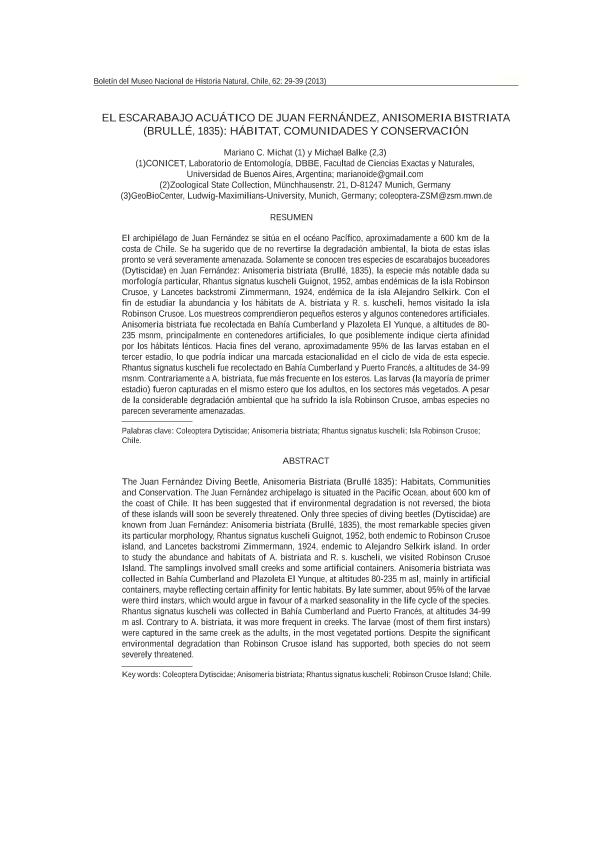
El archipiélago de Juan Fernández se sitúa en el océano Pacífico, aproximadamente a 600 km de la costa de Chile. Se ha sugerido que de no revertirse la degradación ambiental, la biota de estas islas pronto se verá severamente amenazada. Solamente se conocen tres especies de escarabajos buceadores (Dytiscidae) en Juan Fernández: Anisomeria bistriata (Brullé, 1835), la especie más notable dada su morfología particular, Rhantus signatus kuscheli Guignot, 1952, ambas endémicas de la isla Robinson Crusoe, y Lancetes backstromi Zimmermann, 1924, endémica de la isla Alejandro Selkirk. Con el fin de estudiar la abundancia y los hábitats de A. bistriata y R. s. kuscheli, hemos visitado la isla Robinson Crusoe. Los muestreos comprendieron pequeños esteros y algunos contenedores artificiales. Anisomeria bistriata fue recolectada en Bahía Cumberland y Plazoleta El Yunque, a altitudes de 80- 235 msnm, principalmente en contenedores artificiales, lo que posiblemente indique cierta afinidad por los hábitats lénticos. Hacia fines del verano, aproximadamente 95% de las larvas estaban en el tercer estadio, lo que podría indicar una marcada estacionalidad en el ciclo de vida de esta especie. Rhantus signatus kuscheli fue recolectado en Bahía Cumberland y Puerto Francés, a altitudes de 34-99 msnm. Contrariamente a A. bistriata, fue más frecuente en los esteros. Las larvas (la mayoría de primer estadio) fueron capturadas en el mismo estero que los adultos, en los sectores más vegetados. A pesar de la considerable degradación ambiental que ha sufrido la isla Robinson Crusoe, ambas especies no parecen severamente amenazadas. The Juan Fernández archipelago is situated in the Pacifi c Ocean, about 600 km of the coast of Chile. It has been suggested that if environmental degradation is not reversed, the biota of these islands will soon be severely threatened. Only three species of diving beetles (Dytiscidae) are known from Juan Fernández: Anisomeria bistriata (Brullé, 1835), the most remarkable species given its particular morphology, Rhantus signatus kuscheli Guignot, 1952, both endemic to Robinson Crusoe island, and Lancetes backstromi Zimmermann, 1924, endemic to Alejandro Selkirk island. In order to study the abundance and habitats of A. bistriata and R. s. kuscheli, we visited Robinson Crusoe Island. The samplings involved small creeks and some artifi cial containers. Anisomeria bistriata was collected in Bahía Cumberland and Plazoleta El Yunque, at altitudes 80-235 m asl, mainly in artifi cial containers, maybe refl ecting certain affi nity for lentic habitats. By late summer, about 95% of the larvae were third instars, which would argue in favour of a marked seasonality in the life cycle of the species. Rhantus signatus kuscheli was collected in Bahía Cumberland and Puerto Francés, at altitudes 34-99 m asl. Contrary to A. bistriata, it was more frequent in creeks. The larvae (most of them fi rst instars) were captured in the same creek as the adults, in the most vegetated portions. Despite the signifi cant environmental degradation than Robinson Crusoe island has supported, both species do not seem severely threatened.
El escarabajo acuático de Juan Fernández, Anisomeria Bistriata (Brullé, 1835): hábitat, comunidades y conservación
Título:
The Juan Fernández diving beetle, Anisomeria Bistriata (Brullé 1835): habitats, communities and conservation

Fecha de publicación:
2013
Editorial:
Museo Nacional de Historia Natural
Revista:
Boletín del Museo Nacional de Historia Natural
ISSN:
0027-3910
Idioma:
Español
Tipo de recurso:
Artículo publicado
Clasificación temática:
Resumen
Archivos asociados

Tamaño:
519.4Kb
Formato:
PDF
Licencia
 Excepto donde se diga explícitamente, este item se publica bajo la siguiente descripción:
Creative Commons Attribution-NonCommercial-ShareAlike 2.5 Unported (CC BY-NC-SA 2.5)
Excepto donde se diga explícitamente, este item se publica bajo la siguiente descripción:
Creative Commons Attribution-NonCommercial-ShareAlike 2.5 Unported (CC BY-NC-SA 2.5)
Identificadores
Colecciones
Articulos(IBBEA)
Articulos de INSTITUTO DE BIODIVERSIDAD Y BIOLOGIA EXPERIMENTAL Y APLICADA
Articulos de INSTITUTO DE BIODIVERSIDAD Y BIOLOGIA EXPERIMENTAL Y APLICADA
Citación
Michat, Mariano Cruz; Balke, Michael; El escarabajo acuático de Juan Fernández, Anisomeria Bistriata (Brullé, 1835): hábitat, comunidades y conservación; Museo Nacional de Historia Natural; Boletín del Museo Nacional de Historia Natural; 62; -1-2013; 29-39
Compartir

