Artículo
Lrig1 and lrig3 cooperate to control ret receptor signaling, sensory axonal growth and epidermal innervations
de Vincenti, Ana Paula ; Alsina, Fernando Cruz
; Ferrero Restelli, Facundo Nahuel
; Hedman, Håkan; Ledda, Maria Fernanda
; Paratcha, Gustavo
; Alsina, Fernando Cruz
; Ferrero Restelli, Facundo Nahuel
; Hedman, Håkan; Ledda, Maria Fernanda
; Paratcha, Gustavo
; Alsina, Fernando Cruz
; Ferrero Restelli, Facundo Nahuel
; Hedman, Håkan; Ledda, Maria Fernanda
; Paratcha, Gustavo
Fecha de publicación:
08/2021
Editorial:
Company of Biologists
Revista:
Development
ISSN:
0950-1991
Idioma:
Inglés
Tipo de recurso:
Artículo publicado
Clasificación temática:
Resumen
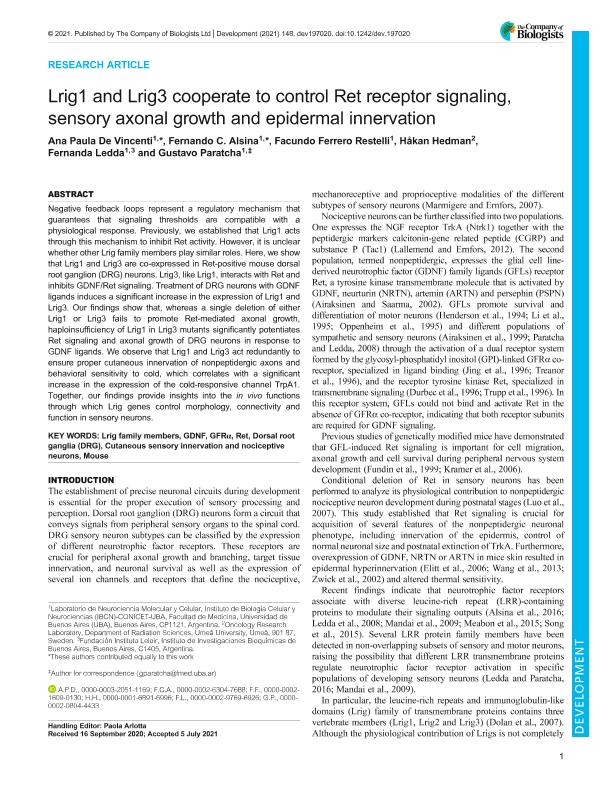
Negative feedback loops represent a regulatory mechanism that guarantees that signaling thresholds are compatible with a physiological response. Previously, we established that Lrig1 acts through this mechanism to inhibit Ret activity. However, it is unclear whether other Lrig family members play similar roles. Here, we show that Lrig1 and Lrig3 are co-expressed in Ret-positive mouse dorsal root ganglion (DRG) neurons. Lrig3, like Lrig1, interacts with Ret and inhibits GDNF/Ret signaling. Treatment of DRG neurons with GDNF ligands induces a significant increase in the expression of Lrig1 and Lrig3. Our findings show that, whereas a single deletion of either Lrig1 or Lrig3 fails to promote Ret-mediated axonal growth, haploinsufficiency of Lrig1 in Lrig3 mutants significantly potentiates Ret signaling and axonal growth of DRG neurons in response to GDNF ligands. We observe that Lrig1 and Lrig3 act redundantly to ensure proper cutaneous innervation of nonpeptidergic axons and behavioral sensitivity to cold, which correlates with a significant increase in the expression of the cold-responsive channel TrpA1. Together, our findings provide insights into the in vivo functions through which Lrig genes control morphology, connectivity and function in sensory neurons.
Archivos asociados

Tamaño:
6.803Mb
Formato:
PDF
Licencia
 Excepto donde se diga explícitamente, este item se publica bajo la siguiente descripción:
Creative Commons Attribution-NonCommercial-ShareAlike 2.5 Unported (CC BY-NC-SA 2.5)
Excepto donde se diga explícitamente, este item se publica bajo la siguiente descripción:
Creative Commons Attribution-NonCommercial-ShareAlike 2.5 Unported (CC BY-NC-SA 2.5)
Identificadores
Colecciones
Articulos(IBCN)
Articulos de INST.DE BIOLO.CEL.Y NEURCS."PROF.E.DE ROBERTIS"
Articulos de INST.DE BIOLO.CEL.Y NEURCS."PROF.E.DE ROBERTIS"
Citación
de Vincenti, Ana Paula; Alsina, Fernando Cruz; Ferrero Restelli, Facundo Nahuel; Hedman, Håkan; Ledda, Maria Fernanda; et al.; Lrig1 and lrig3 cooperate to control ret receptor signaling, sensory axonal growth and epidermal innervations; Company of Biologists; Development; 148; 18; 8-2021; 1-17
Compartir


Altmétricas