Artículo
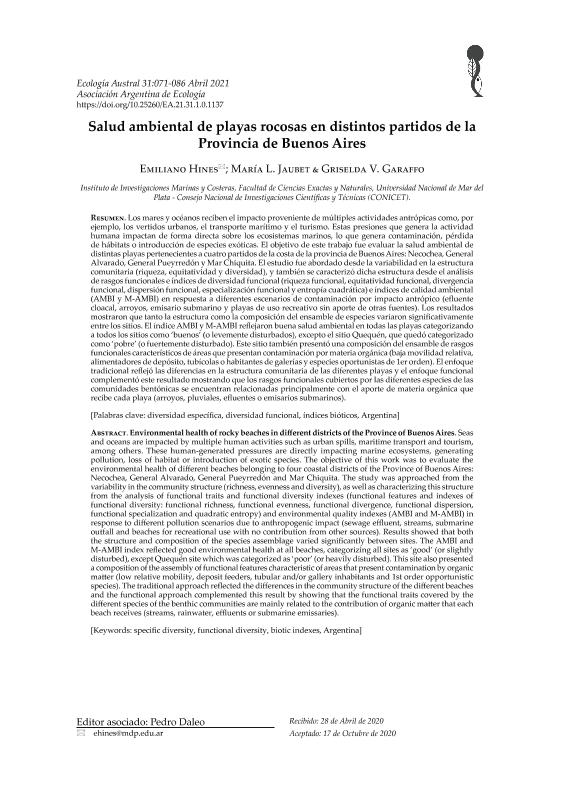
Los mares y océanos reciben el impacto proveniente de múltiples actividades antrópicas como por ejemplo los vertidos urbanos, transporte marítimo, turismo, etc. Estas presiones generadas por el hombre están impactando directamente sobre los ecosistemas marinos, generando contaminación, pérdida de hábitats o introducción de especies exóticas. El objetivo de este trabajo fue evaluar la salud ambiental de distintas playas pertenecientes a cuatro partidos de la costa de la provincia de Buenos Aires: Partido de Necochea, General Alvarado, General Pueyrredón y Mar Chiquita. El estudio fue abordado desde la variabilidad en la estructura comunitaria (riqueza, equitatividad y diversidad), así como desde el funcionamiento de la comunidad (rasgos funcionales e índices de diversidad funcional: Riqueza funcional, Equitatividad funcional, Divergencia funcional, Dispersión funcional, Especialización funcional y Entropía cuadrática) e índices de calidad ambiental (AMBI y M-AMBI); en respuesta a diferentes escenarios de contaminación por impacto antrópico (efluente cloacal, arroyos, emisario submarino y playas de uso recreativo sin aporte de otras fuentes). Los resultados mostraron que tanto la estructura como la composición del ensamble de especies variaron significativamente entre los sitios. El índice AMBI y M-AMBI reflejaron buena salud ambiental en todas las playas categorizando a todos los sitios como Buenos (o levemente disturbados), excepto el sitio Quequén que quedó categorizado como pobre (o fuertemente disturbado). Este sitio también presentó una composición del ensamble de rasgos funcionales característicos de áreas que presentan contaminación por materia orgánica (baja movilidad relativa, alimentadores de depósito, tubícolas y/o habitantes de galerías y especies oportunistas (V)). El enfoque tradicional reflejó las diferencias en la estructura comunitaria de las diferentes playas y el enfoque funcional complementó este resultado mostrando que las funciones cubiertas por las diferentes especies de las comunidades bentónicas se encuentran relacionadas principalmente con el aporte de materia orgánica que recibe cada playa (arroyos, pluviales, efluentes o emisarios submarinos). Seas and oceans are impacted by multiple human activities such as urban spills, maritime transport and tourism, among others. These human-generated pressures are directly impacting marine ecosystems, generating pollution, loss of habitat or introduction of exotic species. The objective of this work was to evaluate the environmental health of different beaches belonging to four coastal districts of the Province of Buenos Aires: Necochea, General Alvarado, General Pueyrredón and Mar Chiquita. The study was approached from the variability in the community structure (richness, evenness and diversity), as well as characterizing this structure from the analysis of functional traits and functional diversity indexes (functional features and indexes of functional diversity: functional richness, functional evenness, functional divergence, functional dispersion, functional specialization and quadratic entropy) and environmental quality indexes (AMBI and M-AMBI) in response to different pollution scenarios due to anthropogenic impact (sewage effluent, streams, submarine outfall and beaches for recreational use with no contribution from other sources). Results showed that both the structure and composition of the species assemblage varied significantly between sites. The AMBI and M-AMBI index reflected good environmental health at all beaches, categorizing all sites as ‘good’ (or slightly disturbed), except Quequén site which was categorized as ‘poor’ (or heavily disturbed). This site also presented a composition of the assembly of functional features characteristic of areas that present contamination by organic matter (low relative mobility, deposit feeders, tubular and/or gallery inhabitants and 1st order opportunistic species). The traditional approach reflected the differences in the community structure of the different beaches and the functional approach complemented this result by showing that the functional traits covered by the different species of the benthic communities are mainly related to the contribution of organic matter that each beach receives (streams, rainwater, effluents or submarine emissaries).
Salud ambiental de playas rocosas en distintos partidos de la Provincia de Buenos Aires
Título:
Environmental health of rocky beaches in different districts of the Province of Buenos Aires

Fecha de publicación:
04/2021
Editorial:
Asociación Argentina de Ecología
Revista:
Ecología Austral
ISSN:
1667-7838
Idioma:
Español
Tipo de recurso:
Artículo publicado
Clasificación temática:
Resumen
Palabras clave:
DIVERSIDAD ESPECÍFICA
,
DIVERSIDAD FUNCIONAL
,
ÍNDICES BIÓTICOS
,
ARGENTINA
Archivos asociados

Tamaño:
3.383Mb
Formato:
PDF
Licencia
 Excepto donde se diga explícitamente, este item se publica bajo la siguiente descripción:
Creative Commons Attribution 2.5 Unported (CC BY 2.5)
Excepto donde se diga explícitamente, este item se publica bajo la siguiente descripción:
Creative Commons Attribution 2.5 Unported (CC BY 2.5)
Identificadores
Colecciones
Articulos(IIMYC)
Articulos de INSTITUTO DE INVESTIGACIONES MARINAS Y COSTERAS
Articulos de INSTITUTO DE INVESTIGACIONES MARINAS Y COSTERAS
Citación
Hines, Emiliano; Jaubet, Maria Lourdes; Garaffo, Griselda Valeria; Salud ambiental de playas rocosas en distintos partidos de la Provincia de Buenos Aires; Asociación Argentina de Ecología; Ecología Austral; 31; 1; 4-2021; 71-86
Compartir


Altmétricas