Artículo
Names for trace fossils: a uniform approach
Bertling, Markus; Braddy, Simon J.; Bromley, Richard G.; Demathieu, George R.; Genise, Jorge Fernando ; Mikulás, Radek; Nielsen, Jan K.; Nielsen, Kurt S. S.; Rindsberg, Andrew K.; Schlirf, Michael; Uchman, Alfred
; Mikulás, Radek; Nielsen, Jan K.; Nielsen, Kurt S. S.; Rindsberg, Andrew K.; Schlirf, Michael; Uchman, Alfred
Fecha de publicación:
09/2006
Editorial:
Taylor & Francis
Revista:
Lethaia
ISSN:
0024-1164
Idioma:
Inglés
Tipo de recurso:
Artículo publicado
Clasificación temática:
Resumen
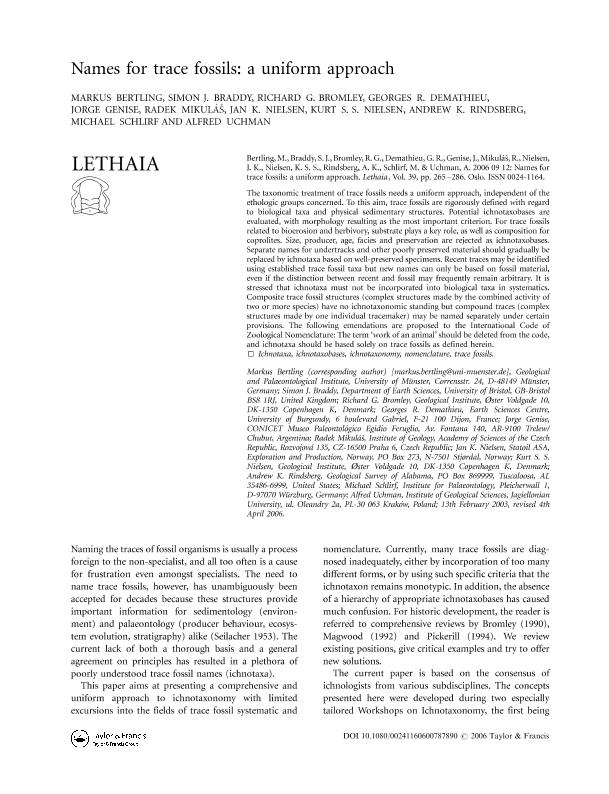
The taxonomic treatment of trace fossils needs a uniform approach, independent of the ethologic groups concerned. To this aim, trace fossils are rigorously defined with regard to biological taxa and physical sedimentary structures. Potential ichnotaxobases are evaluated, with morphology resulting as the most important criterion. For trace fossils related to bioerosion and herbivory, substrate plays a key role, as well as composition for coprolites. Size, producer, age, facies and preservation are rejected as ichnotaxobases. Separate names for undertracks and other poorly preserved material should gradually be replaced by ichnotaxa based on well-preserved specimens. Recent traces may be identified using established trace fossil taxa but new names can only be based on fossil material, even if the distinction between recent and fossil may frequently remain arbitrary. It is stressed that ichnotaxa must not be incorporated into biological taxa in systematics. Composite trace fossil structures (complex structures made by the combined activity of two or more species) have no ichnotaxonomic standing but compound traces (complex structures made by one individual tracemaker) may be named separately under certain provisions. The following emendations are proposed to the International Code of Zoological Nomenclature: The term ‘work of an animal’ should be deleted from the code, and ichnotaxa should be based solely on trace fossils as defined herein.
Palabras clave:
Ichnotaxa
,
Ichnotaxobases
,
Nomenclature
,
Trace Fossils
,
Ichnotaxonomy
Archivos asociados

Tamaño:
1.238Mb
Formato:
PDF
Licencia
 Excepto donde se diga explícitamente, este item se publica bajo la siguiente descripción:
Creative Commons Attribution-NonCommercial-ShareAlike 2.5 Unported (CC BY-NC-SA 2.5)
Excepto donde se diga explícitamente, este item se publica bajo la siguiente descripción:
Creative Commons Attribution-NonCommercial-ShareAlike 2.5 Unported (CC BY-NC-SA 2.5)
Identificadores
Colecciones
Articulos(CCT-CENPAT)
Articulos de CTRO.CIENTIFICO TECNOL.CONICET - CENPAT
Articulos de CTRO.CIENTIFICO TECNOL.CONICET - CENPAT
Citación
Bertling, Markus; Braddy, Simon J.; Bromley, Richard G.; Demathieu, George R.; Genise, Jorge Fernando; et al.; Names for trace fossils: a uniform approach; Taylor & Francis; Lethaia; 39; 3; 9-2006; 265-286
Compartir


Altmétricas