Artículo
Hydrogen uptake and diffusivity in steel armor wires with different chemical composition, carbide distribution, grain size, and degree of deformation

Fecha de publicación:
03/2022
Editorial:
Wiley VCH Verlag
Revista:
Materials And Corrosion-Werkstoffe und Korrosion
ISSN:
0947-5117
Idioma:
Inglés
Tipo de recurso:
Artículo publicado
Clasificación temática:
Resumen
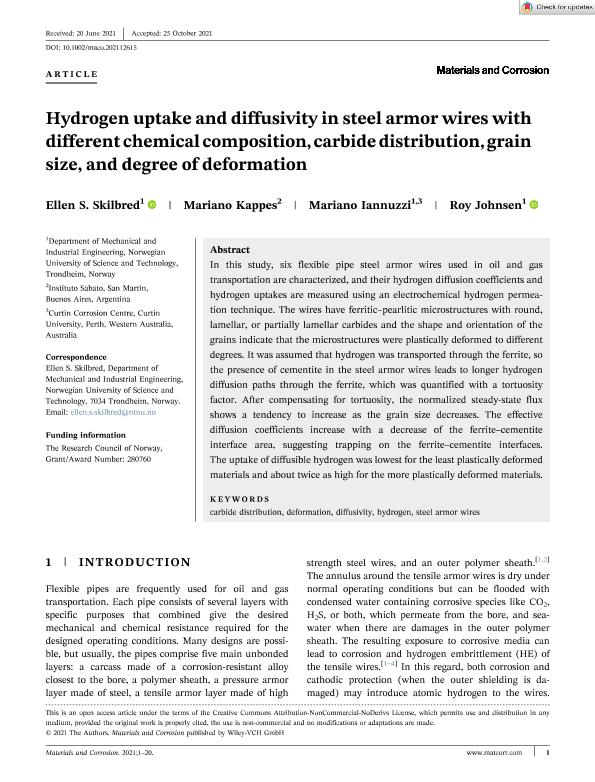
In this study, six flexible pipe steel armor wires used in oil and gas transportation are characterized, and their hydrogen diffusion coefficients and hydrogen uptakes are measured using an electrochemical hydrogen permeation technique. The wires have ferritic–pearlitic microstructures with round, lamellar, or partially lamellar carbides and the shape and orientation of the grains indicate that the microstructures were plastically deformed to different degrees. It was assumed that hydrogen was transported through the ferrite, so the presence of cementite in the steel armor wires leads to longer hydrogen diffusion paths through the ferrite, which was quantified with a tortuosity factor. After compensating for tortuosity, the normalized steady-state flux shows a tendency to increase as the grain size decreases. The effective diffusion coefficients increase with a decrease of the ferrite–cementite interface area, suggesting trapping on the ferrite–cementite interfaces. The uptake of diffusible hydrogen was lowest for the least plastically deformed materials and about twice as high for the more plastically deformed materials.
Palabras clave:
CARBIDE DISTRIBUTION
,
DEFORMATION
,
DIFFUSIVITY
,
HYDROGEN
,
STEEL ARMOR WIRES
Archivos asociados

Tamaño:
3.192Mb
Formato:
PDF
Licencia
 Excepto donde se diga explícitamente, este item se publica bajo la siguiente descripción:
Atribución-NoComercial-SinDerivadas 2.5 Argentina (CC BY-NC-ND 2.5 AR)
Excepto donde se diga explícitamente, este item se publica bajo la siguiente descripción:
Atribución-NoComercial-SinDerivadas 2.5 Argentina (CC BY-NC-ND 2.5 AR)
Identificadores
Colecciones
Articulos(SEDE CENTRAL)
Articulos de SEDE CENTRAL
Articulos de SEDE CENTRAL
Citación
Skilbred, Ellen S.; Kappes, Mariano Alberto; Iannuzzi, Mariano; Johnsen, Roy; Hydrogen uptake and diffusivity in steel armor wires with different chemical composition, carbide distribution, grain size, and degree of deformation; Wiley VCH Verlag; Materials And Corrosion-Werkstoffe und Korrosion; 73; 3; 3-2022; 326-345
Compartir


Altmétricas