Artículo
Particle acceleration and non-Thermal emission in colliding-wind binary systems

Fecha de publicación:
07/2021
Editorial:
Wiley Blackwell Publishing, Inc
Revista:
Monthly Notices of the Royal Astronomical Society
ISSN:
0035-8711
Idioma:
Inglés
Tipo de recurso:
Artículo publicado
Clasificación temática:
Resumen
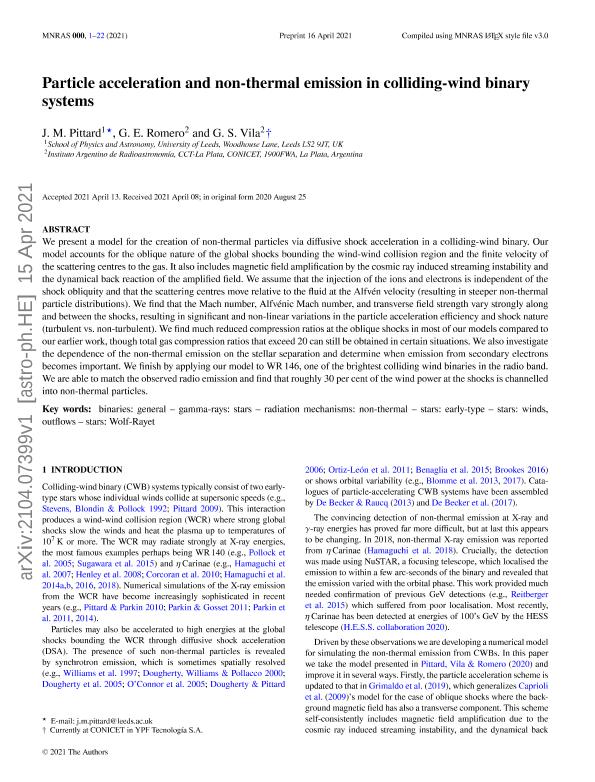
We present a model for the creation of non-Thermal particles via diffusive shock acceleration in a colliding-wind binary. Our model accounts for the oblique nature of the global shocks bounding the wind-wind collision region and the finite velocity of the scattering centres to the gas. It also includes magnetic field amplification by the cosmic ray induced streaming instability and the dynamical back reaction of the amplified field. We assume that the injection of the ions and electrons is independent of the shock obliquity and that the scattering centres move relative to the fluid at the Alfvén velocity (resulting in steeper non-Thermal particle distributions). We find that the Mach number, Alfvénic Mach number, and transverse field strength vary strongly along and between the shocks, resulting in significant and non-linear variations in the particle acceleration efficiency and shock nature (turbulent versus non-Turbulent). We find much reduced compression ratios at the oblique shocks in most of our models compared to our earlier work, though total gas compression ratios that exceed 20 can still be obtained in certain situations. We also investigate the dependence of the non-Thermal emission on the stellar separation and determine when emission from secondary electrons becomes important. We finish by applying our model to WR 146, one of the brightest colliding wind binaries in the radio band. We are able to match the observed radio emission and find that roughly 30 per cent of the wind power at the shocks is channelled into non-Thermal particles.
Archivos asociados

Tamaño:
1.577Mb
Formato:
PDF
Licencia
 Excepto donde se diga explícitamente, este item se publica bajo la siguiente descripción:
Creative Commons Attribution-NonCommercial-ShareAlike 2.5 Unported (CC BY-NC-SA 2.5)
Excepto donde se diga explícitamente, este item se publica bajo la siguiente descripción:
Creative Commons Attribution-NonCommercial-ShareAlike 2.5 Unported (CC BY-NC-SA 2.5)
Identificadores
Colecciones
Articulos(SEDE CENTRAL)
Articulos de SEDE CENTRAL
Articulos de SEDE CENTRAL
Citación
Pittard, J. M; Romero, G. E.; Vila, Gabriela Soledad; Particle acceleration and non-Thermal emission in colliding-wind binary systems; Wiley Blackwell Publishing, Inc; Monthly Notices of the Royal Astronomical Society; 504; 3; 7-2021; 4204-4225
Compartir


Altmétricas