Artículo
Spatiotemporal Variations in Antarctic Protistan Communities Highlight Phytoplankton Diversity and Seasonal Dominance by a Novel Cryptophyte Lineage
Hamilton, Maria; Mascioni, Martina ; Hehenberger, Elisabeth; Bachy, Charles; Yung, Charmaine; Vernet, Maria; Worden, Alexandra Z.
; Hehenberger, Elisabeth; Bachy, Charles; Yung, Charmaine; Vernet, Maria; Worden, Alexandra Z.
Fecha de publicación:
12/2021
Editorial:
American Society for Microbiology
Revista:
mBio
e-ISSN:
2150-7511
Idioma:
Inglés
Tipo de recurso:
Artículo publicado
Clasificación temática:
Resumen
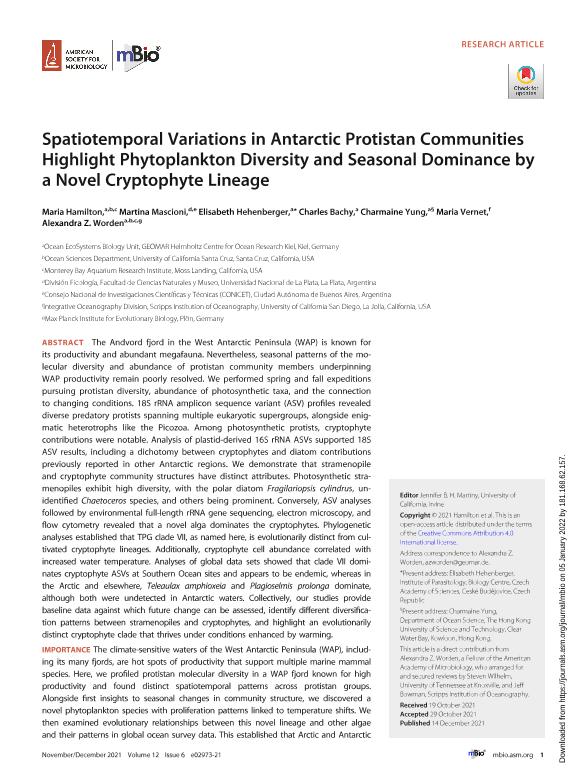
The Andvord fjord in the West Antarctic Peninsula (WAP) is known for its productivity and abundant megafauna. Nevertheless, seasonal patterns of the molecular diversity and abundance of protistan community members underpinning WAP productivity remain poorly resolved. We performed spring and fall expeditions pursuing protistan diversity, abundance of photosynthetic taxa, and the connection to changing conditions. 18S rRNA amplicon sequence variant (ASV) profiles revealed diverse predatory protists spanning multiple eukaryotic supergroups, alongside enigmatic heterotrophs like the Picozoa. Among photosynthetic protists, cryptophyte contributions were notable. Analysis of plastid-derived 16S rRNA ASVs supported 18S ASV results, including a dichotomy between cryptophytes and diatom contributions previously reported in other Antarctic regions. We demonstrate that stramenopile and cryptophyte community structures have distinct attributes. Photosynthetic stramenopiles exhibit high diversity, with the polar diatom Fragilariopsis cylindrus, unidentified Chaetoceros species, and others being prominent. Conversely, ASV analyses followed by environmental full-length rRNA gene sequencing, electron microscopy, and flow cytometry revealed that a novel alga dominates the cryptophytes. Phylogenetic analyses established that TPG clade VII, as named here, is evolutionarily distinct from cultivated cryptophyte lineages. Additionally, cryptophyte cell abundance correlated with increased water temperature. Analyses of global data sets showed that clade VII dominates cryptophyte ASVs at Southern Ocean sites and appears to be endemic, whereas in the Arctic and elsewhere, Teleaulax amphioxeia and Plagioselmis prolonga dominate, although both were undetected in Antarctic waters. Collectively, our studies provide baseline data against which future change can be assessed, identify different diversification patterns between stramenopiles and cryptophytes, and highlight an evolutionarily distinct cryptophyte clade that thrives under conditions enhanced by warming. IMPORTANCE The climate-sensitive waters of the West Antarctic Peninsula (WAP), including its many fjords, are hot spots of productivity that support multiple marine mammal species. Here, we profiled protistan molecular diversity in a WAP fjord known for high productivity and found distinct spatiotemporal patterns across protistan groups. Alongside first insights to seasonal changes in community structure, we discovered a novel phytoplankton species with proliferation patterns linked to temperature shifts. We then examined evolutionary relationships between this novel lineage and other algae and their patterns in global ocean survey data. This established that Arctic and Antarctic cryptophyte communities have different species composition, with the newly identified lineage being endemic to Antarctic waters. Our research provides critical knowledge on how specific phytoplankton at the base of Antarctic food webs respond to warming, as well as information on overall diversity and community structure in this changing polar environment.
Archivos asociados

Tamaño:
4.458Mb
Formato:
PDF
Licencia
 Excepto donde se diga explícitamente, este item se publica bajo la siguiente descripción:
Creative Commons Attribution-NonCommercial-ShareAlike 2.5 Unported (CC BY-NC-SA 2.5)
Excepto donde se diga explícitamente, este item se publica bajo la siguiente descripción:
Creative Commons Attribution-NonCommercial-ShareAlike 2.5 Unported (CC BY-NC-SA 2.5)
Identificadores
Colecciones
Articulos(CCT - LA PLATA)
Articulos de CTRO.CIENTIFICO TECNOL.CONICET - LA PLATA
Articulos de CTRO.CIENTIFICO TECNOL.CONICET - LA PLATA
Citación
Hamilton, Maria; Mascioni, Martina; Hehenberger, Elisabeth; Bachy, Charles; Yung, Charmaine; et al.; Spatiotemporal Variations in Antarctic Protistan Communities Highlight Phytoplankton Diversity and Seasonal Dominance by a Novel Cryptophyte Lineage; American Society for Microbiology; mBio; 12; 6; 12-2021; 1-23
Compartir


Altmétricas