Evento
When does the mammalian GPS use the dentate gyrus in everyday challenges of spatial navigation?

Tipo del evento:
Reunión
Nombre del evento:
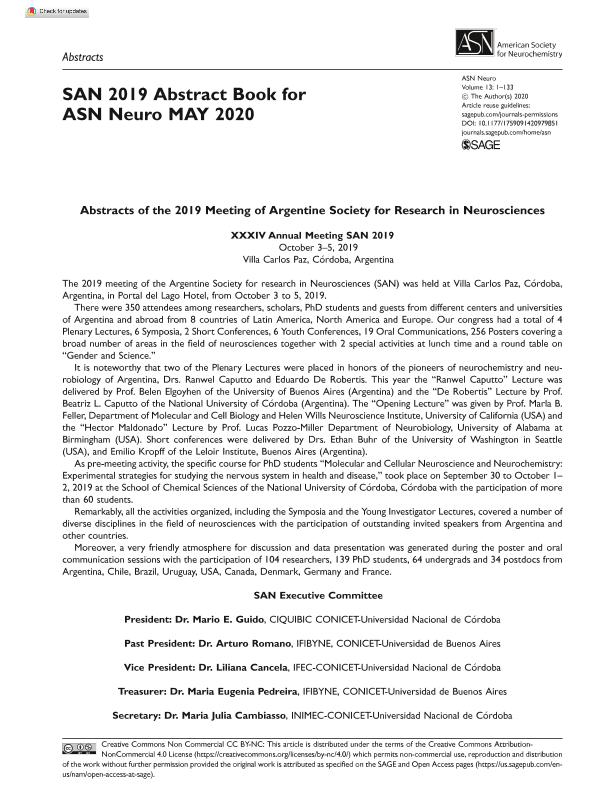
XXXIV Annual Meeting of the Argentine Society for Research in Neuroscience
Fecha del evento:
03/10/2019
Institución Organizadora:
Sociedad Argentina de Investigación en Neurociencias;
Título de la revista:
ASN Neuro
Editorial:
SAGE Publications
Idioma:
Inglés
Clasificación temática:
Resumen
Our mammalian GPS, Global Positioning System, is made of diverse brain structures such as the dentate gyrus (DG) of the hippocampus. This is one of the most plastic brain regions because it has adult neurogenesis and this process is modulated by the animal experiences.The most accepted function of the DG and its new neurons is the discrimination of similar spatial contexts. However, their contribution in an ordinary behaviour remains unknown. We started investigating the hypothesis that the DG would be necessary to solve difficult spatial challenges but not easy ones in a goal guided behaviour. Therefore, adult mice were infected with AAV flex-hM4Di plus CAG-Cre retrovirus in the DG to allow chemogenetic manipulation of neuronal activity in mice navigating in a crossword maze after the i. p. injection of the synthetic agonist clozapine-N-oxide (?CNO?) or its vehicle (?control?). In a single day mice had to learn two shortest paths to a new reward location. We designed spatial routes of two levels of cognitive demand and evaluated mice performance with or without chemogenetic inhibition (CNO vs. control). Easy and difficult journeys were equally solved and learnt by mice under control condition. However, mice receiving CNO could only learn easy spatial trajectories but not the difficult ones (p = 0.01, Wilcoxon signed rank test, N = 4 mice). Therefore, our preliminary data suggest that the DG is required by the GPS during spatial navigation in complex mnemonic challenges.
Palabras clave:
CROSSWORD MAZE
,
hM4Di
,
NOVELTY
,
CLOZAPINE-N-OXIDE
Archivos asociados

Tamaño:
123.5Kb
Formato:
PDF
Licencia
 Excepto donde se diga explícitamente, este item se publica bajo la siguiente descripción:
Creative Commons Attribution-NonCommercial-ShareAlike 2.5 Unported (CC BY-NC-SA 2.5)
Excepto donde se diga explícitamente, este item se publica bajo la siguiente descripción:
Creative Commons Attribution-NonCommercial-ShareAlike 2.5 Unported (CC BY-NC-SA 2.5)
Identificadores
Colecciones
Eventos(IIBBA)
Eventos de INST.DE INVEST.BIOQUIMICAS DE BS.AS(I)
Eventos de INST.DE INVEST.BIOQUIMICAS DE BS.AS(I)
Citación
When does the mammalian GPS use the dentate gyrus in everyday challenges of spatial navigation?; XXXIV Annual Meeting of the Argentine Society for Research in Neuroscience; Argentina; 2019; 1-2
Compartir


Altmétricas