Artículo
Mechanical stress impairs pheromone signaling via Pkc1-mediated regulation of the MAPK scaffold Ste5
van Drogen, Frank; Mishra, Ranjan; Rudolf, Fabian; Walczak, Michal J.; Lee, Sung Sik; Reiter, Wolfgang; Hegemann, Björn; Pelet, Serge; Dohnal, Ilse; Binolfi, Andrés ; Yudina, Zinaida; Selenko, Philipp; Wider, Gerhard; Ammerer, Gustav; Peter, Matthias
; Yudina, Zinaida; Selenko, Philipp; Wider, Gerhard; Ammerer, Gustav; Peter, Matthias
Fecha de publicación:
09/2019
Editorial:
Rockefeller University Press
Revista:
The Journal of cell biology
e-ISSN:
1540-8140
Idioma:
Inglés
Tipo de recurso:
Artículo publicado
Clasificación temática:
Resumen
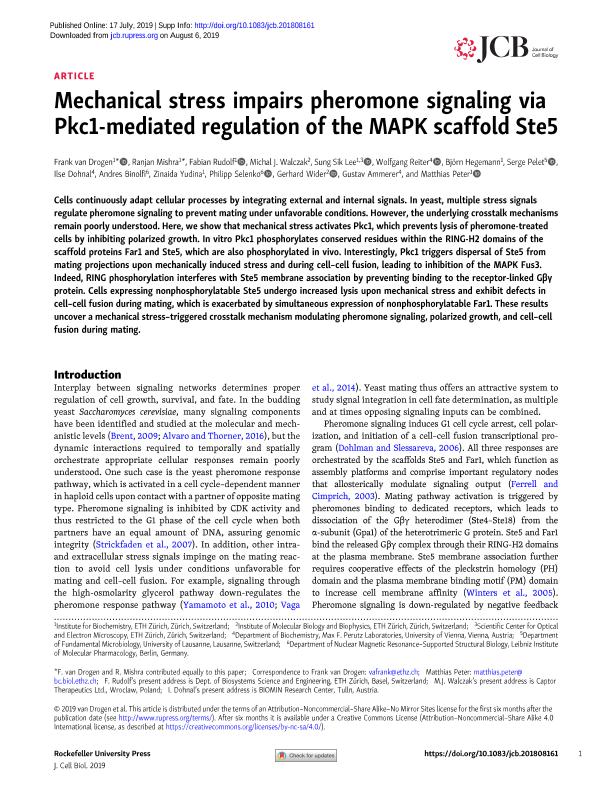
Cells continuously adapt cellular processes by integrating external and internal signals. In yeast, multiple stress signals regulate pheromone signaling to prevent mating under unfavorable conditions. However, the underlying crosstalk mechanisms remain poorly understood. Here, we show that mechanical stress activates Pkc1, which prevents lysis of pheromone-treated cells by inhibiting polarized growth. In vitro Pkc1 phosphorylates conserved residues within the RING-H2 domains of the scaffold proteins Far1 and Ste5, which are also phosphorylated in vivo. Interestingly, Pkc1 triggers dispersal of Ste5 from mating projections upon mechanically induced stress and during cell-cell fusion, leading to inhibition of the MAPK Fus3. Indeed, RING phosphorylation interferes with Ste5 membrane association by preventing binding to the receptor-linked Gβγ protein. Cells expressing nonphosphorylatable Ste5 undergo increased lysis upon mechanical stress and exhibit defects in cell-cell fusion during mating, which is exacerbated by simultaneous expression of nonphosphorylatable Far1. These results uncover a mechanical stress-triggered crosstalk mechanism modulating pheromone signaling, polarized growth, and cell-cell fusion during mating.
Palabras clave:
PKC
,
STE5
,
NMR
,
MECHANICAL STRESS
Archivos asociados

Tamaño:
2.766Mb
Formato:
PDF
Licencia
 Excepto donde se diga explícitamente, este item se publica bajo la siguiente descripción:
Creative Commons Attribution-NonCommercial-ShareAlike 2.5 Unported (CC BY-NC-SA 2.5)
Excepto donde se diga explícitamente, este item se publica bajo la siguiente descripción:
Creative Commons Attribution-NonCommercial-ShareAlike 2.5 Unported (CC BY-NC-SA 2.5)
Identificadores
Colecciones
Articulos(IBR)
Articulos de INST.DE BIOLOGIA MOLECULAR Y CELULAR DE ROSARIO
Articulos de INST.DE BIOLOGIA MOLECULAR Y CELULAR DE ROSARIO
Citación
van Drogen, Frank; Mishra, Ranjan; Rudolf, Fabian; Walczak, Michal J.; Lee, Sung Sik; et al.; Mechanical stress impairs pheromone signaling via Pkc1-mediated regulation of the MAPK scaffold Ste5; Rockefeller University Press; The Journal of cell biology; 218; 9; 9-2019; 3117-3133
Compartir


Altmétricas