Artículo
Polyaniline-modified cellulose nanofibrils as reinforcement of a smart polyurethane
Auad, María L.; Richardson, Tara; Orts, Williams J.; Medeiros, Eliton S.; Mattoso, Luiz H.C.; Mosiewicki, Mirna Alejandra ; Marcovich, Norma Esther
; Aranguren, Mirta Ines
; Marcovich, Norma Esther
; Aranguren, Mirta Ines
; Marcovich, Norma Esther
; Aranguren, Mirta Ines
Fecha de publicación:
24/05/2011
Editorial:
Soc Chemical Industry
Revista:
Polymer International
e-ISSN:
1097-0126
Idioma:
Inglés
Tipo de recurso:
Artículo publicado
Clasificación temática:
Resumen
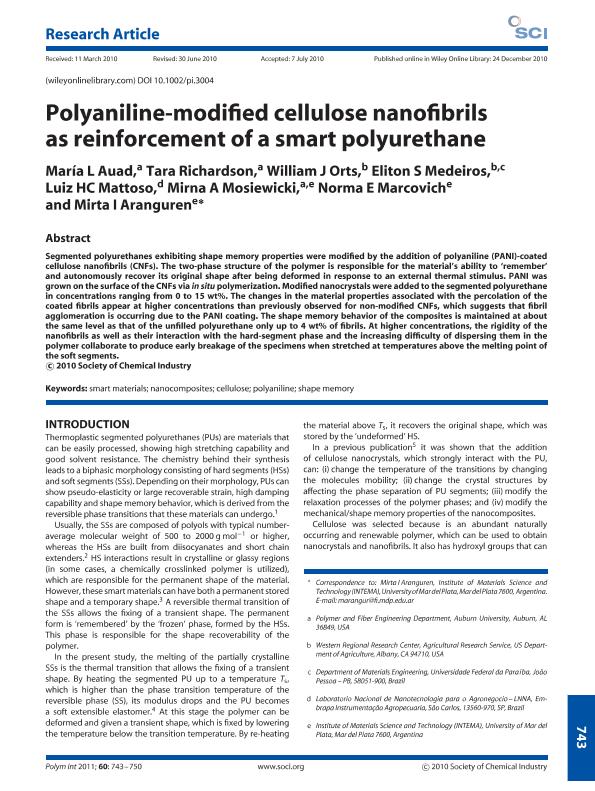
Segmented polyurethanes exhibiting shape memory properties were modified by the addition of polyaniline (PANI)-coated cellulose nanofibrils (CNFs). The two-phase structure of the polymer is responsible for the material's ability to ‘remember’ and autonomously recover its original shape after being deformed in response to an external thermal stimulus. PANI was grown on the surface of the CNFs via in situ polymerization. Modified nanocrystals were added to the segmented polyurethane in concentrations ranging from 0 to 15 wt%. The changes in the material properties associated with the percolation of the coated fibrils appear at higher concentrations than previously observed for non-modified CNFs, which suggests that fibril agglomeration is occurring due to the PANI coating. The shape memory behavior of the composites is maintained at about the same level as that of the unfilled polyurethane only up to 4 wt% of fibrils. At higher concentrations, the rigidity of the nanofibrils as well as their interaction with the hard-segment phase and the increasing difficulty of dispersing them in the polymer collaborate to produce early breakage of the specimens when stretched at temperatures above the melting point of the soft segments.
Palabras clave:
Smart Materials
,
Nanocomposites
,
Cellulose
,
Polyaniline
,
Shape Memory
Archivos asociados

Tamaño:
248.5Kb
Formato:
PDF
Licencia
 Excepto donde se diga explícitamente, este item se publica bajo la siguiente descripción:
Creative Commons Attribution-NonCommercial-ShareAlike 2.5 Unported (CC BY-NC-SA 2.5)
Excepto donde se diga explícitamente, este item se publica bajo la siguiente descripción:
Creative Commons Attribution-NonCommercial-ShareAlike 2.5 Unported (CC BY-NC-SA 2.5)
Identificadores
Colecciones
Articulos(INTEMA)
Articulos de INST.DE INV.EN CIENCIA Y TECNOL.MATERIALES (I)
Articulos de INST.DE INV.EN CIENCIA Y TECNOL.MATERIALES (I)
Citación
Auad, María L.; Richardson, Tara; Orts, Williams J.; Medeiros, Eliton S.; Mattoso, Luiz H.C.; et al.; Polyaniline-modified cellulose nanofibrils as reinforcement of a smart polyurethane; Soc Chemical Industry; Polymer International; 60; 5; 24-5-2011; 743-750
Compartir


Altmétricas