Artículo
Chemical interactions between ship‐originated air pollutants and ocean‐emitted halogens
Qinyi, Li; Badia, Alba; Fernandez, Rafael Pedro ; Mahajan, Anoop S.; Lopez Noreña, Ana Isabel
; Zhang, Yan; Wang, Shanshan; Puliafito, Salvador Enrique
; Cuevas, Carlos Alberto; Saiz López, Alfonso
; Mahajan, Anoop S.; Lopez Noreña, Ana Isabel
; Zhang, Yan; Wang, Shanshan; Puliafito, Salvador Enrique
; Cuevas, Carlos Alberto; Saiz López, Alfonso
; Mahajan, Anoop S.; Lopez Noreña, Ana Isabel
; Zhang, Yan; Wang, Shanshan; Puliafito, Salvador Enrique
; Cuevas, Carlos Alberto; Saiz López, Alfonso
Fecha de publicación:
12/01/2021
Editorial:
Wiley
Revista:
Journal of Geophysical Research
ISSN:
2169-897X
e-ISSN:
2169-8996
Idioma:
Inglés
Tipo de recurso:
Artículo publicado
Clasificación temática:
Resumen
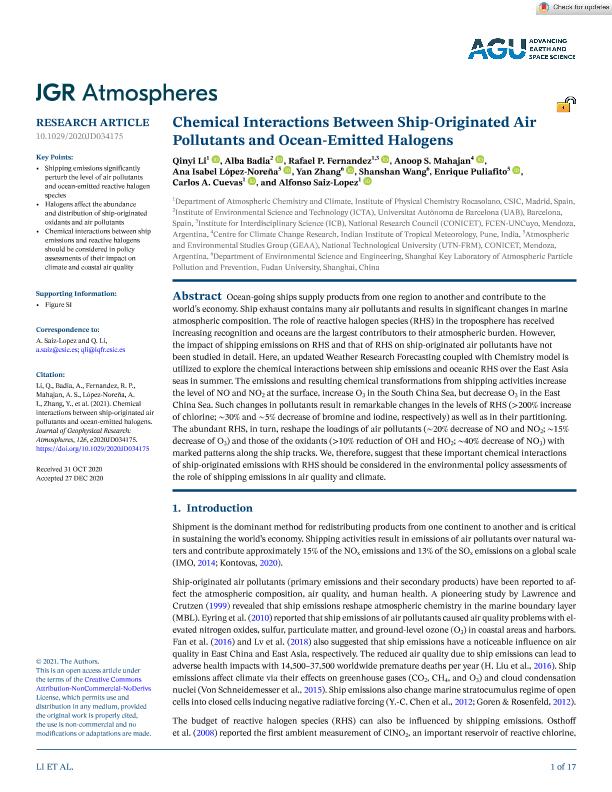
Ocean‐going ships supply products from one region to another and contribute to the world?s economy. Ship exhaust contains many air pollutants and results in significant changes in marine atmospheric composition. The role of reactive halogen species (RHS) in the troposphere has received increasing recognition and oceans are the largest contributors to their atmospheric burden. However, the impact of shipping emissions on RHS and that of RHS on ship‐originated air pollutants have not been studied in detail. Here, an updated Weather Research Forecasting coupled with Chemistry model is utilized to explore the chemical interactions between ship emissions and oceanic RHS over the East Asia seas in summer. The emissions and resulting chemical transformations from shipping activities increase the level of NO and NO2 at the surface, increase O3 in the South China Sea, but decrease O3 in the East China Sea. Such changes in pollutants result in remarkable changes in the levels of RHS (>200% increase of chlorine; ∼30% and ∼5% decrease of bromine and iodine, respectively) as well as in their partitioning. The abundant RHS, in turn, reshape the loadings of air pollutants (∼20% decrease of NO and NO2; ∼15% decrease of O3) and those of the oxidants (>10% reduction of OH and HO2; ∼40% decrease of NO3) with marked patterns along the ship tracks. We, therefore, suggest that these important chemical interactions of ship‐originated emissions with RHS should be considered in the environmental policy assessments of the role of shipping emissions in air quality and climate.
Palabras clave:
EMISSIONS
,
HALOGENS
,
SHIPPING
,
ASIA
Archivos asociados

Tamaño:
10.50Mb
Formato:
PDF
Licencia
 Excepto donde se diga explícitamente, este item se publica bajo la siguiente descripción:
Atribución-NoComercial-SinDerivadas 2.5 Argentina (CC BY-NC-ND 2.5 AR)
Excepto donde se diga explícitamente, este item se publica bajo la siguiente descripción:
Atribución-NoComercial-SinDerivadas 2.5 Argentina (CC BY-NC-ND 2.5 AR)
Identificadores
Colecciones
Articulos(CCT - MENDOZA)
Articulos de CTRO.CIENTIFICO TECNOL.CONICET - MENDOZA
Articulos de CTRO.CIENTIFICO TECNOL.CONICET - MENDOZA
Citación
Qinyi, Li; Badia, Alba; Fernandez, Rafael Pedro; Mahajan, Anoop S.; Lopez Noreña, Ana Isabel; et al.; Chemical interactions between ship‐originated air pollutants and ocean‐emitted halogens; Wiley; Journal of Geophysical Research; 126; 12-1-2021; 1-17
Compartir


Altmétricas