Mostrar el registro sencillo del ítem
dc.contributor.author
Maldonado, Marina Luciana
dc.contributor.author
Bécher Quinodóz, Fátima Noelia
dc.contributor.author
Cabrera, Adriana Edith
dc.contributor.author
Blarasin, Mónica Teresa
dc.contributor.author
Lutri, Veronica Florencia
dc.contributor.author
Matteoda, Edel Mara
dc.contributor.author
Giuliano Albo, María Jesica
dc.date.available
2022-04-29T01:30:13Z
dc.date.issued
2018-08
dc.identifier.citation
Maldonado, Marina Luciana; Bécher Quinodóz, Fátima Noelia; Cabrera, Adriana Edith; Blarasin, Mónica Teresa; Lutri, Veronica Florencia; et al.; Hydrogeochemical features and groundwater renewal rate estimates from deep aquifers in the Pampean Plain, Córdoba Province, Argentina.; Pergamon-Elsevier Science Ltd; Journal of South American Earth Sciences; 85; 8-2018; 126-134
dc.identifier.issn
0895-9811
dc.identifier.uri
http://hdl.handle.net/11336/156052
dc.description.abstract
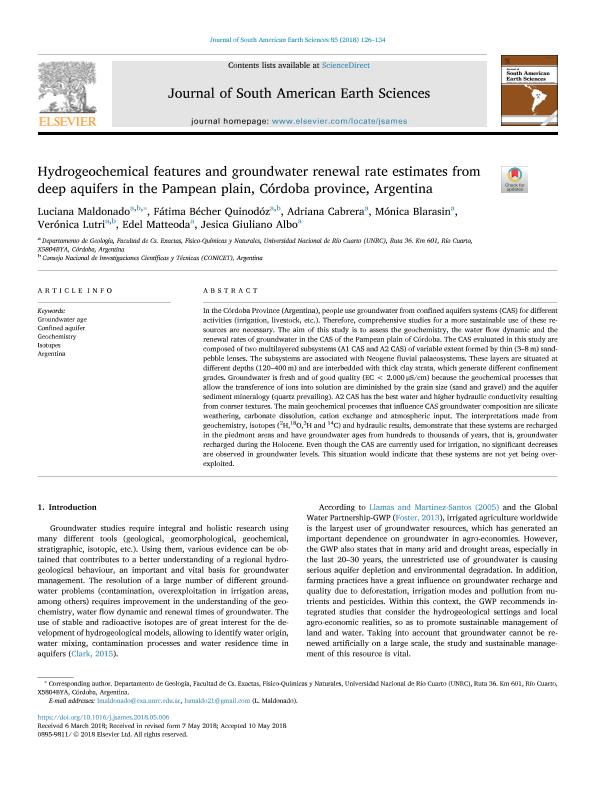
In the Córdoba Province (Argentina), people use groundwater from confined aquifers systems (CAS) for different activities (irrigation, livestock, etc.). Therefore, comprehensive studies for a more sustainable use of these resources are necessary. The aim of this study is to assess the geochemistry, the water flow dynamic and the renewal rates of groundwater in the CAS of the Pampean plain of Córdoba. The CAS evaluated in this study are composed of two multilayered subsystems (A1 CAS and A2 CAS) of variable extent formed by thin (3–8 m) sandpebble lenses. The subsystems are associated with Neogene fluvial palaeosystems. These layers are situated at different depths (120–400 m) and are interbedded with thick clay strata, which generate different confinement grades. Groundwater is fresh and of good quality (EC < 2.000 μS/cm) because the geochemical processes that allow the transference of ions into solution are diminished by the grain size (sand and gravel) and the aquifer sediment mineralogy (quartz prevailing). A2 CAS has the best water and higher hydraulic conductivity resulting from coarser textures. The main geochemical processes that influence CAS groundwater composition are silicate weathering, carbonate dissolution, cation exchange and atmospheric input. The interpretations made from geochemistry, isotopes (2 H,18O,3 H and 14C) and hydraulic results, demonstrate that these systems are recharged in the piedmont areas and have groundwater ages from hundreds to thousands of years, that is, groundwater recharged during the Holocene. Even though the CAS are currently used for irrigation, no significant decreases are observed in groundwater levels. This situation would indicate that these systems are not yet being overexploited.
dc.format
application/pdf
dc.language.iso
eng
dc.publisher
Pergamon-Elsevier Science Ltd
dc.rights
info:eu-repo/semantics/openAccess
dc.rights.uri
https://creativecommons.org/licenses/by-nc-sa/2.5/ar/
dc.subject
GROUNDWATER AGE
dc.subject
CONFINED AQUIFER
dc.subject
GEOCHEMISTRY
dc.subject
ISOTOPES
dc.subject
ARGENTINA
dc.subject.classification
Oceanografía, Hidrología, Recursos Hídricos
dc.subject.classification
Ciencias de la Tierra y relacionadas con el Medio Ambiente
dc.subject.classification
CIENCIAS NATURALES Y EXACTAS
dc.title
Hydrogeochemical features and groundwater renewal rate estimates from deep aquifers in the Pampean Plain, Córdoba Province, Argentina.
dc.type
info:eu-repo/semantics/article
dc.type
info:ar-repo/semantics/artículo
dc.type
info:eu-repo/semantics/publishedVersion
dc.date.updated
2022-04-20T14:49:46Z
dc.identifier.eissn
1873-0647
dc.journal.volume
85
dc.journal.pagination
126-134
dc.journal.pais
Países Bajos
dc.journal.ciudad
Amsterdam
dc.description.fil
Fil: Maldonado, Marina Luciana. Universidad Nacional de Río Cuarto. Facultad de Ciencias Exactas, Fisicoquímicas y Naturales. Departamento de Geología; Argentina. Consejo Nacional de Investigaciones Científicas y Técnicas. Centro Científico Tecnológico Conicet - Córdoba; Argentina
dc.description.fil
Fil: Bécher Quinodóz, Fátima Noelia. Universidad Nacional de Río Cuarto. Facultad de Ciencias Exactas, Fisicoquímicas y Naturales. Departamento de Geología; Argentina. Consejo Nacional de Investigaciones Científicas y Técnicas. Centro Científico Tecnológico Conicet - Córdoba; Argentina
dc.description.fil
Fil: Cabrera, Adriana Edith. Universidad Nacional de Río Cuarto. Facultad de Ciencias Exactas, Fisicoquímicas y Naturales. Departamento de Geología; Argentina
dc.description.fil
Fil: Blarasin, Mónica Teresa. Universidad Nacional de Río Cuarto. Facultad de Ciencias Exactas, Fisicoquímicas y Naturales. Departamento de Geología; Argentina
dc.description.fil
Fil: Lutri, Veronica Florencia. Universidad Nacional de Río Cuarto. Facultad de Ciencias Exactas, Fisicoquímicas y Naturales. Departamento de Geología; Argentina. Consejo Nacional de Investigaciones Científicas y Técnicas. Centro Científico Tecnológico Conicet - Córdoba; Argentina
dc.description.fil
Fil: Matteoda, Edel Mara. Universidad Nacional de Río Cuarto. Facultad de Ciencias Exactas, Fisicoquímicas y Naturales. Departamento de Geología; Argentina
dc.description.fil
Fil: Giuliano Albo, María Jesica. Consejo Nacional de Investigaciones Científicas y Técnicas. Centro Científico Tecnológico Conicet - Córdoba; Argentina. Universidad Nacional de Río Cuarto. Facultad de Ciencias Exactas, Fisicoquímicas y Naturales. Departamento de Geología; Argentina
dc.journal.title
Journal of South American Earth Sciences
dc.relation.alternativeid
info:eu-repo/semantics/altIdentifier/url/https://www.sciencedirect.com/science/article/abs/pii/S0895981118301093?via%3Dihub#!
dc.relation.alternativeid
info:eu-repo/semantics/altIdentifier/doi/http://dx.doi.org/10.1016/j.jsames.2018.05.006
Archivos asociados

Tamaño:
3.182Mb
Formato:
PDF