Artículo
Vulnerability to climate change of a microendemic lizard species from the central Andes
Laspiur, Julio Alejandro ; Santos, J. C.; Medina, Susana Marlin
; Pizarro, Jesús Ezequiel
; Sanabria, Eduardo Alfredo
; Sinervo, B.; Ibarguengoytía, Nora
; Santos, J. C.; Medina, Susana Marlin
; Pizarro, Jesús Ezequiel
; Sanabria, Eduardo Alfredo
; Sinervo, B.; Ibarguengoytía, Nora
; Santos, J. C.; Medina, Susana Marlin
; Pizarro, Jesús Ezequiel
; Sanabria, Eduardo Alfredo
; Sinervo, B.; Ibarguengoytía, Nora
Fecha de publicación:
06/2021
Editorial:
Nature Publishing Group
Revista:
Scientific Reports
ISSN:
2045-2322
Idioma:
Inglés
Tipo de recurso:
Artículo publicado
Clasificación temática:
Resumen
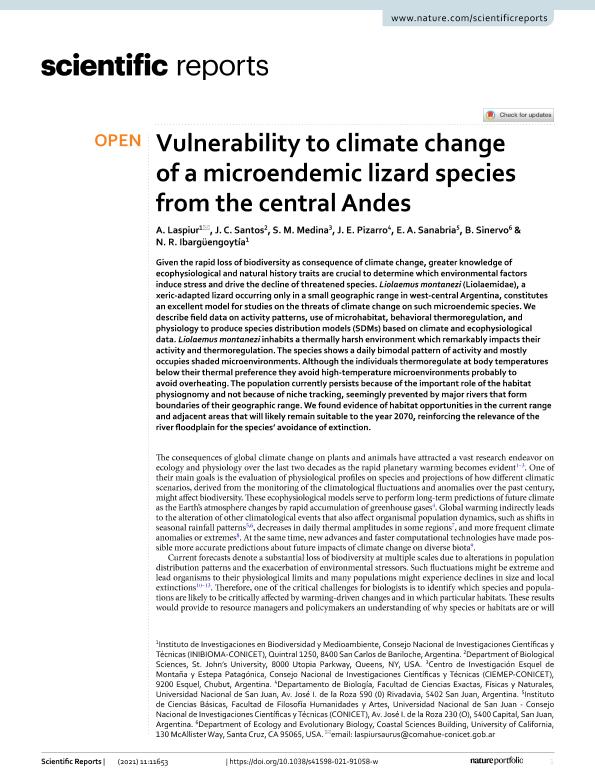
Given the rapid loss of biodiversity as consequence of climate change, greater knowledge of ecophysiological and natural history traits are crucial to determine which environmental factors induce stress and drive the decline of threatened species. Liolaemus montanezi (Liolaemidae), a xeric-adapted lizard occurring only in a small geographic range in west-central Argentina, constitutes an excellent model for studies on the threats of climate change on such microendemic species. We describe feld data on activity patterns, use of microhabitat, behavioral thermoregulation, and physiology to produce species distribution models (SDMs) based on climate and ecophysiological data. Liolaemus montanezi inhabits a thermally harsh environment which remarkably impacts their activity and thermoregulation. The species shows a daily bimodal pattern of activity and mostly occupies shaded microenvironments. Although the individuals thermoregulate at body temperatures below their thermal preference they avoid high-temperature microenvironments probably to avoid overheating. The population currently persists because of the important role of the habitat physiognomy and not because of niche tracking, seemingly prevented by major rivers that form boundaries of their geographic range. We found evidence of habitat opportunities in the current range and adjacent areas that will likely remain suitable to the year 2070, reinforcing the relevance of the river foodplain for the species’ avoidance of extinction.
Palabras clave:
CALENTAMIENTO GLOBAL
,
SAN JUAN
,
LIOLAEMUS MOTANEZI
,
VULNERABILIDAD
Archivos asociados

Tamaño:
2.074Mb
Formato:
PDF
Licencia
 Excepto donde se diga explícitamente, este item se publica bajo la siguiente descripción:
Creative Commons Attribution 2.5 Unported (CC BY 2.5)
Excepto donde se diga explícitamente, este item se publica bajo la siguiente descripción:
Creative Commons Attribution 2.5 Unported (CC BY 2.5)
Identificadores
Colecciones
Articulos(CCT - SAN JUAN)
Articulos de CENTRO CIENTIFICO TECNOLOGICO CONICET - SAN JUAN
Articulos de CENTRO CIENTIFICO TECNOLOGICO CONICET - SAN JUAN
Articulos(CIEMEP)
Articulos de CENTRO DE INVESTIGACION ESQUEL DE MONTAÑA Y ESTEPA PATAGONICA
Articulos de CENTRO DE INVESTIGACION ESQUEL DE MONTAÑA Y ESTEPA PATAGONICA
Articulos(INIBIOMA)
Articulos de INST. DE INVEST.EN BIODIVERSIDAD Y MEDIOAMBIENTE
Articulos de INST. DE INVEST.EN BIODIVERSIDAD Y MEDIOAMBIENTE
Citación
Laspiur, Julio Alejandro; Santos, J. C.; Medina, Susana Marlin; Pizarro, Jesús Ezequiel; Sanabria, Eduardo Alfredo; et al.; Vulnerability to climate change of a microendemic lizard species from the central Andes; Nature Publishing Group; Scientific Reports; 11; 1; 6-2021
Compartir


Altmétricas