Artículo
Optimizing protein isolation from defatted and non-defatted Nannochloropsis microalgae biomass
Gerde, Jose Arnaldo ; Wang Tong; Yao, Linxing; Jung, Stephanie; Johnson, Lawrence A.; Lamsal, Buddhi
; Wang Tong; Yao, Linxing; Jung, Stephanie; Johnson, Lawrence A.; Lamsal, Buddhi
Fecha de publicación:
03/2013
Editorial:
Elsevier Science
Revista:
Algal Research
ISSN:
2211-9264
Idioma:
Inglés
Tipo de recurso:
Artículo publicado
Clasificación temática:
Resumen
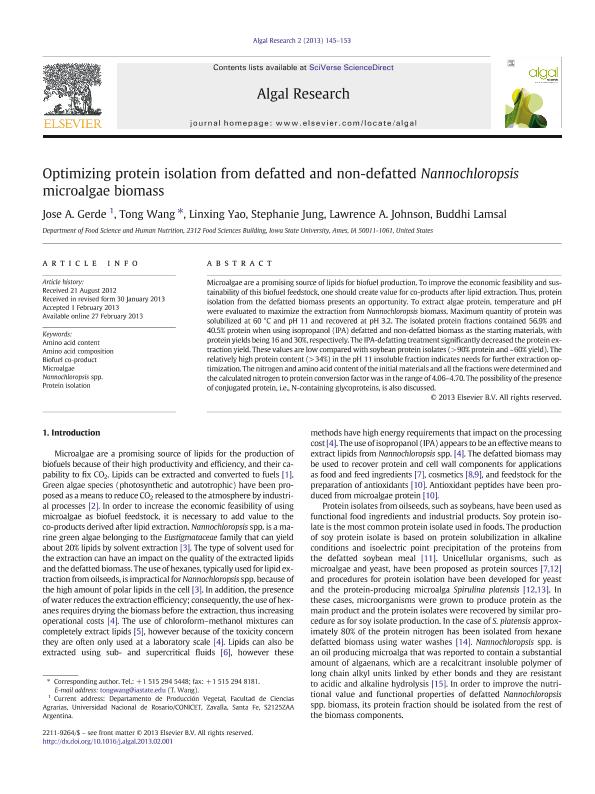
Microalgae are a promising source of lipids for biofuel production. To improve the economic feasibility and sustainability of this biofuel feedstock, one should create value for co-products after lipid extraction. Thus, protein isolation from the defatted biomass presents an opportunity. To extract algae protein, temperature and pH were evaluated to maximize the extraction from Nannochloropsis biomass. Maximum quantity of protein was solubilized at 60 °C and pH 11 and recovered at pH 3.2. The isolated protein fractions contained 56.9% and 40.5% protein when using isopropanol (IPA) defatted and non-defatted biomass as the starting materials, with protein yields being 16 and 30%, respectively. The IPA-defatting treatment significantly decreased the protein extraction yield. These values are low compared with soybean protein isolates (> 90% protein and ~ 60% yield). The relatively high protein content (> 34%) in the pH 11 insoluble fraction indicates needs for further extraction optimization. The nitrogen and amino acid content of the initial materials and all the fractions were determined and the calculated nitrogen to protein conversion factor was in the range of 4.06–4.70. The possibility of the presence of conjugated protein, i.e., N-containing glycoproteins, is also discussed.
Archivos asociados

Tamaño:
572.6Kb
Formato:
PDF
Licencia
 Excepto donde se diga explícitamente, este item se publica bajo la siguiente descripción:
Atribución-NoComercial-SinDerivadas 2.5 Argentina (CC BY-NC-ND 2.5 AR)
Excepto donde se diga explícitamente, este item se publica bajo la siguiente descripción:
Atribución-NoComercial-SinDerivadas 2.5 Argentina (CC BY-NC-ND 2.5 AR)
Identificadores
Colecciones
Articulos(CCT - ROSARIO)
Articulos de CTRO.CIENTIFICO TECNOL.CONICET - ROSARIO
Articulos de CTRO.CIENTIFICO TECNOL.CONICET - ROSARIO
Citación
Gerde, Jose Arnaldo; Wang Tong; Yao, Linxing; Jung, Stephanie; Johnson, Lawrence A.; et al.; Optimizing protein isolation from defatted and non-defatted Nannochloropsis microalgae biomass; Elsevier Science; Algal Research; 2; 2; 3-2013; 145-153
Compartir


Altmétricas