Artículo
Solving nonstationary classification problems with coupled support vector machines

Fecha de publicación:
01/2011
Editorial:
Institute Of Electrical And Electronics Engineers
Revista:
Ieee Transactions On Neural Networks
ISSN:
1045-9227
e-ISSN:
1941-0093
Idioma:
Inglés
Tipo de recurso:
Artículo publicado
Clasificación temática:
Resumen
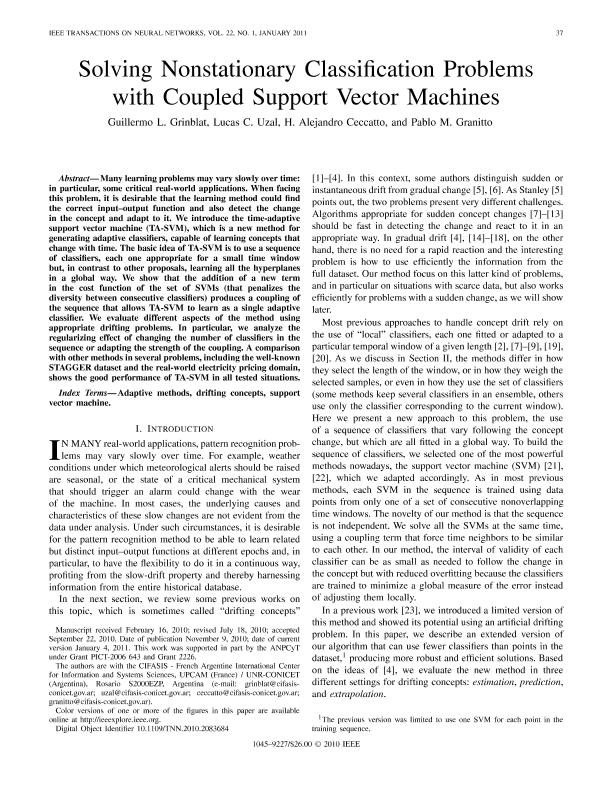
Many learning problems may vary slowly over time: in particular, some critical real-world applications. When facing this problem, it is desirable that the learning method could find the correct input-output function and also detect the change in the concept and adapt to it. We introduce the time-adaptive support vector machine (TA-SVM), which is a new method for generating adaptive classifiers, capable of learning concepts that change with time. The basic idea of TA-SVM is to use a sequence of classifiers, each one appropriate for a small time window but, in contrast to other proposals, learning all the hyperplanes in a global way. We show that the addition of a new term in the cost function of the set of SVMs (that penalizes the diversity between consecutive classifiers) produces a coupling of the sequence that allows TA-SVM to learn as a single adaptive classifier. We evaluate different aspects of the method using appropriate drifting problems. In particular, we analyze the regularizing effect of changing the number of classifiers in the sequence or adapting the strength of the coupling. A comparison with other methods in several problems, including the well-known STAGGER dataset and the real-world electricity pricing domain, shows the good performance of TA-SVM in all tested situations.
Palabras clave:
Adaptive Methods
,
Drifting Concepts
,
Support Vector Machine
Archivos asociados

Tamaño:
753.0Kb
Formato:
PDF
Licencia
 Excepto donde se diga explícitamente, este item se publica bajo la siguiente descripción:
Creative Commons Attribution-NonCommercial-ShareAlike 2.5 Unported (CC BY-NC-SA 2.5)
Excepto donde se diga explícitamente, este item se publica bajo la siguiente descripción:
Creative Commons Attribution-NonCommercial-ShareAlike 2.5 Unported (CC BY-NC-SA 2.5)
Identificadores
Colecciones
Articulos(CIFASIS)
Articulos de CENTRO INT.FRANCO ARG.D/CS D/L/INF.Y SISTEM.
Articulos de CENTRO INT.FRANCO ARG.D/CS D/L/INF.Y SISTEM.
Citación
Grinblat, Guillermo Luis; Uzal, Lucas César; Ceccatto, Hermenegildo A.; Granitto, Pablo Miguel; Solving nonstationary classification problems with coupled support vector machines; Institute Of Electrical And Electronics Engineers; Ieee Transactions On Neural Networks; 22; 1; 1-2011; 37-51
Compartir


Altmétricas