Artículo
Time course changes of oxidative stress markers in a rat experimental glaucoma model
Ferreira, Sandra María; Fabián Lerner, S.; Brunzini, Ricardo; Reides, Claudia Gabriela; Evelson, Pablo Andrés ; Llesuy, Susana Francisca
; Llesuy, Susana Francisca
Fecha de publicación:
09/2010
Editorial:
Association for Research in Vision and Ophthalmology
Revista:
Investigative Ophthalmology & Visual Science
ISSN:
0146-0404
Idioma:
Inglés
Tipo de recurso:
Artículo publicado
Clasificación temática:
Resumen
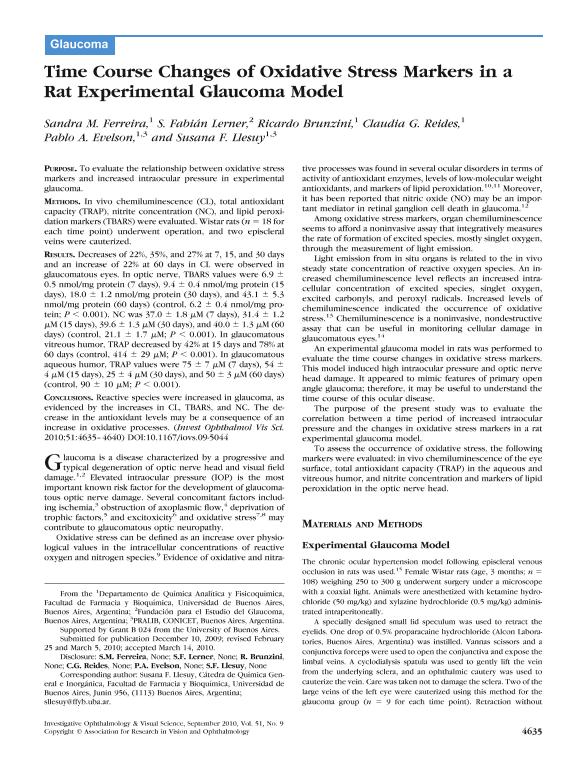
PURPOSE. To evaluate the relationship between oxidative stress arkers and increased intraocular pressure in experimental laucoma. METHODS. In vivo chemiluminescence (CL), total antioxidant apacity (TRAP), nitrite concentration (NC), and lipid peroxidation arkers (TBARS) were evaluated. Wistar rats (n = 18 for ach time point) underwent operation, and two episcleral eins were cauterized. ESULTS. Decreases of 22%, 35%, and 27% at 7, 15, and 30 days nd an increase of 22% at 60 days in CL were observed in laucomatous eyes. In optic nerve, TBARS values were 6.9 ± 0.5 nmol/mg protein (7 days), 9.4 ± 0.4 nmol/mg protein (15 ays), 18.0 ±1.2 nmol/mg protein (30 days), and 43.1 ± 5.3 nmol/mg protein (60 days) (control, 6.2 ± 0.4 nmol/mg protein; P < 0.001). NC was 37.0 ± 1.8 μM (7 days), 31.4 ± 1.2 μM (15 days), 39.6 ± 1.3 μM (30 days), and 40.0 ± 1.3 μM (60 days) (control, 21.1 ± 1.7 μM; P < 0.001). In glaucomatous vitreous humor, TRAP decreased by 42% at 15 days and 78% at 60 days (control, 414 ± 29 μM; P < 0.001). In glaucomatous aqueous humor, TRAP values were 75 ± 7 μM (7 days), 54 ±4 μM (15 days), 25 ± 4 μM (30 days), and 50 ± 3 μM (60 days) (control, 90 ±10 μM; P < 0.001). CONCLUSIONS. Reactive species were increased in glaucoma, as evidenced by the increases in CL, TBARS, and NC. The decrease in the antioxidant levels may be a consequence of an increase in oxidative processes.
Palabras clave:
glaucoma
,
OXIDATIVE STRESS
,
antioxidant
,
modelo experimental
Archivos asociados

Tamaño:
821.7Kb
Formato:
PDF
Licencia
 Excepto donde se diga explícitamente, este item se publica bajo la siguiente descripción:
Atribución-NoComercial-SinDerivadas 2.5 Argentina (CC BY-NC-ND 2.5 AR)
Excepto donde se diga explícitamente, este item se publica bajo la siguiente descripción:
Atribución-NoComercial-SinDerivadas 2.5 Argentina (CC BY-NC-ND 2.5 AR)
Identificadores
Colecciones
Articulos(IBIMOL)
Articulos de INSTITUTO DE BIOQUIMICA Y MEDICINA MOLECULAR
Articulos de INSTITUTO DE BIOQUIMICA Y MEDICINA MOLECULAR
Citación
Ferreira, Sandra María; Fabián Lerner, S.; Brunzini, Ricardo; Reides, Claudia Gabriela; Evelson, Pablo Andrés; et al.; Time course changes of oxidative stress markers in a rat experimental glaucoma model; Association for Research in Vision and Ophthalmology; Investigative Ophthalmology & Visual Science; 51; 9; 9-2010; 4635-4640
Compartir


Altmétricas