Artículo
Decapentaplegic acutely defines the connectivity of central pacemaker neurons in drosophila

Fecha de publicación:
08/2021
Editorial:
Society for Neuroscience
Revista:
Journal of Neuroscience
ISSN:
0270-6474
e-ISSN:
1529-2401
Idioma:
Inglés
Tipo de recurso:
Artículo publicado
Clasificación temática:
Resumen
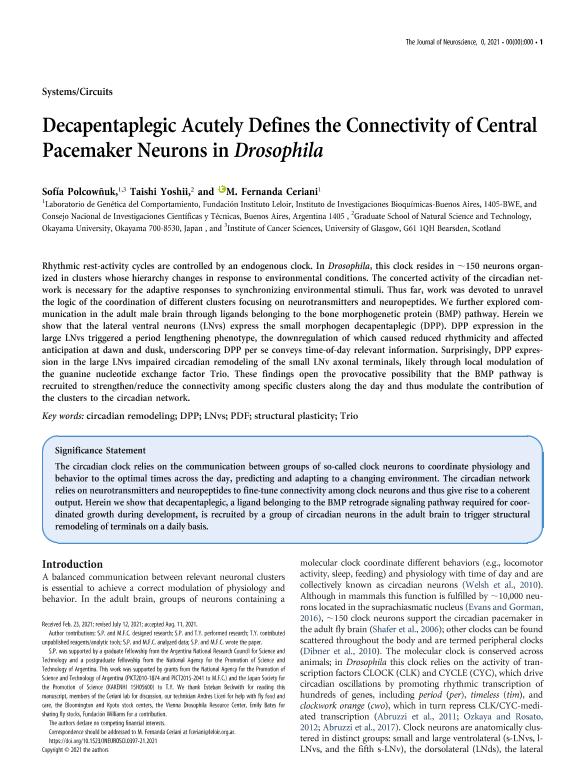
Rhythmic rest-activity cycles are controlled by an endogenous clock. In Drosophila, this clock resides in ;150 neurons organized in clusters whose hierarchy changes in response to environmental conditions. The concerted activity of the circadian network is necessary for the adaptive responses to synchronizing environmental stimuli. Thus far, work was devoted to unravel the logic of the coordination of different clusters focusing on neurotransmitters and neuropeptides. We further explored communication in the adult male brain through ligands belonging to the bone morphogenetic protein (BMP) pathway. Herein we show that the lateral ventral neurons (LNvs) express the small morphogen decapentaplegic (DPP). DPP expression in the large LNvs triggered a period lengthening phenotype, the downregulation of which caused reduced rhythmicity and affected anticipation at dawn and dusk, underscoring DPP per se conveys time-of-day relevant information. Surprisingly, DPP expression in the large LNvs impaired circadian remodeling of the small LNv axonal terminals, likely through local modulation of the guanine nucleotide exchange factor Trio. These findings open the provocative possibility that the BMP pathway is recruited to strengthen/reduce the connectivity among specific clusters along the day and thus modulate the contribution of the clusters to the circadian network.
Palabras clave:
CIRCADIAN REMODELING
,
DPP
,
LNVS
,
PDF
,
STRUCTURAL PLASTICITY
,
TRIO
Archivos asociados

Tamaño:
4.324Mb
Formato:
PDF
Licencia
 Excepto donde se diga explícitamente, este item se publica bajo la siguiente descripción:
Creative Commons Attribution-NonCommercial-ShareAlike 2.5 Unported (CC BY-NC-SA 2.5)
Excepto donde se diga explícitamente, este item se publica bajo la siguiente descripción:
Creative Commons Attribution-NonCommercial-ShareAlike 2.5 Unported (CC BY-NC-SA 2.5)
Identificadores
Colecciones
Articulos(IIBBA)
Articulos de INST.DE INVEST.BIOQUIMICAS DE BS.AS(I)
Articulos de INST.DE INVEST.BIOQUIMICAS DE BS.AS(I)
Citación
Polcowñuk, Sofía; Yoshii, Taishi; Ceriani, Maria Fernanda; Decapentaplegic acutely defines the connectivity of central pacemaker neurons in drosophila; Society for Neuroscience; Journal of Neuroscience; 41; 41; 8-2021; 8338-8350
Compartir


Altmétricas