Artículo
Citizens Rights and Environmental Genocide

Fecha de publicación:
05/2012
Editorial:
Mary Ann Liebert Inc
Revista:
Environmental justice
ISSN:
1939-4071
Idioma:
Inglés
Tipo de recurso:
Artículo publicado
Clasificación temática:
Resumen
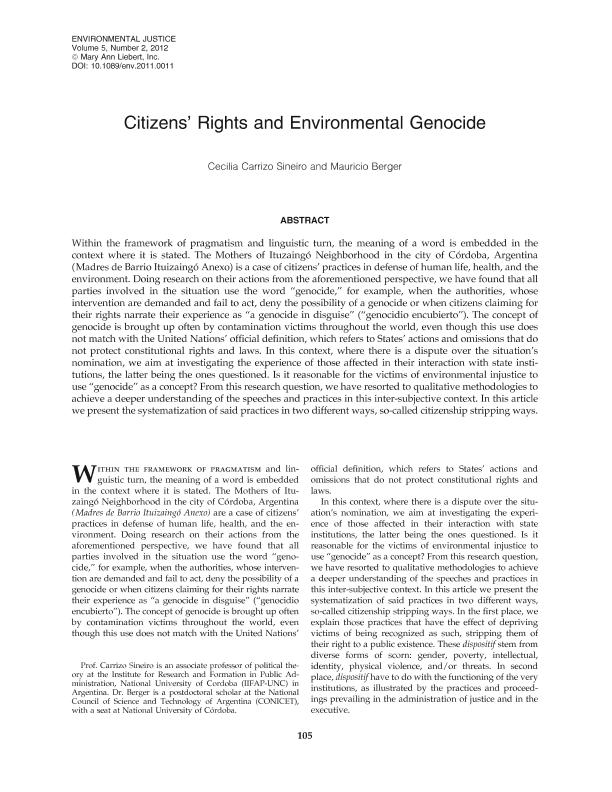
Within the framework of pragmatism and linguistic turn, the meaning of a word is embedded in the context where it is stated. The Mothers of Ituzaingo´ Neighborhood in the city of Córdoba, Argentina (Madres de Barrio Ituizaingo´ Anexo) is a case of citizens’ practices in defense of human life, health, and the environment. Doing research on their actions from the aforementioned perspective, we have found that all parties involved in the situation use the word ‘‘genocide,’’ for example, when the authorities, whose intervention are demanded and fail to act, deny the possibility of a genocide or when citizens claiming for their rights narrate their experience as ‘‘a genocide in disguise’’ (‘‘genocidio encubierto’’). The concept of genocide is brought up often by contamination victims throughout the world, even though this use does not match with the United Nations’ official definition, which refers to States’ actions and omissions that do not protect constitutional rights and laws. In this context, where there is a dispute over the situation’s nomination, we aim at investigating the experience of those affected in their interaction with state institutions, the latter being the ones questioned. Is it reasonable for the victims of environmental injustice to use ‘‘genocide’’ as a concept? From this research question, we have resorted to qualitative methodologies to achieve a deeper understanding of the speeches and practices in this inter-subjective context. In this article we present the systematization of said practices in two different ways, so-called citizenship stripping ways.
Palabras clave:
Environmental Genocide
,
Citizenship
,
Environmental Justice
Archivos asociados

Tamaño:
132.2Kb
Formato:
PDF
Licencia
 Excepto donde se diga explícitamente, este item se publica bajo la siguiente descripción:
Creative Commons Attribution-NonCommercial-ShareAlike 2.5 Unported (CC BY-NC-SA 2.5)
Excepto donde se diga explícitamente, este item se publica bajo la siguiente descripción:
Creative Commons Attribution-NonCommercial-ShareAlike 2.5 Unported (CC BY-NC-SA 2.5)
Identificadores
Colecciones
Articulos(CIECS)
Articulos de CENTRO DE INVESTIGACIONES Y ESTUDIO SOBRE CULTURA Y SOCIEDAD
Articulos de CENTRO DE INVESTIGACIONES Y ESTUDIO SOBRE CULTURA Y SOCIEDAD
Citación
Carrizo, Cecilia; Berger, Mauricio Sebastian; Citizens Rights and Environmental Genocide; Mary Ann Liebert Inc; Environmental justice; 5; 2; 5-2012; 105-110
Compartir


Altmétricas