Artículo
Nitrous oxide emissions decrease with plant diversity but increase with grassland primary productivity

Fecha de publicación:
06/2019
Editorial:
Springer
Revista:
Oecologia
ISSN:
0029-8549
Idioma:
Inglés
Tipo de recurso:
Artículo publicado
Clasificación temática:
Resumen
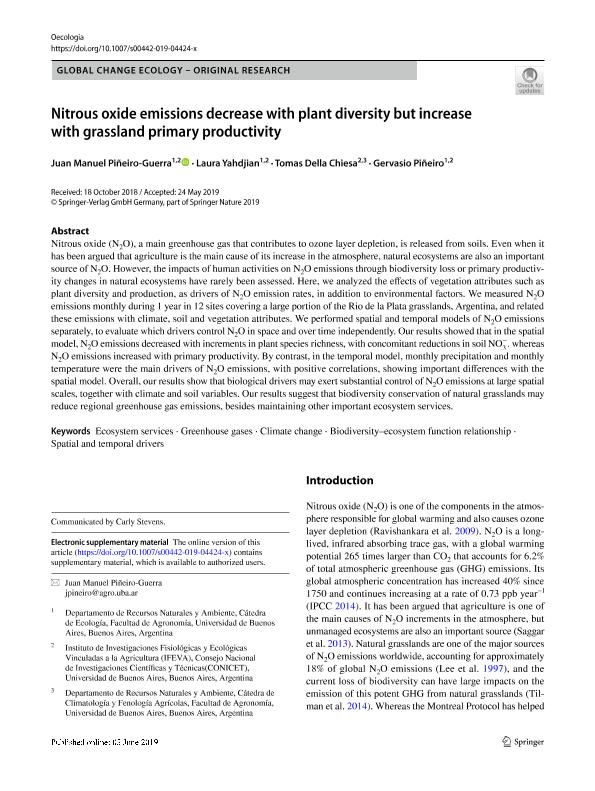
Nitrous oxide (N2O), a main greenhouse gas that contributes to ozone layer depletion, is released from soils. Even when it has been argued that agriculture is the main cause of its increase in the atmosphere, natural ecosystems are also an important source of N2O. However, the impacts of human activities on N2O emissions through biodiversity loss or primary productivity changes in natural ecosystems have rarely been assessed. Here, we analyzed the effects of vegetation attributes such as plant diversity and production, as drivers of N2O emission rates, in addition to environmental factors. We measured N2O emissions monthly during 1 year in 12 sites covering a large portion of the Rio de la Plata grasslands, Argentina, and related these emissions with climate, soil and vegetation attributes. We performed spatial and temporal models of N2O emissions separately, to evaluate which drivers control N2O in space and over time independently. Our results showed that in the spatial model, N2O emissions decreased with increments in plant species richness, with concomitant reductions in soil NO3-, whereas N2O emissions increased with primary productivity. By contrast, in the temporal model, monthly precipitation and monthly temperature were the main drivers of N2O emissions, with positive correlations, showing important differences with the spatial model. Overall, our results show that biological drivers may exert substantial control of N2O emissions at large spatial scales, together with climate and soil variables. Our results suggest that biodiversity conservation of natural grasslands may reduce regional greenhouse gas emissions, besides maintaining other important ecosystem services.
Archivos asociados

Tamaño:
1.204Mb
Formato:
PDF
Licencia
 Excepto donde se diga explícitamente, este item se publica bajo la siguiente descripción:
Creative Commons Attribution-NonCommercial-ShareAlike 2.5 Unported (CC BY-NC-SA 2.5)
Excepto donde se diga explícitamente, este item se publica bajo la siguiente descripción:
Creative Commons Attribution-NonCommercial-ShareAlike 2.5 Unported (CC BY-NC-SA 2.5)
Identificadores
Colecciones
Articulos(IFEVA)
Articulos de INST.D/INV.FISIOLOGICAS Y ECO.VINCULADAS A L/AGRIC
Articulos de INST.D/INV.FISIOLOGICAS Y ECO.VINCULADAS A L/AGRIC
Citación
Piñeiro Guerra, Juan Manuel; Yahdjian, María Laura; Della Chiesa, Tomás; Piñeiro, Gervasio; Nitrous oxide emissions decrease with plant diversity but increase with grassland primary productivity; Springer; Oecologia; 190; 2; 6-2019; 497-507
Compartir


Altmétricas