Artículo
The effectiveness of the quality improvement collaborative strategy in low- And middle-income countries: A systematic review and meta-analysis
Garcia Elorrio, Ezequiel ; Rowe, Samantha Y.; Teijeiro, Maria E.; Ciapponi, Agustín
; Rowe, Alexander K.
; Rowe, Samantha Y.; Teijeiro, Maria E.; Ciapponi, Agustín
; Rowe, Alexander K.
; Rowe, Samantha Y.; Teijeiro, Maria E.; Ciapponi, Agustín
; Rowe, Alexander K.
Fecha de publicación:
10/2019
Editorial:
Public Library of Science
Revista:
Plos One
ISSN:
1932-6203
Idioma:
Inglés
Tipo de recurso:
Artículo publicado
Clasificación temática:
Resumen
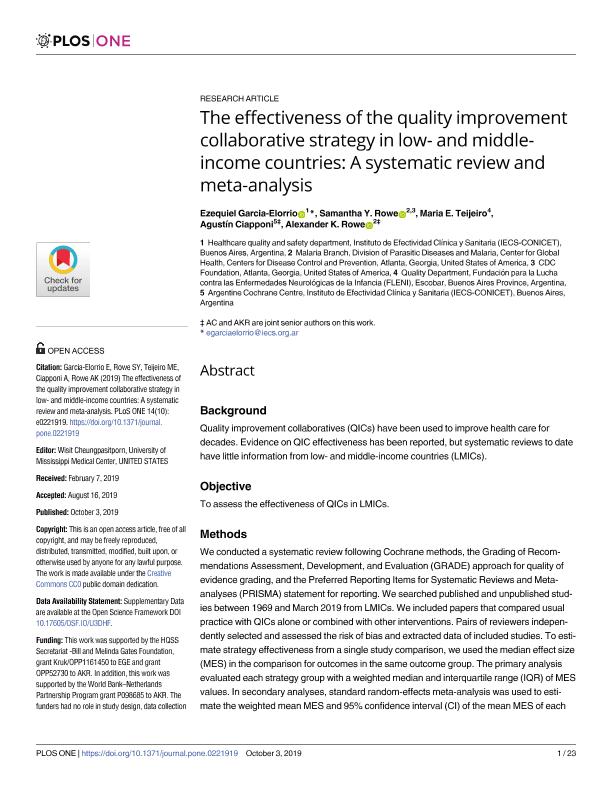
Background Quality improvement collaboratives (QICs) have been used to improve health care for decades. Evidence on QIC effectiveness has been reported, but systematic reviews to date have little information from low- and middle-income countries (LMICs). Objective To assess the effectiveness of QICs in LMICs. Methods We conducted a systematic review following Cochrane methods, the Grading of Recommendations Assessment, Development, and Evaluation (GRADE) approach for quality of evidence grading, and the Preferred Reporting Items for Systematic Reviews and Meta-analyses (PRISMA) statement for reporting. We searched published and unpublished studies between 1969 and March 2019 from LMICs. We included papers that compared usual practice with QICs alone or combined with other interventions. Pairs of reviewers independently selected and assessed the risk of bias and extracted data of included studies. To estimate strategy effectiveness from a single study comparison, we used the median effect size (MES) in the comparison for outcomes in the same outcome group. The primary analysis evaluated each strategy group with a weighted median and interquartile range (IQR) of MES values. In secondary analyses, standard random-effects meta-analysis was used to estimate the weighted mean MES and 95% confidence interval (CI) of the mean MES of each strategy group. This review is registered with PROSPERO (International Prospective Register of Systematic Reviews): CRD42017078108. Results Twenty-nine studies were included; most (21/29, 72.4%) were interrupted time series studies. Evidence quality was generally low to very low. Among studies involving health facility-based health care providers (HCPs), for “QIC only”, effectiveness varied widely across outcome groups and tended to have little effect for patient health outcomes (median MES less than 2 percentage points for percentage and continuous outcomes). For “QIC plus training”, effectiveness might be very high for patient health outcomes (for continuous outcomes, median MES 111.6 percentage points, range: 96.0 to 127.1) and HCP practice outcomes (median MES 52.4 to 63.4 percentage points for continuous and percentage outcomes, respectively). The only study of lay HCPs, which used “QIC plus training”, showed no effect on patient care-seeking behaviors (MES -0.9 percentage points), moderate effects on non-care-seeking patient behaviors (MES 18.7 percentage points), and very large effects on HCP practice outcomes (MES 50.4 percentage points). Conclusions The effectiveness of QICs varied considerably in LMICs. QICs combined with other invention components, such as training, tended to be more effective than QICs alone. The low evidence quality and large effect sizes for QIC plus training justify additional high-quality studies assessing this approach in LMICs.
Palabras clave:
IMPROVE HEALTH
Archivos asociados

Tamaño:
1.610Mb
Formato:
PDF
Licencia
 Excepto donde se diga explícitamente, este item se publica bajo la siguiente descripción:
Creative Commons Attribution-NonCommercial-ShareAlike 2.5 Unported (CC BY-NC-SA 2.5)
Excepto donde se diga explícitamente, este item se publica bajo la siguiente descripción:
Creative Commons Attribution-NonCommercial-ShareAlike 2.5 Unported (CC BY-NC-SA 2.5)
Identificadores
Colecciones
Articulos(CIESP)
Articulos de CENTRO DE INVESTIGACIONES EN EPIDEMIOLOGIA Y SALUD PUBLICA
Articulos de CENTRO DE INVESTIGACIONES EN EPIDEMIOLOGIA Y SALUD PUBLICA
Citación
Garcia Elorrio, Ezequiel; Rowe, Samantha Y.; Teijeiro, Maria E.; Ciapponi, Agustín; Rowe, Alexander K.; The effectiveness of the quality improvement collaborative strategy in low- And middle-income countries: A systematic review and meta-analysis; Public Library of Science; Plos One; 14; 10; 10-2019; 1-23
Compartir


Altmétricas